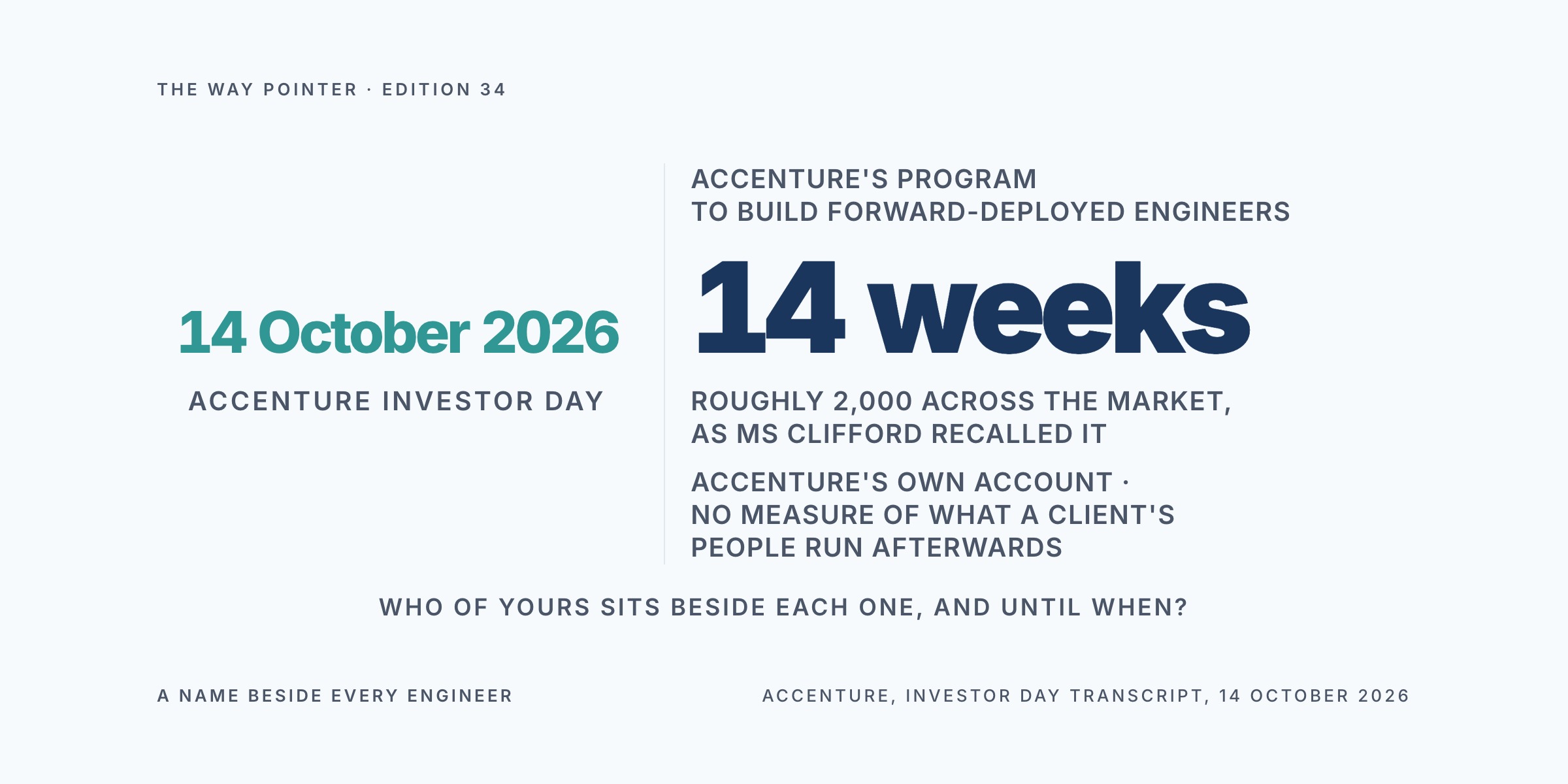
Between 12 and 16 October 2026 three firms each named the same role, the forward-deployed engineer. HCLTech said on 12 October that its new Anthropic unit will provide "secure sandbox environments for enterprise deployments of Claude through FDEs". On 14 October Accenture's Kate Clifford recalled that when Accenture looked for the skill there were "roughly 2,000 across the market", so it built "a 14-week program"; that is Accenture's own account, of a role it says it did not have 18 months ago. On 16 October McKinsey wrote that "Forward-deployed engineers work inside another company's own systems". None of the three gives a measure of what a client's own people can run once that engineer leaves.
We think that where a firm's engineer works inside your systems, the person closest to the detail can be someone else's employee, unless you put one of yours beside them.
If you own the programme, this article leaves you with one page, filled in: each embedded engineer, the name of your person beside them, their hours, who covers their day job, and the date by which your person runs that part alone.
If an integrator, a software vendor or a consultancy has engineers working inside your systems, or proposes to, the three statements below name the role you would be asking about. The page at the end goes on your plan.
Three firms name the role; none gives a measure of what a client's people can run once the engineer leaves
The firms' own pages read for this article are HCLTech's press release of 12 October 2026, Accenture's own transcript of its Investor Day of 14 October 2026, and McKinsey's explainer of 16 October 2026, of which only the text introduction was read; its video was not watched.[1][2][3]
| Who, where and when | What the firm says of the engineer or its offering | What the firm says of the client's people | A measure of what the client's people run afterwards |
|---|---|---|---|
| HCLTech, press release, 12 October 2026 | Its Anthropic unit will "provide secure sandbox environments for enterprise deployments of Claude through FDEs" | It will help clients "train their workforces and build the organizational capabilities needed to operate Agentic AI safely at scale" | None given |
| Accenture, Investor Day, 14 October 2026: Kate Clifford, Chief Leadership and Human Resources Officer | "the intersection of a software engineer, a solution architect, a product manager, and a consultant, all wrapped up into one"; "18 months ago we didn't have any FDEs at Accenture" | Manish Sharma, Chief Strategy and Reinvention Services Officer, on a separate line of business: LearnVantage "helps clients upskill their people in technology, data, and AI at scale", and "is also a non-FTE commercial model" | None given |
| McKinsey, explainer, 16 October 2026 | "Forward-deployed engineers work inside another company's own systems", adapting tools to a business problem and "helping teams change how they work" | The engineer builds software "alongside the people who will use it" | None given |
Each firm says something about the client's people. HCLTech makes a promise to help train them. Accenture sells upskilling as its own service line. McKinsey describes the engineer working beside the people who will use what is built. Each is a promise or a service, with no count of people trained and no test of what they can then run alone.
These are each firm's account of its own offering. Accenture says the role is 18 months old at Accenture. McKinsey says the label "may be a buzzword for a service that consulting firms and technology providers have offered for years", and that its three speakers' views on how an FDE differs from a traditional consultant "suggest the role is still evolving". None of the three says how many engineers it has placed, or what happened at any client. The roughly 2,000 is the number Ms Clifford recalled for people with the skill across the market when Accenture looked, not a count of engineers at work.
Four jobs in one person
Ms Clifford's description is worth reading slowly if you own a programme. Software engineer, solution architect, product manager and consultant, in one person. Those are the four jobs that decide how a part of your system works, why it was built that way and what it would take to change it.
That is no criticism of the engineer or of the firm: putting those jobs in one person is what Ms Clifford says the role is. None of the three statements says where an engineer goes when a client's work ends.
What none of the three says is what happens to that detail on your side when the engineer goes. That part is yours to plan, and you can plan it now, while the engineer is still there to work beside.
Where the hours come from
The first question back from anyone you name will be where the time comes from. They already have a day job.
As an illustrative sum on example figures, four engineers placed, with one person of yours beside each for 12 hours a week over 12 weeks, comes to 576 hours of your people's time; if their day job is covered at £60 an hour, the cover costs £34,560.
Put your own numbers in their place. The sum prices the cover for the day job, not the person. A name on the plan with no cover beside it is a person asked to do two jobs at once.
The page to write now
You do not run the engineers, and you do not need to. You need one page, kept in your own records, with a row for each engineer placed inside your systems.
Here it is filled in as an example. The parts and the roles are invented; put your own people's names where the roles are.
| The engineer's firm, and the part of the system | Your person beside them | Hours a week | Who covers their day job | What your person will run alone | By when |
|---|---|---|---|---|---|
| Your integrator: the order-to-cash approval workflow | Accounts receivable lead | 12 | Senior credit controller | Change an approval rule, test it and put it live without the engineer | End of week 12 |
| Your software vendor: month-end close automation | Deputy financial controller | 12 | Management accountant | Run one close on the automation and repair a failed step | End of week 12 |
| Your integrator: supplier master data | Master data analyst | 8 | Nobody yet | Add a supplier type and its checks | End of week 10 |
| Your consultancy: the cash forecasting model | Nobody yet | Not set | Not set | Not set | No date until there is a name |
Two rows show what the gap looks like. In one, a person is named but nobody covers their day job. In the other, an engineer is working inside a part of the system with nobody of yours beside them at all. Each is the next thing to fill.
To fill the page in, ask each firm three things about each of its engineers: which part of the system they work in, which decisions they take without anyone of yours in the room, and who of yours was present for the last one. Agree the cover with your named person's line manager. The date is yours to set; where a date for your person to run the part alone is not in the contract, it is a change to agree with the firm.
Done when: every row has a name, the hours, the cover and a date, and your sponsor has seen the page.
A head start for the person you name
The person you put beside the engineer has a piece written for them this edition. The Early Adopter Signal gives them three things to hold for every change on their own work package: whether it can be undone, who repairs it, and what it is for, in one sentence they can say. When your finance director asks what those 12 hours a week are spent on, that piece is a good place to start the answer.
What would show this wrong
Cognizant reports its third-quarter results on Thursday 29 October 2026, and Capgemini on Friday 30 October 2026.[4] We expect neither to publish, in its third-quarter results, a measure of what a client's own people can run once its embedded engineers leave. The forecast falls due on Friday 30 October 2026, and we are wrong if either does.
What is still yours when the engineers move on
McKinsey describes forward-deployed engineers as working "inside another company's own systems", and HCLTech and Accenture name the role. Your people stay.
We think the part of the system your own people can run is the part that is still yours when the engineers have gone.
References
HCLTech, press release, HCLTech and Anthropic sign Global Premier Partnership to scale governed Agentic AI across global enterprises, 12 October 2026. https://www.hcltech.com/en-us/press-releases/hcltech-and-anthropic-sign-global-premier-partnership-scale-governed-agentic-ai.
Accenture, Investor Day FY27 conference transcript, 14 October 2026, Kate Clifford and Manish Sharma. Accenture's own transcript. https://investor.accenture.com/~/media/Files/A/accenture-v4/investors/documents/accentures-fy2027-investor-an-analyst-conference-transcript.pdf.
McKinsey & Company, What is a forward-deployed engineer?, 16 October 2026; the text introduction. https://www.mckinsey.com/featured-insights/mckinsey-explainers/what-is-a-forward-deployed-engineer.
The results dates are from the firms' investor pages: Cognizant and Capgemini.