Anthropic says it developed skills while working on its own agent, Claude Code, which "often lacked the procedural knowledge that real business tasks need".[1] On your work package, that procedural knowledge is yours. It is the order the steps go in, and the exception you only know because it once went wrong.
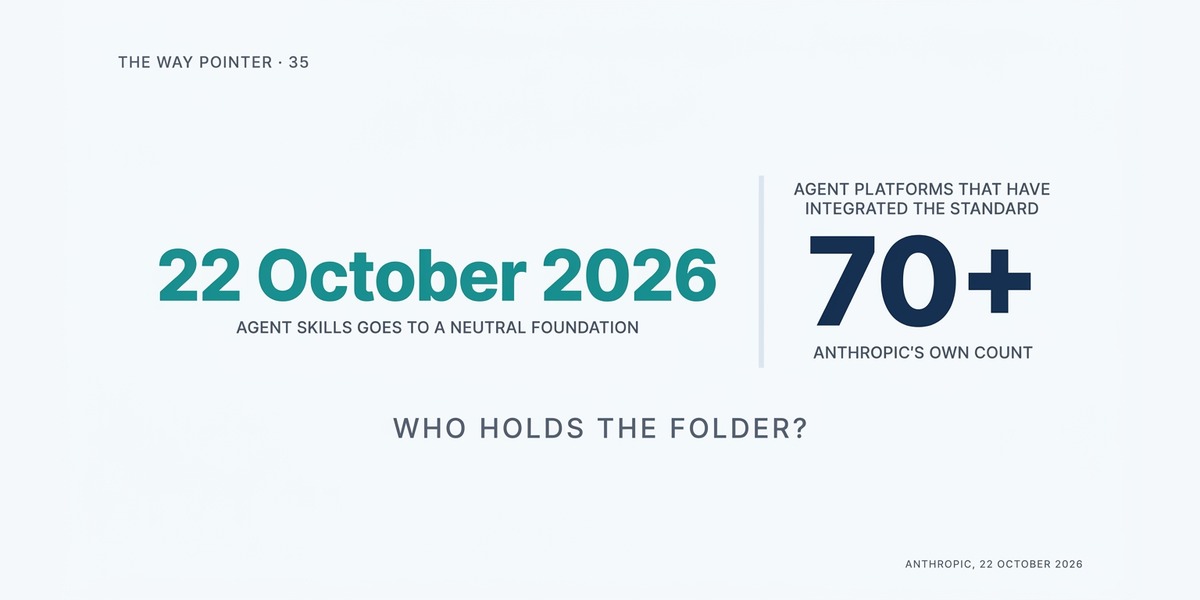
On 22 October 2026 Anthropic gave the Agent Skills standard to the Agentic AI Foundation, a body under the Linux Foundation.[1] The standard is a format for writing that kind of knowledge down so that an agent can use it. More than 70 agent platforms have integrated it, by Anthropic's count. A procedure written as a skill is not tied to one vendor's product. It stays with you only if you write it and you hold the folder.
That holds on either side of a programme. If you work for the client, the folder is how your know-how outlasts the people who built the system with you. If you work for the integrator, it is what you can leave behind on purpose.
This piece sets out what changed on 22 October, what Anthropic's applied team said the same day about where know-how belongs in an agent, and which procedure to write first.
A skill is a folder, and on 22 October Anthropic gave the standard to a neutral foundation
Anthropic's announcement defines a skill as "a folder containing a SKILL.md file that teaches an agent a specific task or domain, along with any scripts or reference material it needs".[1] The SKILL.md file holds the instructions. The rest of the folder holds whatever those instructions point to: a template, a lookup table, a short script.
Anthropic published the standard in December 2025. It says that "More than 70 agent platforms, including ChatGPT, Cursor, GitHub Copilot, and VS Code, have integrated Agent Skills" since then. It adds: "So far, 1 million skills have been published and nearly 280 million installed".[1] Those counts are Anthropic's own. No source says how many of the million are any good.
The donation is a governance step. Anthropic handed over the standard's name and logo, its GitHub organisation and the agentskills.io web address. It says engineers from Anthropic, Google, OpenAI and other companies will maintain the standard as individuals.[1] That changes who decides where the format goes next. It changes nothing inside any skill already written.
What it means at your desk is narrower, and more useful. A procedure you write to this standard is not tied to the agent your organisation happens to buy this year. If the tools change, the folder can go with you, and any platform that reads the standard can read it.
Anthropic's applied team puts know-how in skills, and warns against agents that copy the org chart
The same day, Anthropic's applied AI team published advice for enterprises building agents on its platform.[2] It says that too often it sees enterprises "give each team or problem type its own subagent, with the agent architecture becoming a copy of their org chart".
A subagent is a separate agent with its own instructions, handed one part of the job by a coordinating agent. In the team's comparisons across several enterprise deployments, "a single agent with skills frequently outperformed both the one-prompt-for-everything design and the subagent design on quality".[2]
The article is plain about what a skill is for. Skills are the right fit, it says, "when the agent needs to know how a team does work", such as the steps, rules and judgement calls that a specialist subagent used to hold. On upkeep, its approach is "to give the maintenance work back to the people writing the skills".[2]
This is one vendor's account of its own platform. "Frequently" and "often" are its words, not counts, and it names no customer. It also says subagents "still have their place", for example when several tasks need to run side by side.
Read from your work package, the advice points one way. The steps, rules and judgement calls of your team are what a skill holds. Whoever writes them down holds them, and the vendor's own advice is to leave the upkeep with that person.
Whoever writes the skill decides where the know-how lives
Uber is a large example of the in-house choice. It is an intention, with no result yet. On 22 October 2026 OpenAI announced that Uber is rolling its ChatGPT Work agent out to more than 30,000 employees, "Expanding from an initial pilot of 1,000 employees".[3] OpenAI says the rollout "will be supported by Uber’s internal AI skills library, approved integrations and dedicated employee training". The library is Uber's own. The two companies say they "plan to share further insights into adoption, use cases and measurable outcomes as the rollout progresses".[3]
Now take one procedure on a finance system programme: loading supplier records into the new system before each test cycle. One analyst knows which fields the old system fills wrongly, and which rejections can safely be cleared. Suppose an integrator's engineer, working beside her, turns that into a skill so an agent can run the load. The skill sits in the integrator's repository, the shared store where its engineers keep their work, under the engineer's name. When the engineer moves to the next client, the procedure is written down, and it has still left.
Take the same procedure written by the analyst herself, in a folder her organisation keeps, with her name as its holder. The agent runs it the same way. This time the know-how has stayed, and her successor can read it.
If you are the integrator's practitioner, you may be the one writing these. A folder you write for a client can be the cleanest thing you hand over, provided you agree who holds it before the work package closes. Agree it inside your own firm first. A folder can hold your firm's method, and its reference files can hold client data that has to stay where the contract puts it.
The folder is now the plainest test of whether know-how has stayed: you can point to it, and you can name who holds it.
On example figures, 8 hours to write it down against 40 to rebuild it
Here is an illustrative sum on example figures. Writing one procedure as a skill takes the person who knows it 6 hours. A colleague then spends 2 hours running it from the folder and noting the gaps. That is 8 hours.
Suppose instead that the person leaves with the procedure unwritten. Their successor spends 3 hours a week for 10 weeks working it out. Colleagues lose 1 hour a week over the same 10 weeks answering questions. That is 40 hours, and the first few runs carry the errors the leaver would have caught.
Put your own figures in their place. The sum only holds if the successor can find the folder.
Write one procedure from your work package as a skill someone else could run
Choose the procedure that would stall if you were away for a fortnight. Then write it as a folder. Here is an illustrative one:
supplier-record-load/
  SKILL.md                        name and description at the top, then what it is for, when to use it, the steps, the checks
  references/field-mapping.xlsx   which old field fills which new one
  references/rejection-codes.md   which rejections to clear, and which to stop on
Start SKILL.md with a name and a short description, as the standard asks.[4] Then write the steps in the order you do them. After each step, write the check you run and what you do when it fails. Put the tables and templates the steps point to in the references folder. SKILL.md is a text file, so write it for a person as well as an agent: the first reader to test it should be a colleague.
This week's Capability Brief asks you to write a stop rule for your work package: what it must show, by when and who can stop it. That rule is a procedure too, and it can sit in the same folder.
Done when: a colleague who has never done the procedure runs it from the folder alone, and every question they had to ask you is now answered in the file.
Keep the folder where your organisation keeps its records, and name who holds it
A personal drive leaves with you. A repository that belongs to the integrator leaves with the integrator. Put the folder where your organisation keeps the records of the work package. Then write on the plan where the folder is, who holds it and who reviews it when the procedure changes.
On the integrator's side, raise it before the work package closes. Agree with the client's lead which folders pass to the client, and whose name goes beside each.
Done when: the plan names the folder's location, its holder and its reviewer, and someone other than you has opened it from there.
Ask of any agent design on your work package which procedures it holds, and where they are kept
If you are handed an agent design, read it against the applied team's warning. If it gives each team its own agent, it may be a copy of your org chart. Then ask the narrower question: which of your procedures does it depend on, where is each skill kept and who maintains it?
Some answers will come back blank. A blank is the next folder to write, and it is easier to write while the person who drew up the design is still on the programme.
Done when: every procedure the design depends on has a folder and a holder's name beside it, or a blank you can show your programme lead.
References
Anthropic, Donating Agent Skills to the Agentic AI Foundation, 22 October 2026. https://www.anthropic.com/news/donating-agent-skills-to-the-agentic-ai-foundation.
Anthropic, Claude Platform, Building agents: When to fold subagents into your main agent loop, 22 October 2026. https://claude.com/resources/articles/building-agents-when-to-fold-subagents-into-your-main-agent-loop.
OpenAI, Uber brings ChatGPT Work to all employees with OpenAI, 22 October 2026. https://openai.com/index/uber-chatgpt-work-rollout/.
Agent Skills, Specification, read 25 October 2026. https://agentskills.io/specification.