Every transformation programme has a strategy deck. Most of them are good. The vision is clear, the business case stacks up, the sponsors are named, the governance model has a RACI chart with actual names on it.
And then the programme fails anyway.
Not spectacularly. Not in a way that makes the newspapers. It fails the way most transformations fail: slowly, quietly, through a thousand small gaps between intention and execution. The business case erodes. The consultants deliver and leave. The capability they were supposed to transfer evaporates. Six months later, the organisation is back where it started — but poorer, more fatigued, and less willing to try again.
We have studied this pattern across 29 documented cases totalling over $12.7 billion in financial exposure.[^1] The failure is almost never strategic. The strategy was usually fine. The failure is structural — a missing methodology between "here is what we want" and "here is how we get there, step by step, in sequence, with decision gates that actually gate."
That is what the O2O framework exists to solve.
The Problem with Leaps
The word "transformation" implies a single dramatic change. That framing is part of the problem.
Transformation is not a leap. It is a sequence of decisions, each building on the last, each requiring different inputs, different governance, and different types of work. Treating it as a single initiative — even a large, well-funded one — guarantees that critical steps get compressed, skipped, or never designed for in the first place.
Consider a pattern we see constantly: an organisation invests heavily in Phase 3 execution — the build, the deployment, the go-live — without completing the strategic foundation work that should precede it. The programme lands on time and on budget. The RAG status was green throughout. But within a year, the new operating model is drifting, because nobody designed the governance to sustain it. Nobody specified what capability needed to stay inside the organisation versus what could be outsourced. Nobody built the absorption architecture that would allow the change to stick.
The programme succeeded at delivery. It failed at transformation. Those are different things, and most methodologies do not distinguish between them.
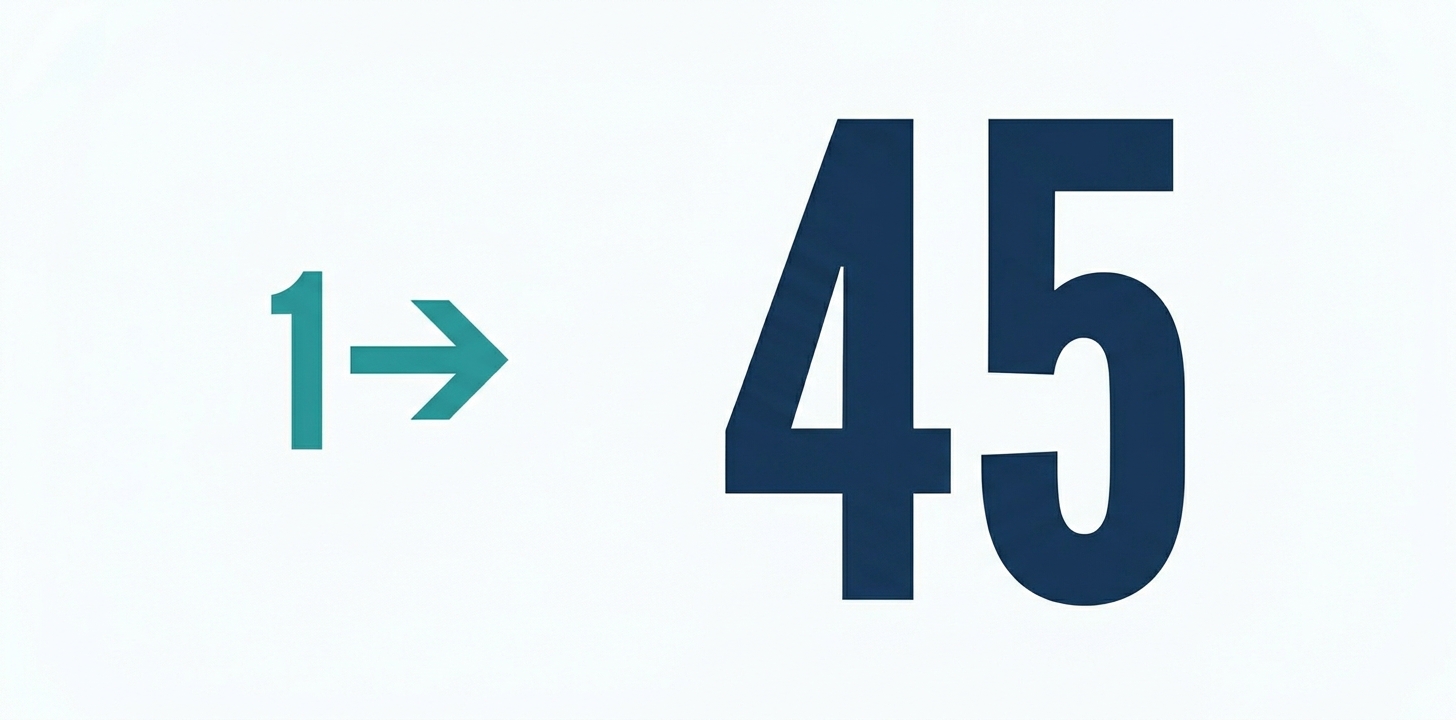
O2O does. Forty-five steps, four phases, with explicit decision gates between each phase. Not because bureaucracy is virtuous, but because transformation without sequence is just organised chaos with a Gantt chart.
Phase 1: Strategy — Where Are You Going and Why (Steps 1-9)
Phase 1 is the Success Map. Nine steps that establish whether the transformation should happen at all, and if so, on what terms.
This is where most programmes are weakest. Not because leaders skip strategy — everyone does strategy — but because they do it at the wrong altitude. They produce a vision document and a business case and then hand both to a delivery team that has to reverse-engineer all of the decisions that should have been made explicitly.
Step 1 begins with context: the external forces, the internal constraints, the root causes behind the symptoms that prompted the transformation in the first place. Step 2 secures the change arena — strategic intentions, sponsor commitment, portfolio alignment. Step 3 crystallises the strategy across all four layers: why, what outcomes, what deliverables, how to finance, operate, and transition.
Steps 4 and 5 are where O2O diverges from conventional frameworks. Step 4 engineers the platform capability — not a project plan, but a governance and continuous change architecture that will outlive any single programme. Step 5 curates the ecosystem: the partners, the strategic versus operational capability split, the commercial terms designed for full lifecycle rather than just delivery.
Step 6 is a genuine decision gate. Go or no-go, with a full lifecycle stress test and validated sign-offs — not a rubber stamp, but a substantive commitment from every party whose name appears on the RACI. Steps 7 and 8 calibrate the delivery portfolio and craft the gameplay. Step 9 finalises the transformation architecture and hands it over to execution.
Nine steps before anyone writes a line of code, configures a system, or mobilises a delivery team. That is deliberate. Our evidence base shows that the most damaging failure patterns — governance void, change absence, planning collapse — originate in Phase 1 gaps that only surface during Phase 3 execution.[^2] By then, the cost of fixing them has multiplied by an order of magnitude.
Phase 2: Operating Model — How Will You Get There (Steps 10-18)
Phase 2 takes the portfolio strategy from Phase 1 and decomposes it into programme-level execution. Steps 10-18 mirror the structure of Steps 1-9, but at a lower altitude — programme-specific context, programme-specific outcomes, programme-specific governance.
This mirroring is not accidental. Step 10 is Step 1 zoomed in. Step 11 is Step 2 at programme level. Step 12 is Step 3 with a programme-specific business case. The discipline of repeating the same strategic logic at each level of decomposition is what prevents the disconnect we see in nearly every failed programme: a portfolio strategy that makes sense at 30,000 feet and a programme reality that has quietly diverged at ground level.
Step 13 validates platform capabilities — not as aspirations, but as operational realities. Can your governance actually govern? Can your continuous change capability actually change? Step 14 moves ecosystem partners from "attracted" to "engaged and committed" — contracts signed, resources named, capability gaps closed.
Step 15 is the second major decision gate. This is go/no-go for execution, and it requires a programme-level stress test distinct from the portfolio-level test at Step 6. Steps 16 and 17 synchronise the programme roadmap with portfolio cadence, optimise delivery phasing, and mobilise the team. Step 18 commits to execution.
The operating model phase is where the transformation's immune system is built. Get this right, and the programme can absorb the inevitable shocks of execution — requirements changes, vendor issues, organisational restructures. Get it wrong, and Phase 3 becomes damage control.
Phase 3: Execution — Making It Real (Steps 18.1-18.9)
Phase 3 is nine sub-steps within Step 18, and this is where the work actually happens. Baseline, requirements, functional design, lifecycle design, build and test, UAT, release preparation, go-live, and handover to operations.
What makes O2O's execution phase different from standard delivery methodologies is the 9-tile architecture. At every sub-step, the framework requires work across three views — business architecture, enterprise architecture, and change architecture — at three levels each. This is not theoretical elegance. It is the practical mechanism that prevents the most common execution failure: building a technical solution that works perfectly and an organisational change that was never designed.
Step 18.1 baselines the current state across all nine tiles. Step 18.2 firms the requirements — and "firm" is the operative word. Requirements that are still evolving at Step 18.3 indicate that Phase 2 work was incomplete. Step 18.5 builds and tests not just the solution but the transition and deployment capability. Step 18.6 requires 360-degree UAT: business, operations, and change perspectives, not just functional testing.
Step 18.9 is the handover from delivery to operations, and it is where most programmes declare victory prematurely. The sign-off question is not "does it work?" but "can operations own this?" Those are different questions, and the gap between them is where transformation value goes to die.
Phase 4: Operations — Sustaining and Improving (Steps 19-27)
Most transformation frameworks stop at go-live. O2O does not.
Phase 4 is nine steps of operational change — continuous improvement, platform governance, capability evolution, and the flywheel that connects Step 27 back to Step 1. This is where the transformation either compounds or decays, and it is where O2O's Theory of Constraints integration becomes critical.
Steps 19.4 through 19.6 embed what we call the absorption triad: maximise throughput (19.4), apply constraint theory to reduce bottlenecks (19.5), and align dynamics to resolve conflicts (19.6).[^3] Absorption — the organisation's capacity to take a new capability and make it operational at pace — is the bottleneck that separates the 6% of enterprises capturing value from AI from the 94% that are not.[^4] The TOC triad gives that bottleneck a structured resolution mechanism rather than leaving it to organisational heroics.
Step 19 is also where ambidextrous leadership becomes explicit. The organisation must simultaneously exploit current operations for efficiency and explore the innovation pipeline for the next cycle of change. Step 22 governs the platform. Step 25 connects operational change to portfolio strategy. Step 27 completes the cycle and feeds back into Step 1 at the strategic level, Step 10 at the programme level, or Step 19 at the operational level.
This is the flywheel. Not a metaphor — a structural feature. Each cycle through Steps 19-27 builds the organisation's transformation capability. Over multiple cycles, that capability compounds into adaptability: the meta-capability to continuously reclassify what is core and what is context, and to reallocate resources accordingly. That meta-capability is what Transformation Capability Management names as a discipline.[^5]
AI-Augmented, Not AI-Replaced
Each of the 45 steps has AI agent support. Athena coaches through Phase 1 diagnostics. Sophina provides research intelligence across all phases. Specialised agents handle vendor evaluation, failure pattern detection, and operational monitoring.
But the AI serves the methodology, not the other way around.
This distinction matters. An AI tool without a methodology is a faster way to do the wrong thing. A methodology without AI support is sound but slow. O2O pairs the two deliberately: the framework provides the sequence, the decision logic, and the governance architecture. The AI provides speed, pattern recognition, and the capacity to process more information at each step than a human team alone could manage.
The founding principle is sovereignty. Every piece of insight the AI generates stays with the organisation. Every diagnostic, every assessment, every coaching output belongs to you. When you complete a cycle, you have not just a delivered outcome but a documented methodology that your team can repeat, adapt, and improve without external dependency.
That is the difference between a transformation that happened to you and one you own.
Your Waypoint
Before your next transformation steering committee, run this test on your current programme.
Take the four phases — strategy, operating model, execution, operations — and for each one, answer a single question: can you point to the specific document, decision, or artefact that completed this phase before the next one began?
Not "we covered this in the strategy deck." A specific, dated decision gate where a named person signed off that the phase was complete, the conditions for the next phase were met, and the outstanding risks were accepted rather than ignored.
If you can do that for all four phases, your programme has structural integrity. Most cannot. Most will find that Phase 1 and Phase 2 were compressed into a single "planning" phase, that Phase 3 started before Phase 2 was complete, and that Phase 4 was never designed at all.
The gaps you find are not failures of effort. They are failures of sequence. And sequence, unlike effort, can be fixed with methodology rather than more hours.
If you want to test where your strategic foundation stands, Athena's 9-step diagnostic walks through Phase 1 in depth — the same steps we use with every engagement. It takes about an hour, costs less than a single day of external consulting, and the output is yours to keep.
[^1]: BusinessGPS O2O Evidence Base: 29+ cases across 4 independent evidence sources including litigation records, programme audits, and vendor proposal analysis. Financial exposure documented from 24 ERP programme failures (Third Sage Group case analyses, 2000-2024).
[^2]: Base patterns BP-002 (Governance Void), BP-004 (Change Absence), and BP-003 (Planning Collapse) were confirmed across all vendor proposals tested in the O2O Evidence Base (3/3 prevalence for each). Project Atlas validation (2026) confirmed 9/9 predictions with 100% accuracy.
[^3]: The absorption triad applies Goldratt's Theory of Constraints to transformation capability — identifying the binding constraint, subordinating other activities to it, and elevating it through targeted investment. See Goldratt, The Goal (1984).
[^4]: McKinsey 2025 State of AI data identifies approximately 6% of organisations as "AI high performers" capturing disproportionate value. Deloitte's 2026 State of Generative AI report found two-thirds of leaders say AI is advancing faster than their organisation can absorb it.
[^5]: TCM (Transformation Capability Management) is the discipline that names this meta-capability. See the TCM Crisis Report for the full evidence base and theoretical foundation.