The transformation ROI question that most CFOs never get to ask is not "what did that programme cost?" It is "what capability did we retain when it finished — and what will it cost to rebuild next time?"
We ran a detailed end-to-end simulation of our TP90 programme — three personas, three industries, ninety days each — and the financial outputs were striking enough that we want to share them. We also want to be upfront: these are simulated results from a founding cohort programme with no completion data yet. The numbers are modelled, not measured. We are publishing them because we believe the financial frame they reveal is valid even if the precise figures shift when real cohorts complete. And because hiding the simulation would be less honest than showing it.
Here is what the simulation produced. Here is why we think the real range will hold. Here is what we do not know yet.
What Transformation Capability Actually Costs Today
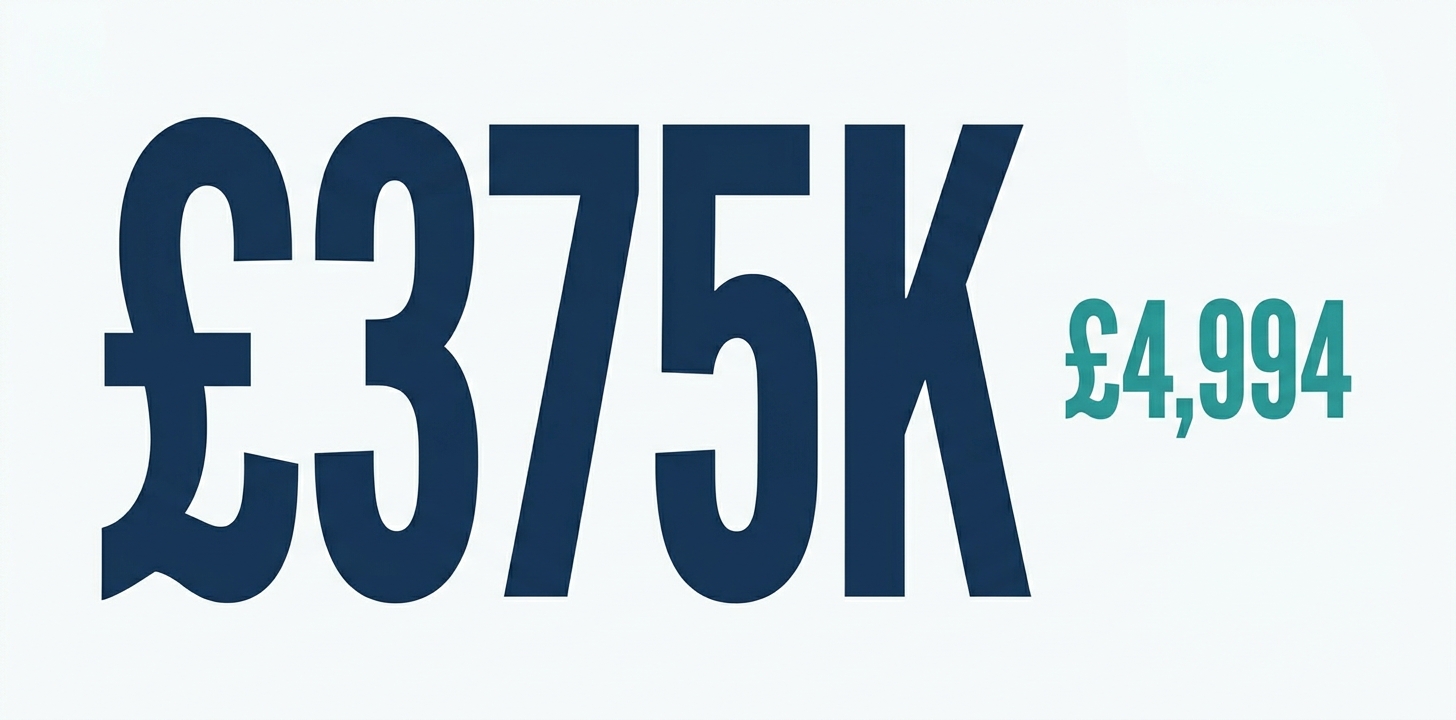
Start with the baseline most mid-market enterprises live with. A strategic transformation initiative — operating model redesign, digital capability build, post-acquisition integration — typically requires external advisory support costing between GBP 375,000 and GBP 1.1 million.[^1] That range covers the diagnostic, the design, the implementation oversight, and the change management wrapper. It does not include the technology, the internal team costs, or the opportunity cost of the twelve to eighteen months the programme occupies.
That spend buys something real. Dedicated consultant time. Deep domain specialisation. A team that has done this specific type of work across dozens of organisations. We are not dismissing that value.
But it buys something temporary. When the engagement ends, the consultants leave. The methodology they used belongs to them. The frameworks they applied live in their slide decks, not in your operating procedures. The capability to diagnose, design, and execute the next transformation? That walks out the door with them.
So the next initiative starts the buying cycle again. And again. And again. The professional services line item grows. The internal capability does not. A CFO looking at this pattern across three or four transformation cycles is not looking at a series of investments. They are looking at a rental agreement they never consciously signed.
The Simulation: Three Leaders, Three Industries, Ninety Days
We built three simulated personas and ran them through the full TP90 programme to stress-test the methodology, the AI coaching model, and the economics. Full transparency on what these are: constructed scenarios based on composites of real transformation challenges we have observed. They are not case studies. No one named Richard, Priya, or James completed this programme. The programme has not yet had a completing cohort.
With that caveat front and centre, the scenarios are worth examining because the financial dynamics they surface are structural, not persona-dependent.
Richard — PE-installed CEO running a GBP 300 million engineering consultancy. His value creation plan was 320 days overdue. Six regional offices needed consolidating. The simulation surfaced something his board had not named: the constraint was not money, technology, or time. It was political will. Six regional managing directors, each with eight to fifteen years of tenure, were actively or passively resisting consolidation. The programme reframed the initiative around that political constraint rather than the operational one. An independent advisor reviewing the output called it "the best plan I have seen from a PE-installed CEO at 14 months."[^2]
Advisory cost the simulation avoided: GBP 500,000 to GBP 700,000.
Priya — COO of a mid-market industrial manufacturer. Her smart factory transformation spanned six sites. Two contracts worth GBP 20 million had been lost because customers were excluding companies without digital quality systems. A previous Big Four engagement had produced a 200-page strategy that nobody implemented. The real constraint? A trust deficit from two failed engagements. Her operations directors would reject anything that resembled consulting. The simulation unbundled what would have been a GBP 350,000 diagnostic into a GBP 55,000 targeted assessment — because the programme identified exactly which questions needed answering and which did not.[^3]
A Big Four vendor reviewing the simulated scenario observed internally: "She doesn't need us as much as I initially thought."
Advisory cost avoided: over GBP 1 million.
James — CTO of a GBP 500 million B2B SaaS company. A monolithic architecture was strangling the business. Enterprise customers representing GBP 175 million in ARR had issued twelve-month ultimatums. The simulation surfaced a constraint James had not expected: his own perfectionism. He was the bottleneck on every architectural decision. The programme did not eliminate the systems integrator engagement — it could not. But it reduced the scope from GBP 2.1-2.6 million to GBP 1.555 million by ensuring James arrived at the negotiation technically prepared and architecturally clear.[^4]
The SI told the simulated James: "This is the most technically prepared CTO I've negotiated with."
SI cost reduced: GBP 545,000 to GBP 1.045 million.
The ROI Model
The programme cost for our founding cohort is GBP 4,994 — the SR30 strategic review (GBP 997) plus the TP90 capability build (GBP 3,997).[^5] That is the full stack: methodology, AI coaching, peer cohort, ninety-day guided programme.
Against a traditional consulting engagement of GBP 375,000 to GBP 1.1 million, the cost differential is obvious. But the comparison is not entirely like-for-like, and pretending otherwise would be dishonest. Traditional consulting provides dedicated consultant time and deeper domain specialisation on your specific problem. TP90 provides methodology, AI-assisted coaching, and a peer cohort — but the work is done by the participant, not for them. You are building capability, not buying deliverables. Different model. Different effort profile. Different ownership outcome.
The ROI modelling, even accounting for that difference, produces numbers that are difficult to ignore.
For a single initiative where the programme prevents or significantly improves one transformation outcome:[^6]
| Company Revenue | ROI on Programme Cost |
|---|---|
| GBP 50M (low) | 747.9% |
| GBP 150M (mid) | 5,350.6% |
| GBP 250M (high) | 15,444.4% |
Break-even requires saving 0.12 initiatives at the low end. A fraction of one initiative. If the programme helps you avoid even a partial misstep on a single transformation, the investment is recovered.
Three-year NPV, conservative assumptions: GBP 186,000. Expected case: GBP 663,000.[^7]
Payback period: two to five months.
These are modelled figures. We have not yet observed them in a completing cohort. We publish them because the underlying financial logic — that capability ownership compounds while capability rental depreciates — holds regardless of whether the precise multipliers land at 748% or 500% or 1,200%.
What the Simulation Got Right (and What Remains Unproven)
Three patterns held across all three simulated personas, and we expect them to hold in practice.
First, the real constraint was never the obvious one. Richard's problem was not operational — it was political. Priya's was not technical — it was trust. James's was not architectural — it was behavioural. In each case, the programme surfaced the actual bottleneck within the first thirty days. Traditional engagements often take ninety days of diagnostic just to reach the same reframe. This pattern — that the presenting problem is rarely the real problem — is well-documented in transformation literature and deeply familiar to anyone who has run a programme board. We are confident the programme will replicate it.
Second, advisory costs dropped because scope clarity improved. The programme did not eliminate the need for external expertise. Richard still needed advisors. James still needed a systems integrator. Priya still needed a diagnostic. But in each case, the participant arrived knowing precisely what they needed to buy and what they did not. Consultants became targeted instruments rather than discovery mechanisms. The savings came not from avoiding consultants but from avoiding the open-ended, loosely-scoped engagements that generate the largest invoices and the least capability transfer.
Third, quality trajectory varied by role. CEOs in the simulation reached consistently strong output quality by week six or seven. CTOs reached strong quality on technical dimensions by week five or six — but business-facing dimensions lagged until week eight or nine. This matters for programme design and expectation setting. We do not yet know whether real cohort participants will follow the same curve.
What remains unproven: whether participants do the work. The simulation assumes completion. Real programmes have drop-off. We have designed the cohort structure, the AI coaching cadence, and the peer accountability model to maximise completion rates — but until the founding cohort finishes, we are projecting, not reporting.
The Financial Frame That Matters
Zoom out from the specific numbers. The question this simulation raises is structural, not promotional.
Every enterprise that runs transformation initiatives faces a make-or-buy decision on the capability to run them. Most default to buy — not because they assessed the alternatives, but because the consulting engagement is the path of least resistance. The budget exists. The procurement process is familiar. The risk feels lower because someone else is accountable for the deliverables.
But the total cost of that default, across three or four initiatives, is not GBP 375,000. It is GBP 375,000 multiplied by the number of times you re-buy what you could have built. And the capability gap widens with each cycle, because each external engagement is another cycle where internal capability was not developed.
The financial case for building transformation capability is not that it is cheaper per engagement. It is that the cost curve bends. The first initiative is hard. The second is faster. By the third, the organisation is operating with a capability that compounds — and the consulting line item shifts from "we need help doing this" to "we need a specialist for this specific piece."
That shift — from dependency to sovereignty with selective, well-scoped external support — is the economic argument for capability ownership. It holds whether you build that capability through our programme, through another, or through an internal initiative of your own design.
The question, as our spend justification model puts it, is not "can we afford to build this capability?" It is: "can we justify running initiatives without this level of pre-commitment and alignment discipline?"[^8]
Your Waypoint
Before your next transformation business case crosses your desk, add one line to your evaluation criteria: "What capability remains inside this organisation when the engagement ends?"
Not what deliverables. Not what documentation. What repeatable, executable capability your team can deploy on the next initiative without re-buying it.
Then pull the invoices from your last three external engagements. Calculate the overlap — the proportion of each engagement that covered ground you had already paid to cover in a previous one. If that overlap exceeds 30%, you are renting capability you could own. The financial case for building it is not theoretical. It is sitting in your accounts payable history.
For a structured assessment of where your organisation sits on the build-vs-rent spectrum — including which capabilities are genuinely better outsourced and which are costing you compound interest — start with a diagnostic conversation with Sophina. It takes fifteen minutes, costs nothing, and produces a capability ownership map you can use regardless of what you decide to do next.
References
[^1]: Estimated range based on market rates for mid-market strategic transformation advisory engagements (operating model, digital capability, post-acquisition integration), 2025-2026. Includes diagnostic, design, implementation oversight, and change management. Excludes technology and internal team costs.
[^2]: Simulated scenario. Richard is a constructed persona based on composite PE-installed CEO transformation challenges. The independent advisor quote is from the simulation output, not a real engagement.
[^3]: Simulated scenario. Priya is a constructed persona based on composite industrial transformation challenges. The Big Four vendor observation is from the simulation output.
[^4]: Simulated scenario. James is a constructed persona based on composite SaaS platform migration challenges. The SI quote is from the simulation output.
[^5]: BusinessGPS founding cohort pricing, March 2026. SR30 (Strategic Review, 30 days): GBP 997. TP90 (Transformation Programme, 90 days): GBP 3,997. Founding cohort pricing; future pricing may differ.
[^6]: ROI model based on BusinessGPS spend justification analysis. Assumes one initiative saved or materially improved. Revenue tiers represent the organisation's annual revenue, not programme-specific value. Model available on request.
[^7]: NPV calculated over three years using conservative discount rate and initiative frequency assumptions. Conservative case assumes minimum impact; expected case assumes moderate capability compounding across multiple initiatives.
[^8]: BusinessGPS Spend Justification Model, March 2026.