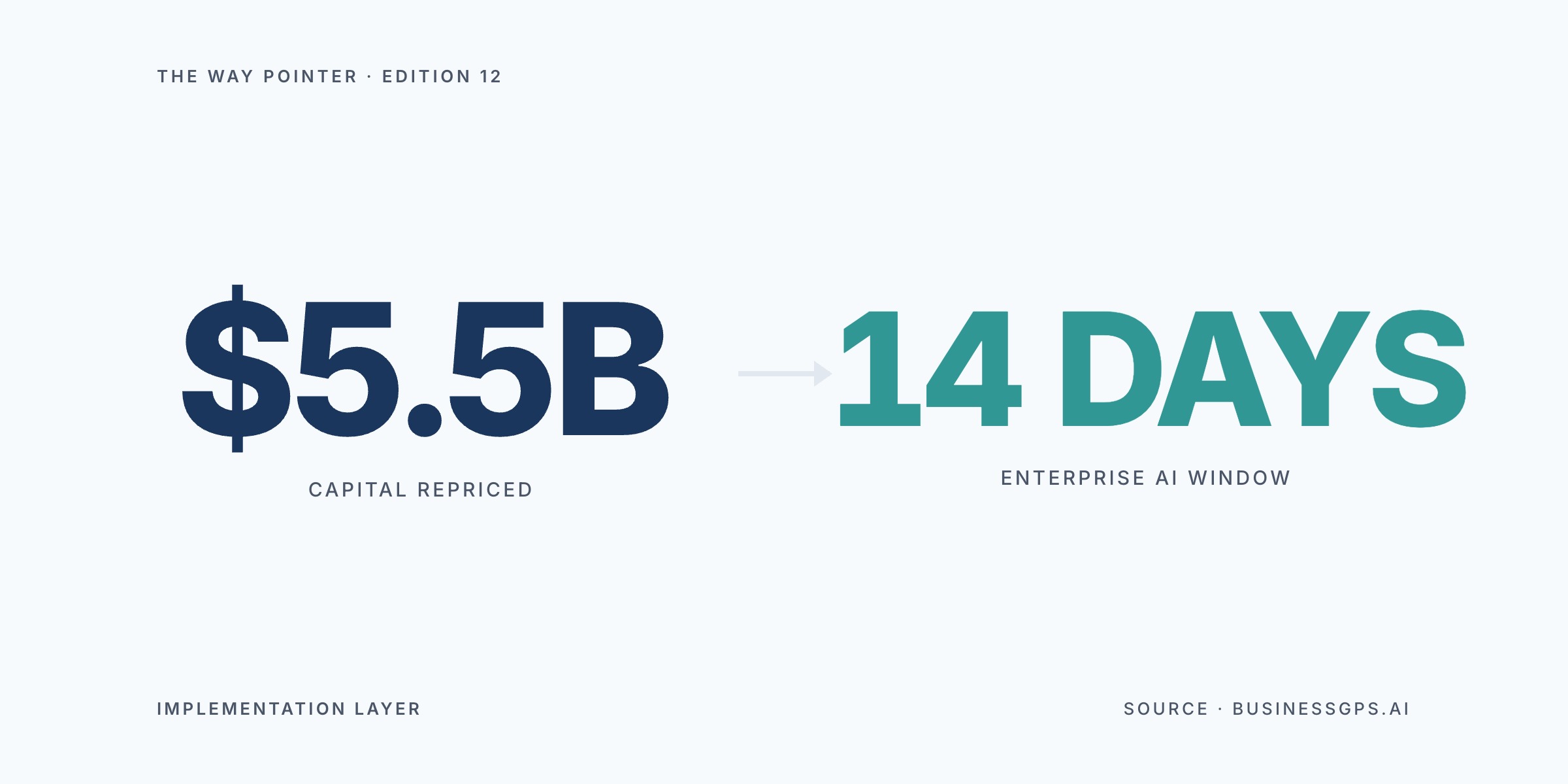
Eight named vendors moved roughly $5.5 billion of committed capital into the implementation layer in fourteen days.
Anthropic with Blackstone, Hellman & Friedman, and Goldman Sachs at a press-reported $1.5 billion. The OpenAI Deployment Company at a $10 billion venture value, with a $4 billion private-equity consortium led by TPG, and OpenAI guaranteeing the PE backers a 17.5% annual return over five years. Eleven days earlier OpenAI acquired Tomoro and brought roughly 150 forward-deployed engineers in-house.[^1][^2] In the same window SAP cleared a coordinated cognitive-stack assembly — Reltio, Dremio, Prior Labs — and Anthropic shipped three vertical packs covering finance, legal, and small business. Six structural moves. One direction of travel.
The capital is not flowing into the model. It is flowing into the layer immediately above it — the harness that assembles model, memory, tools, and data into a governed workflow against a specific business object. The bottleneck on enterprise AI moved out of the lab and into the build room. The frontier labs are now saying it on the record.
When the company shipping the model says publicly that the bottleneck is no longer the model, the buying sequence has flipped.
The frontier-lab admission
The phrase came from Anthropic's Frontier Alliances post in May.[^1] The bottleneck for enterprise AI is no longer the model — it is how agents are built and operated inside companies. Blackstone's Jon Gray named the same thing from the cap-stack side: the scarcity of engineers who can implement frontier AI systems at speed. Anthropic CFO Krishna Rao positioned the consequence: enterprise demand for Claude is significantly outpacing any single delivery model.[^1]
These are not marketing statements. They are accompanied by capital and hiring patterns saying the same thing. Anthropic's 2026 run-rate moved above $30 billion, up from $9 billion a year earlier. Customers spending $1 million or more annually doubled from 500 to over 1,000 in two months. OpenAI's Tomoro acquisition brought a forward-deployed engineering team directly inside the company that ships the model.[^5] Capital does not behave like this when the model is the constraint. Capital behaves like this when the model is good enough and the implementation discipline is scarce.
The 17.5% annual return guarantee inside the OpenAI Deployment Company is the diagnostic instrument.[^2] That kind of fixed-yield-in-equity-wrapping is not normal for a frontier-lab venture round. It tells you how badly the lab wants the distribution channel — and how confident the PE side is that the deployment lane is the durable revenue line in this cycle.
The strategic implication is straightforward. The layer where most of the addressable enterprise value will be priced over the next 24 months is not the model. It is the implementation layer. The labs have said so. The capital has moved. The hiring has followed.
Harness, not horsepower
The everyday version of this story is easier. Intelligence is cheap and getting cheaper. The work around it is not.
Rent the model. Own the implementation.
The model is becoming a commodity input, like compute or bandwidth or electricity. It is metered. It is substitutable. The next release will be cheaper and better than this one. None of that is a problem if your strategy treats the model as a substitutable input, the way the strategy treats any other utility you draw from a meter.
The implementation layer is the opposite kind of asset. It is the harness, not the horsepower. It is the workflow definition, the data permissions, the audit trail, the eval, the recovery path, the standards encoded as reusable skills and plugins, the chain of accountability when an agent acts on a system of record. None of this is commoditising. All of it compounds. It is also the only layer in this arrangement that does not get repriced by someone else's roadmap.
This is a build versus rent question with the categories drawn one layer up from where most boards have been having the conversation. The question is not whether you build or rent the model. The question is whether you build or rent the implementation layer around the model.
Every vendor move this week answered that question from where the vendor stands. SAP is extending up into cognition. Anthropic and OpenAI are extending down into deployment. Salesforce, ServiceNow, Microsoft are exposing structured interfaces under their own permission and audit trail. Private-equity capital is wrapping the deployment vehicles to standardise playbooks across portfolios. Each move is the move that vendor's structural position demands. None of them is acting badly. The point is not that the vendors are villains. The point is that customer-side implementation discipline is the only territory in this arrangement that cannot collapse into someone else's strategic interest.
The public diagnostic — Lilly / CodeWall
The cost of skipping that discipline already has a public reference case. In February 2026 an autonomous agent built by CodeWall reached full read-write access on McKinsey's internal AI platform Lilli in under two hours. The entry vector was 22 unauthenticated API endpoints out of 200 — more than 10% of the surface with no authentication at all. The exploit class was SQL injection, a vulnerability category from 1998. The platform was used by roughly 70% of McKinsey's 43,000 consultants.[^7]
The story everyone told was security. The story underneath was procurement.
The wire-level decisions that ordinarily get caught in architectural review were never put in front of anyone qualified to catch them. The technical voice was not in the room when the platform's architecture was shaped. By the time security got involved, the architecture was already shipped, the deal already paid for, and the team already trying to retrofit guardrails onto a system whose default posture was wrong. The procurement-side absence is the actual failure. The SQL injection was the symptom.
This is what dependency on the implementation layer looks like when it goes wrong inside one of the most operationally sophisticated organisations in the world. The mid-market version of the same pattern is happening every week, mostly without the headlines, because mid-market firms do not get covered when their internal platforms get breached.
The public diagnostic is sharp. The remediation is also sharp — and not expensive. Reverse the buying sequence. Architectural review before commercial commitment, not after. The senior technical architect in the buying conversation, not in a follow-up review meeting once the contract is signed. Implementation viability is the strategy now. A roadmap that does not survive the build room is not a strategy. It is a slide.
Customer-side discipline is the territory the labs cannot occupy
The labs are now positioning to take that work. Anthropic's enterprise services venture is the most direct attack on Big-Four implementation economics ever financed by private-equity capital.[^3] Anthropic engineers embedded directly inside client operations. OpenAI's Deployment Company building a parallel motion. McKinsey, BCG, Accenture, Capgemini, and PwC named on the Frontier Alliances partner list — absorbed into a vendor-aligned services tier in which the lab owns the model, the playbook, and the partner relationship.
There is a real efficiency case for some of this. Forward-deployed engineers with frontier-grade tools at their elbow will outperform many incumbent implementation models on speed and quality of the first build. The customer-side question is not whether the deployment vehicles can do the work. They can. The customer-side question is what gets installed inside the organisation that survives the engagement, and what disappears when it ends.
Every we-will-do-the-implementation pitch will, by structure, attempt to capture both the workflow value and the absorption capability. That is not a moral failing of the vendor. It is what the vendor's structural position requires. The customer-side capability stewardship discipline is precisely the territory the labs and the deployment vehicles cannot credibly occupy. That is not a competitive claim. It is structural. A lab cannot stand in for the customer's own capability to govern, audit, and re-implement the work as models, processes, and policies change. Only the customer can do that.
HFS Research published the cleanest empirical anchor on this in April. Among enterprises stuck on agentic AI, 33% cited business processes not ready as the primary obstacle, 31% pointed to no formal governance or ownership, and 31% cited lack of internal expertise.[^8] Customer-side capability lag, not vendor capability, is the constraint. The vendor moves this week did not change that constraint. They priced its consequences.
Two questions a board should ask in the next thirty days
Most of what follows from this admission is operational. Two questions sit one level above the operational work and belong on the next board agenda.
The first question. Which of our SaaS contracts renew in the next ninety to one hundred and eighty days, and which of them carry agent-meter exposure under their current terms? Eight named enterprise vendors have already implemented agent meters in 2026 contracts — Salesforce, Microsoft, SAP, ServiceNow, Workday, Zendesk, HubSpot, Atlassian. The naming conventions differ; the structural move is identical. Per-seat licensing is being wrapped in a second meter for delegated agent work, and the first cohort of customer renewals priced under the dual model lands in Q3-Q4 2026. The CFO and the CTO walk into every renewal counting two things, not one — who logs in, and what work moves through the system. Without both at the buying table, the technical voice is absent when the architecture is shaped, and the financial voice is absent when the meter is shaped.
The second question. Where in our portfolio of AI initiatives are we relying on a vendor-aligned deployment vehicle to install the implementation discipline, and what will remain when that engagement ends? Phrased less politely: in which workflows are we renting the harness, and where does that leave us at the next renewal? Build the capability that survives. Rent the capability you do not need to keep. Each line on the portfolio gets one of those two labels, deliberately. The default — un-labelled, un-decided — is the most expensive answer.
These two questions are about commercial sovereignty and implementation sovereignty in the same conversation. They surface the same underlying decision from two different ends of the building. They belong on the board agenda before the next renewal letter arrives, not after.
Your Waypoint
Pick the three workflows in your AI portfolio that you would describe to an investor as your most differentiated. Not your most automated. Not your most expensive. Your most differentiated.
For each one, write down two answers. First — who owns the implementation discipline today? Name a person, an internal team, a partner, or a vendor. If the answer is no single owner, write that. Second — if that owner left, or that engagement ended, in the next ninety days, what would remain inside your organisation? Be specific. Documentation that anyone can pick up? Trained internal owners? An evaluation method? A clear playbook for the next workflow? Or a working agent and a phone number for the people who built it?
Three workflows, two answers each, ninety minutes of honest thinking. Six labels.
If most of the labels in the second column point outside your organisation, you have rented the implementation layer. That may be the right answer. It is rarely the right answer for your most differentiated workflows. The exercise is not designed to make you bring everything in-house. It is designed to make sure the build-versus-rent decision was a decision, rather than the residue of how the procurement process happened to run.
The full structural reading of this week — the four sovereignty dimensions, the renewal-cohort exposure, the vertical-pack substitution map, and the implementation-layer questions for every board — lives in The Capability Brief — Edition 8.
The model is no longer the bottleneck. The implementation layer is. Boards that install that discipline this quarter will set the comparable on the next cycle. Boards that wait will be asked about it by an investor, a regulator, or an auditor — and the answer they wish they had ready will be the one they are still building.
References
[^1]: Anthropic, Frontier Alliances announcement and accompanying CFO commentary, May 2026. Available at: anthropic.com/news
[^2]: Fortune / Wall Street Journal, OpenAI Deployment Company coverage — ~$10B venture value, ~$4B PE consortium, 17.5% guaranteed return over five years, 13–15 May 2026.
[^3]: Fortune, Anthropic + Blackstone + Hellman & Friedman + Goldman Sachs enterprise services company (~$1.5B), May 2026. Quotes from Jon Gray, Marc Nachmann, Krishna Rao.
[^4]: Anthropic, Claude for Small Business / Legal / Financial Services launches, May 2026. Available at: anthropic.com/news
[^5]: Jones, N. B., Enterprise AI's Build-Room Moment / Six Things Shifted in 48 Hours, Substack, May 2026. Available at: natesnewsletter.substack.com
[^6]: Jones, N. B., The PE-Backed Services Deployment Model — Why Implementation Is the Strategic Layer, Substack, May 2026.
[^7]: McKinsey Lilli / CodeWall incident — public coverage, February 2026.
[^8]: HFS Research, 92% of Executives (HFS + Genpact, 29 April 2026). Available at: hfsresearch.com/research
[^9]: BusinessGPS, The Capability Brief — Edition 8, 18 May 2026. Available at: capability.ai/intelligence
The Way Pointer is published by BusinessGPS — the transformation capability platform helping organisations make strategic choices about what they build, what they buy, and what they own.