For a year we have made one argument in a dozen forms: the durable asset in an AI programme is not the model, it is the layer above it — the operating capability that decides how the model is used, checked, and swapped. It was always an argument. This fortnight it acquired a household name, and the way the name arrived tells you exactly where the lock is going.
The move, chosen in public
A frontier reasoning model — Claude — was made the default reasoning engine across a leading enterprise-software vendor's whole stack. Not one option among many, kept swappable behind an abstraction; the engine the system reaches for first, across the agent tools, the messaging layer, the developer surface — the systems that vendor's customers run their day on. It shipped with a plug-in that lets the model drive the vendor's own capabilities as if they were tools it could pick up. Some in the trade press coined a portmanteau for the moment. All of it summarised in one blunt line: the end of model-agnostic enterprise AI.
Read that plainly, because it is the whole story. For two years the received wisdom was to stay model-agnostic — keep the underlying model swappable, so no single supplier ever owns your intelligence. This fortnight the largest players stopped pretending that was where the market was going. The reasoning layer — the part that actually decides what to do with your frozen systems underneath — is being chosen and locked, one platform at a time, and sold to you as the modernisation.
And here is the part that makes it a Way Pointer and not a product note: the substrate under all of it did not move. The transaction core, the system of record, the platform that holds the customer data — it is exactly as frozen as it was a month ago. What was added is a layer that reasons across it, decides on top of it, and is priced as the upgrade. That is not a smaller version of replacement. It is a different act, with a different bill — the interpose-over-a-frozen-substrate move we have described for a year, now performed on the largest public stage available to it.
The stack split in two — and the split is the strategy
The household-name launch did not happen alone. In the same fortnight, the boring layer moved the other way. The protocol that lets agents talk to one another was handed to a neutral standards body with a large multi-vendor membership — standardised, shared, governed by no one in particular. Two moves, opposite directions, same fortnight. That is not a coincidence. It is a strategy, and once you see its shape you cannot unsee it.
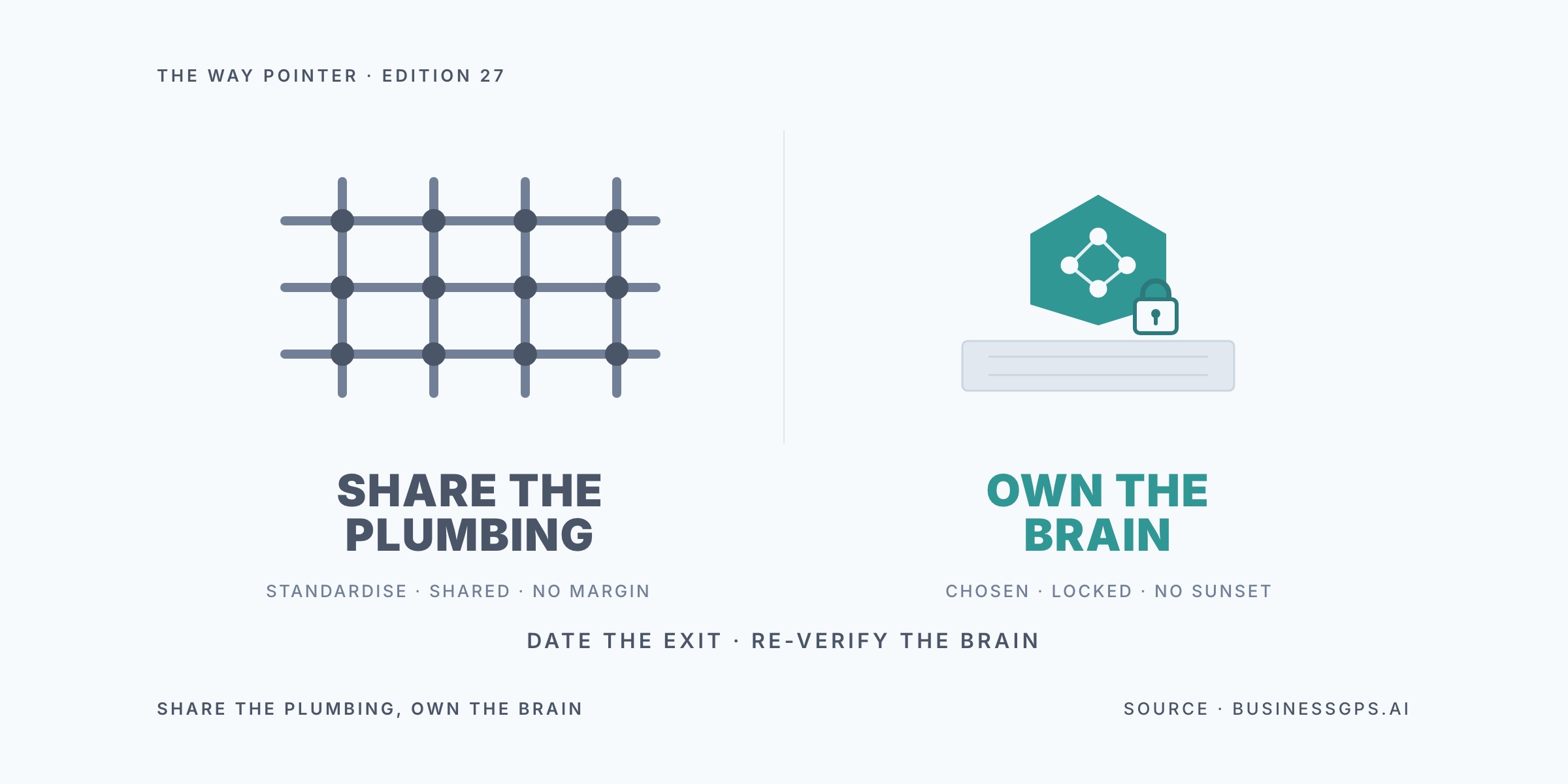
Vertical selection at the model layer. Horizontal standardisation at the protocol layer. The plumbing — the wiring that lets agents interoperate — was given to neutral governance precisely because nobody captures value there. There is no margin in the pipe. The brain — the reasoning layer that decides — is being chosen per platform and locked, precisely because that is where the value, and the lock, live.
So the distinction to carry out of this fortnight is a single line: share the plumbing, own the brain.
Share the plumbing means: standardise hard at the protocol layer. Adopt the shared interoperability standard, insist on it, treat neutral governance there as genuinely in your interest — because it is. Interchangeable wiring is a buyer's asset; it is the thing that keeps your agents able to talk to whatever you choose next.
Own the brain means: the reasoning layer is not plumbing, and you must not let it be handed to you as though it were. It is the part that decides, and the part that locks. When a vendor offers you a strong default reasoning layer bundled into the platform you already run, the convenience is real — and so is the fact that you are being invited to stop choosing. The brain is the one layer you cannot afford to accept by default, because it is the one layer designed to be hard to leave.
Why the brain is the lock — and why it decays
An undated wrap, we wrote last fortnight, is entrenchment sold as modernisation. The household-name reasoning layer is that same trap with two hands added to the same throat.
The first hand is permanence. The default arrived with no sunset — no date on which it ever comes off, no line for what it costs you in year five, no trigger that retires it. From the other direction, the countdown is already visible in the market: a dominant ERP vendor's free agent runtime and studio expire at year-end with no successor price named. "Free through year-end, price to follow" is how a runtime becomes a dependency before it becomes a bill — you build on it while it costs nothing, and you negotiate the price after you can no longer leave. Whether the layer is offered as a bundled default or as a free runtime with the meter switched off, the shape is the same: adopt now, priced later, leave never.
The second hand is newer and worse: decay. A reasoning layer is not a fixed asset even if you never touch it, because the thing inside it moves. The model's behaviour drifts. The harness around it ages. What practitioners now openly call "context rot" — reasoning-layer quality degrading in place — eats capability that no vendor dashboard reports. You are being sold a permanent brain over a frozen body, and told both will keep their promises indefinitely. Neither will. An inert wrap over a stable core at least stays where you left it. A reasoning layer over a moving model quietly gets worse while the metrics that sold it show nothing wrong.
Put the two together and the reason the brain is the lock becomes concrete. It is chosen for you, sold as permanent, and it degrades invisibly — three properties that each, on their own, transfer control to the vendor, and together make the reasoning layer the single most important thing in your stack that you do not currently own the decision about.
And keep one line taped to the wall for every announcement this fortnight produced: the claim is not the proof, and certification is not assurance. The vendor's benchmark is a marketing asset. A neutral standards body certifies that agents can talk, not that they are safe. This fortnight made the point with data: trust in automated evaluation roughly tripled off a low base, the complaint that "the evals don't match reality" fell — and the failure rate did not move. Around half of teams shipped an agent that passed its evaluations and failed a real customer; about two-thirds deploy without human review. Rising trust with a flat failure rate is not progress; it is confidence outrunning accuracy. In the same fortnight the model-builder's own study reported a default classifier catching 89% of dangerous commands against a 13.6% rate for human reviewers — which does not retire supervision, it moves it up a level: the job is no longer to watch every action, but to watch the thing that watches the actions. When the reasoning layer is the default and it degrades invisibly to the metrics that sold it, the only party with the incentive to measure your capability in production is you.
The discipline: share the plumbing, own the brain
So the move is not "refuse the default." A strong, well-integrated reasoning layer genuinely reduces the integration tax, the security surface, and the number of vendors your team must manage — and a frontier model chosen by a serious platform is very likely better today than whatever you would assemble yourself. On a one-year horizon, taking the default often wins. It loses only on the axis the vendor never prices: the multi-year cost of not being able to change your mind, over a substrate that is itself moving. The convenience is real. The permanence is the part you should refuse to sign.
That refusal is a discipline, and none of it is a vendor's job.
First, split your stack the way the market just did — deliberately, and in your favour. Standardise hard at the protocol layer; share the plumbing without hesitation, because interchangeable wiring is a buyer's asset. Stay consciously plural at the reasoning layer for as long as you can bear the integration tax. Where you must pick one reasoning default, treat it as a dated decision with a named alternative kept on the shelf, not a marriage.
Second, date the exit before you accept the default. For every place you put a reasoning layer over a system you chose not to replace, write the two things the vendor will not: the sunset — the date or trigger on which the layer retires or is re-tendered — and the switching terms. Negotiate them first, before a free runtime cliff arms the price, not after. "No sunset" is the answer the vendor wants and the one you cannot accept, because an undated default is a permanent coupling wearing a temporary label.
Third, measure the decay yourself, because certification will not. A standards body certifies interoperability, not safety; a vendor's benchmark is a sales asset, not a service level; rising trust in evaluations this year sat on top of an unchanged failure rate. Instrument the reasoning layer in production. Write down what "good" looks like in one line before you ask the layer to perform. Then judge it by how honestly it discloses its own limits — and re-verify, on a stated cadence, that it hasn't quietly rotted while on. The boundary you own now needs two dates, not one: the date the layer comes off, and the cadence on which you check it still works.
Your waypoint
One question for your next leadership meeting, and let the room sit with it: for every place we have made — or are about to make — a single reasoning layer the default over a system we chose not to replace, what did we freeze, what did we lock, on what date or trigger does the layer come off, and how would we even know it had decayed? If the honest answer is "there is no date, and no one is watching for drift," you have not found a modernisation. You have found a lock being sold to you as a default.
Then make it concrete. Share the plumbing: adopt the shared protocol, standardise hard, and treat neutral governance there as your ally. Own the brain: name the frozen substrate, name the reasoning layer, write the sunset and the switching terms, keep a named alternative on the shelf, and instrument the layer in production so its decay is a number you hold rather than a surprise the next owner inherits.
The market spent this fortnight choosing the operating layer in public — locking the part that reasons, standardising the part that doesn't, and calling the whole thing modernisation. Interpose, by all means; the economics are real and the household-name version does not change them. But own the choice underneath. Share the plumbing, and own the brain — over a substrate you named, on a date you set, measured by an instrument you built. That is the difference between renting today's brain over yesterday's substrate and owning the capacity to change.