Last week we named the trap. Tokenmaxxing — the habit of paying per token to rent hosted intelligence rather than owning the capability that produces value — is a dependency dressed as a strategy, and the market spent the week agreeing the first half of that.[^1] This week the sequel arrived, and it arrived with a receipt.
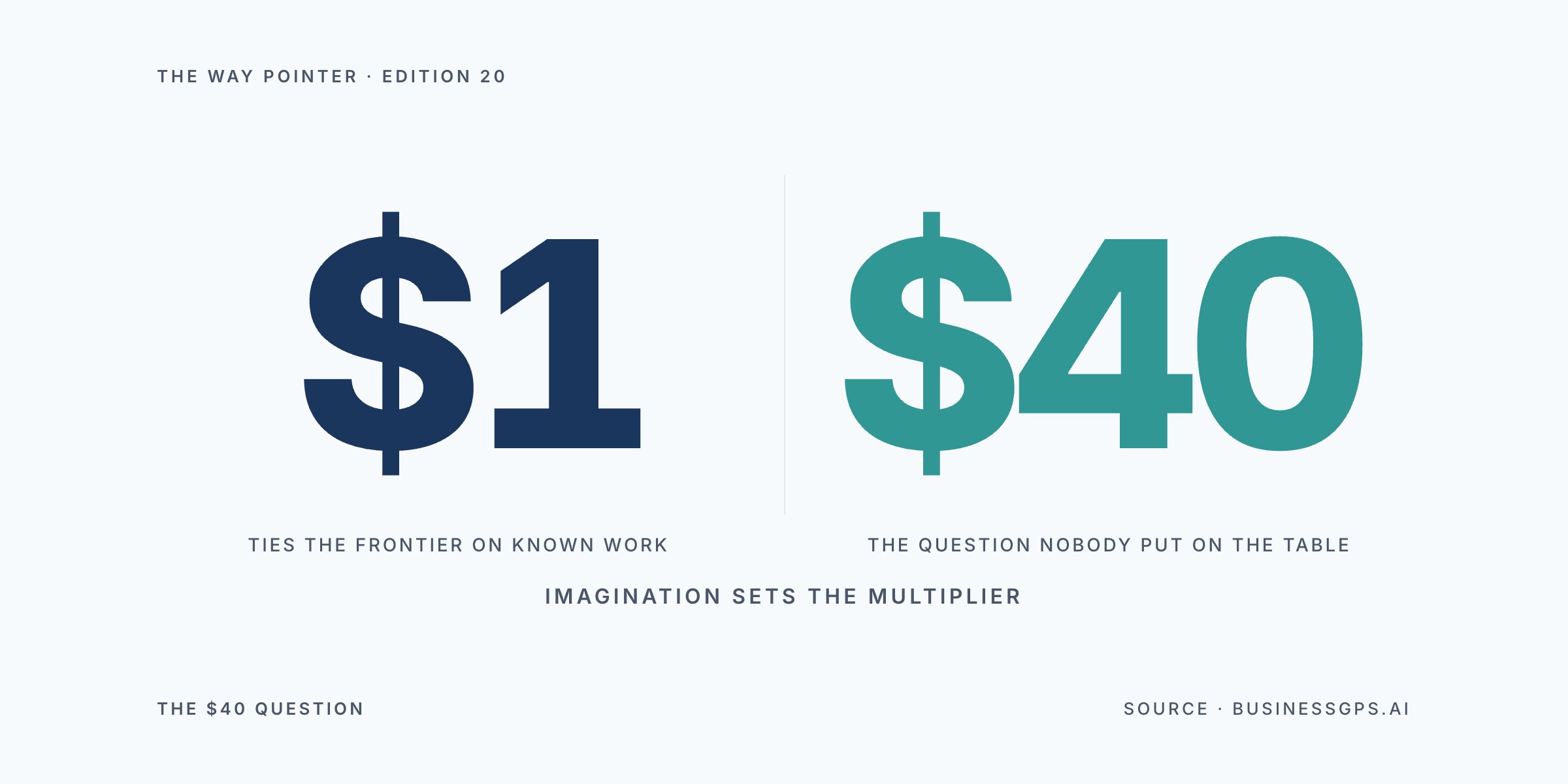
The receipt reads $40. It belongs to one engineer, for one job he assigned to himself, and it describes the only kind of advantage that survives what is about to happen to everyone else's cost structure.
Because here is the thing the market has correctly worked out and not yet finished thinking through. Routing your execution to cheap models is the right call. It is also about to be everyone's call — the playbook is public, the consultants all sell the same one, and the arithmetic is finished. That is precisely why it stops being an advantage. When every organisation runs the identical routing discipline on the identical known task list, the outputs converge along with the costs, and the savings that felt like a strategy turn out to be table stakes available to every competitor you have, at the same excellent price, indefinitely.
The question worth asking is the one the cost frame is structured never to reach: once cheap execution is universal, where does advantage come from? The honest answer is two capacities no vendor sells you. This edition names them.
The playbook everyone is about to run
The routing consensus deserves its due, because it is correct. Fable 5 was the spark that lit it — a frontier model that launched on 9 June, went dark three days later for nineteen days under US export controls, returned on 1 July, and from today is metered at roughly double the prior tier's prices.[^3] A model that can be switched off by a government and repriced by its vendor inside a single month turned every leadership meeting into the same meeting: do we actually have to pay for this, or can we route around it? The answer, for most work, is route. Plan on an expensive model, execute on a cheap one, review on an expensive one. Model triage is a real skill, and if your organisation has not learned it, learn it.
But notice what kind of knowledge this is: public, purchasable, and identical at every company that adopts it. It is real skill on its way to being a shrug — the way "we use the cloud" was a differentiator in 2012 and a baseline assumption by 2018. Execution, the running of already-imagined work through capable models, commoditises on schedule. That is what execution layers do. The interesting question was never whether to ride that curve down. It is what sits on top of it.
And the meter makes the question concrete this week. Fable 5's included-access window closed on 12 July after a backlash-driven extension, and from 13 July — the day this publishes — frontier access is metered credits only, at $10 per million input tokens and $50 per million output, capped at $2,000 a day, with restoration to subscriptions promised only "as capacity allows."[^3] Metered thinking is no longer an incident. It is a pricing model. Which means the cost of curiosity about the frontier is now a visible line item, and what an organisation does with that line item is about to reveal a great deal about it.
The $40 question
The best evidence we have seen came from Mitchell Hashimoto, who spent the days after the Fable launch running frontier and budget models head-to-head on ordinary "implement this feature" work.[^2] All three produced acceptable output. The budget model finished in minutes for under a dollar; the mid-tier ran about $1.50; the frontier model churned for forty minutes and cost roughly $9. Nine dollars against one, for the same work. Read in isolation — and almost everyone read it in isolation — that makes the frontier model look like a luxury tax.
Then he ran a second experiment that drew a fraction of the attention. He handed the frontier model a problem the cheaper ones could not touch: optimising a layout resolver he had written himself, deep specialised work on his own code. Two hours and about $40 later, it had reached a level of performance that Hashimoto, one of the stronger systems engineers of his generation, says he could not have reached himself.
The question that matters about that second result is not about the model. It is: who assigned the task? No router did. No triage policy, no backlog, no sprint. Until Hashimoto posed it, the task did not exist — it was a suspicion, held by one person with deep technical context, that something had just become possible, plus a willingness to spend $40 finding out. This is the framing Nate B Jones has put on it, and it is the sharpest single lens on the whole moment: a routing table can only allocate work you have already imagined.[^1] It takes a known task and assigns it to the cheapest model that handles it reliably, and it does that well. What it cannot do is add a row to the table. The new rows are where the advantage lives, because the new rows are the only place competition has not arrived yet.
This is the first of the two capacities, and Nate B Jones calls it technical imagination. It is not a gift and it is not vision-deck material. It is contact. Hashimoto could pose the $40 question because he has hundreds of hours inside these models and knew, at the level of instinct, where the capability line had just moved. You cannot imagine with capabilities you have not touched, and nobody has ever imagined a use for a tool they know only from a benchmark summary. Which is exactly why the meter starting this week matters beyond the invoice: most organisations have delegated direct contact with frontier models to the people whose mandate is reducing spend, so the entire sensing apparatus for "what just became possible" now reports up through a lens built to ask "what can we do cheaper." A telescope pointed at the ground. Answer the meter with a cost-justification form for frontier access, and you have — in one reasonable-looking policy — defunded your own ability to discover what the model is for.
The half nobody budgets
Contact gets you the questions. It does not get you an organisation that can absorb the answers, and that is the second capacity — the one that appears in no cost conversation we have seen.
The launch-week story everyone repeated was that Stripe ran a migration across a fifty-million-line codebase in a day, against a manual estimate of two-plus months.[^5] The impressive number is "a day." The important number is the years. That migration landed because Stripe had spent years building test coverage that could verify fifty million changed lines, review infrastructure that could move at that speed, and teams that knew how to drive the model through the work. The model deleted two months of typing; the coordination cost had been engineered away in advance, by people, long before the model existed. Point the same model at a codebase with thin tests and a review culture built on heroics and you do not get a one-day migration. You get a fifty-million-line change nobody can approve.
Nate B Jones calls this organizational imagination, and the word "redesign" earns its keep only if you walk through what it actually touches. Judgment: when a model produces two months of output in a day, the constraint moves to whoever must decide the output is right — usually the same senior people who were already the bottleneck. Context: a model can only work with what it can see, and in most organisations the context needed to pose a good question is split across six teams, two wikis, and one person who is on leave. Coordination: when execution speeds up tenfold, every handoff that used to hide inside a two-week cycle becomes the longest pole in the tent. None of this is AI work. All of it determines whether the AI is worth anything.
The reflex at this point is to hire the capacity — one visionary, a head of AI innovation, problem solved. It is the most natural move available and it is a category error, and the last technological transition of this size shows why. When factories electrified a century ago, the technology worked on day one and the productivity payoff took decades, because factories kept their steam-era layout and simply bolted an electric motor where the steam engine used to be.[^9] The gains arrived only when a generation of managers redesigned the factory itself around what cheap, distributed power made possible. The unit of change was never the motor. It was the building. A single visionary hire is the motor bolted to the old drive shaft: they bring imagination and none of your context; the people who hold the context have no contact hours and no permission. The pair is the unit. Either half alone burns money in its own signature way — technical imagination without the organisational half produces a skunkworks of prototypes the business cannot operationalise; organisational imagination without the technical half produces reorg theatre architected around capabilities its architects have never personally used.
What the week proved, in both directions
Two events this fortnight bracket the argument, one in each direction.
The positive proof is Bridgewater. Working with Thinking Machines Labs, it fine-tuned an open model — one described as nowhere near the frontier — on financial-document tasks, and, per the vendors' own published benchmark, beat heavily prompt-engineered frontier models at twelve to twenty times lower cost.[^4] Take the figures as the vendors' claim rather than an independent result, and the direction still holds: an organisation that could run the loop itself turned a commodity model into a proprietary edge. The model was not the multiplier. The capability to operate it was.
The negative proof is louder and better-named. Meta's Mark Zuckerberg told staff on 2 July that AI-agent development "had not accelerated in the way" executives had anticipated and that the reorganisation's benefits "hadn't come to fruition yet."[^6] Walmart is reported to have capped employee use of its own agent when demand outran the inference budget; Salesforce is reported to have reset its Agentforce division.[^7] Gartner expects more than 40% of agentic-AI projects to be cancelled by the end of 2027.[^8] These are not stories about weak models. They are stories about organisations that deployed before the organizational imagination existed — that reorganised first and built the judgment, context, and coordination second, or not at all. The best-resourced adopters in the world are hitting the layer nobody sells.
Read together, the two proofs say the same thing from opposite ends: the value has moved above the model, into the two imaginations, and it can only be built — not bought, not routed to, not hired as a line item.
The only assets that appreciate
This is the sequel to last week's argument, and it closes the loop. Tokenmaxxing named the trap of renting the layer that produces value. This week names what the owned layer actually is. It is not the weights and it is not the routing logic — those churn, and the price war will hand your competitors the same cheap tokens on the same day it hands them to you. What compounds is the standing capacity to see what just became possible and the organisation redesigned to absorb it. Models churn. Prices churn. The two imaginations are the only assets in the entire conversation that appreciate, and they accumulate on your side of the ledger rather than the vendor's.
That is the capability worth owning: not access to intelligence, but the operating command to pose the questions intelligence cannot generate on its own and to land the answers when they come back. Everything else is a lease.
Your Waypoint
One question. One meeting. Then three follow-through moves.
In your next leadership meeting, put Nate B Jones's diagnostic on the table and let the silence do the work: who here is allowed to pose a $40 question today — to spend $40 finding out what just became possible — without asking permission? If the honest answer is "nobody," you have found your constraint, and it was never the model's price. It was the distance your organisation has engineered between the people with context and the permission to act on it.
Then convert the silence into structure with three moves, none of which requires a budget cycle:
Name the budget. Set a standing, no-questions allowance for frontier experiments — a figure small enough that a speculative failure costs nothing and large enough that a real question can be answered. The point is not the money. It is removing the approval that kills the question before anyone asks it.
Name the checkable backlog. Technical imagination is worth little if the answers cannot be verified cheaply. Identify the work where a cheap checker already exists — a test suite, a review gate, a reconciliation — because that is where extra attempts convert to results and where a $40 question pays back fastest. Where you have no checker, building one is the higher-order investment.
Name the owner. Put the contact hours where the domain context already lives, not in a distant innovation office. The person who understands the claims process, the supply chain, the close, is the person whose $40 question is worth funding. Give them the model, the allowance, and the standing permission — and hold the redesign of judgment, context, and coordination as an explicit piece of work, not a slide.
The routing table knows exactly what to do with the work everyone has already imagined, and so does every competitor you have. What it cannot know — the only proprietary thing left in the whole stack — is what you have not asked yet.
The full reading of this week's routing signals, the Bridgewater proof, and the walk-back wave is in The Capability Brief — Edition 16. The predecessor to this argument is Tokenmaxxing — and the Trap Karp Isn't Naming. The full intelligence archive sits at the intelligence hub.
References
[^1]: Nate B Jones — "Beyond Model Routing" (Executive Briefing, imagination x execution), 5 July 2026. The "$40 question" framing, the technical-imagination and organizational-imagination distinction, the routing-table-can-only-allocate-imagined-work argument, and the diagnostic "who here is allowed to pose a $40 question today, without asking?" are attributed to this analysis. Practitioner commentary; carried as the argument being made, not as independently verified claims.
[^2]: Mitchell Hashimoto (co-founder, HashiCorp) — head-to-head model testing following the Fable 5 launch, reported through practitioner networks late June–early July 2026. Routine "implement this feature" work converged across a sub-dollar budget-model run, a roughly $1.50 mid-tier run, and a roughly $9 frontier run (about forty minutes); a subsequent self-assigned optimisation of a SwiftUI layout resolver in his own code ran approximately two hours at about $40. Reported figures; attributed as Hashimoto's own experiments, not independently verified.
[^3]: Fable 5 (Anthropic) — launched 9 June 2026; suspended 12 June–1 July (19 days) under US export controls; restored 1 July as included subscription access; included access closed 12 July following a backlash-driven extension from the original 7 July cutoff; metered usage credits begin 13 July 2026 at $10 per million input tokens and $50 per million output tokens — roughly double the prior tier's rates — capped at $2,000 per day, with restoration to subscriptions promised "as capacity allows" and no date given. Reported and vendor-stated; terms remain unilaterally changeable at time of writing.
[^4]: Thinking Machines Labs × Bridgewater — a fine-tune of an open model (Qwen 3 235B, described as nowhere near the frontier) on financial-document tasks, reported to beat heavily prompt-engineered frontier models at twelve to twenty times lower cost, per Thinking Machines Labs' own publication. Vendor-published benchmark; carried as their claim, not independently verified.
[^5]: Stripe — one-day migration across a codebase of approximately fifty million lines, cited as an Anthropic launch-customer signal. The load-bearing point is the years of test and review infrastructure that made the one-day result possible, not the single-day figure itself. Reported vendor signal; flagged as such.
[^6]: Meta — Mark Zuckerberg internal town hall, 2 July 2026: AI-agent development "had not accelerated in the way" executives anticipated; reorganisation benefits "hadn't come to fruition yet"; improvement projected in three to six months. Per TechCrunch; verified reporting.
[^7]: Walmart — reported to have capped employee use of its in-house agent on inference economics. Salesforce — reported to have reset its Agentforce division. Both carried as reported through secondary coverage, not primary-verified.
[^8]: Gartner — estimate that more than 40% of agentic-AI projects will be cancelled by end of 2027. Directional; Gartner estimate, carried as the argument being made.
[^9]: Electrification productivity lag — the decades-long gap between factory electrification and its productivity payoff, per the economic-history literature on general-purpose technologies (Paul David's work on the dynamo). Established scholarship; used here as analogy.
[^10]: BusinessGPS, Tokenmaxxing — and the Trap Karp Isn't Naming, The Way Pointer — Edition 19, 6 July 2026 (direct predecessor); The Capability Brief — Edition 16 and SAP Compass — Edition 10, 13 July 2026 (companion intelligence editions).
The Way Pointer is published by BusinessGPS — the transformation capability platform helping organisations make strategic choices about what they build, what they buy, and what they own.