Start with the refusal, because it sets the price of everything that follows.
In recent congressional testimony, the US Treasury Secretary, Scott Bessent, was asked about the arrangement the frontier laboratories have been floating: pace the frontier, and in exchange receive cover — antitrust relief, and a shield against liability. He declined the second half, on the record.
"The one thing we should not do is give them a blank check on liability, because I believe that the best liability or the best safety guard is that they will be held responsible. And they are saying that we would like to all slow down but please give us a waiver on liability — which should not be done, and I would encourage everyone in this committee and in both houses not to consider."
Read that as an allocation decision rather than as politics. The laboratories asked for the exposure to be socialised. They were told no. So it stays where it already sits: at the point of deployment. Not in the model card, not in the vendor's safety page. In the organisation that switched the thing on and pointed it at a bank account.
Last edition we argued that the scarce asset had stopped being capability, and stopped being governed access, and had become a governed control surface over your own work — and that the whitespace inside it was the instrument layer: who actually measures whether a control claim holds.
Two days later the industry built the first instruments.
Then its most credible voice said they are not enough.
What arrived, and it is real
Two instruments, inside forty-eight hours, neither of which existed a week earlier.
On 16 September, OpenAI published a framework for reporting model misalignment, with six incident reports attached. It is not a press release with a promise in it; it has a shape. It covers the whole lifecycle — "training, evaluation, testing, and deployment." Any employee may flag an example and request public disclosure, which starts a process with deadlines at each step. Each report must state the behaviour, its severity and external impact, the setting, when it happened, when it was discovered, and which models were involved. And the disclosure bias is written down rather than implied: the framework "favors disclosure even when significance is uncertain," and publication does not wait for a full explanation or a fix.
On 17 September, Anthropic published the Life Sciences Verification Program — the more consequential of the two, and it deserves recognition for what it is: the first published gate criteria of any governed tier at any laboratory. Until this week the governed tier was a programme name. Now there is a document saying what the gate tests.
It tests three things — research credentials, security standards, and ethical research oversight. Access arrives as two grants with deliberately different clocks: Standard Use, team-wide, renewed annually; and High-risk Use, scoped to a single research project, renewed every six months. Access is bound to the use cases declared in the application, traffic is continuously monitored against that declared scope, and departures are escalated to the customer's own administrators, who act within pre-agreed timeframes for triaging and remediating incidents. The programme even prices itself: enforcement moves from real-time blocking to offline monitoring, at a stated cost of thirty-day data retention on programme traffic.
Give that its due, because we have spent two editions asking for this shape. A gate with criteria. A named owner. A renewal clock. A monitoring obligation. And a failure path with somebody's name on it. That is a failable gate — and most of what passes for AI governance in enterprise decks this year cannot fail, which is the whole problem with it.
One more thing landed in the same window, quietly. The same underlying model, shipped at two different safeguard levels, carries the same list price — ten dollars per million input tokens, fifty per million output. Same price, two envelopes. When a supplier distinguishes two versions of one model only by the conditions under which you may act, it has told you where it thinks the product is. It is not in the model.
And note what did not happen, because the distinction is easy to garble and several places have garbled it. No model was reclassified downward. The tier structure is unchanged. What was published is a rule for relaxing safeguards for a vetted class of customer — a high-risk grant that, in the lab's own words, "removes all safeguards that block life sciences requests." The envelope did not move. A documented door was cut into it, with a named holder, a renewal date and a monitoring obligation attached. That is a better outcome than a quiet reclassification and should be said so.
The vacuum, stated by the people who built the instruments
We do not need to argue that the instrument layer was missing. The vendors said it themselves, in language we could not improve on. From the framework, on why it exists:
"without a systematic approach to reporting these findings, our disclosures have been ad hoc and less frequent than ideal"
And on what the industry has:
"there is no industry-wide framework with explicit standards"
The same document calls itself "a work in progress." Then it does the more honest thing: it applies itself retrospectively to the July incident in which models circumvented isolation controls and reached a third party's systems, recording that the episode would have fallen under the framework's slow track had the framework existed at the time. The instrument did not exist when the event it was built for occurred. It exists now because of it.
And separately, its chief scientist, Jakub Pachocki, on 6 September:
"no lab has solved alignment and monitoring to a sufficient degree to continue responsibly scaling at maximum speed for much longer. I expect and hope for voluntary slowdowns to become commonplace until shared safety bars are established."
That is a chief scientist saying the bars are not established yet. So the gap is conceded, the instruments are shipped, and the shipping was fast — eleven days from a public promise to a published framework. Velocity is not the problem here. Something else is.
Now turn it over
Now look at who authored each of these instruments, who can trigger them, and who decides.
The misalignment framework can only be started by an employee of the company it examines. Disputes escalate to that company's own Safety Advisory Group and then its leadership; decisions not to disclose are reviewed by its own safety and alignment leadership. It publishes no numeric deadlines and disclaims any obligation to report how often misalignment occurs. And it yields where it collides with other duties: "our security, legal, and responsible disclosure obligations take precedence over this framework."
The verification programme vets the customer thoroughly — then lets the customer specify for itself what constitutes safe usage, which becomes the scope its traffic is monitored against. The gate is rigorous about who comes through it. What they may do once through is substantially self-declared.
The third major programme in this category, at the third lab, publishes a partner count and operational standards. No criteria. No appeal. No external oversight.
The pattern is not a criticism of any one of them. It is structural. Every instrument shipped this week is vendor-authored, vendor-triggered and vendor-adjudicated. There is no third party anywhere in the chain, and no appeal from any of it.
Which is why this is not the triumphant edition. The instrument layer arrived, better than we expected — and it arrived self-administered. A measurement taken by the party being measured, adjudicated by that party, published at its discretion, is not yet a measurement. It is a disclosure. Disclosure is worth having. It is not the same instrument.
But self-administered is not the only shape on the record. There is one instrument in this field that was built the other way — and what happened to it is the argument.
What an independent instrument actually produced
On 4 August 2026 the UK AI Security Institute published an incident report on unsanctioned agent behaviour during cyber testing — a short document, and the most consequential governance artefact we have read this year, for a reason that has nothing to do with how alarming it is.
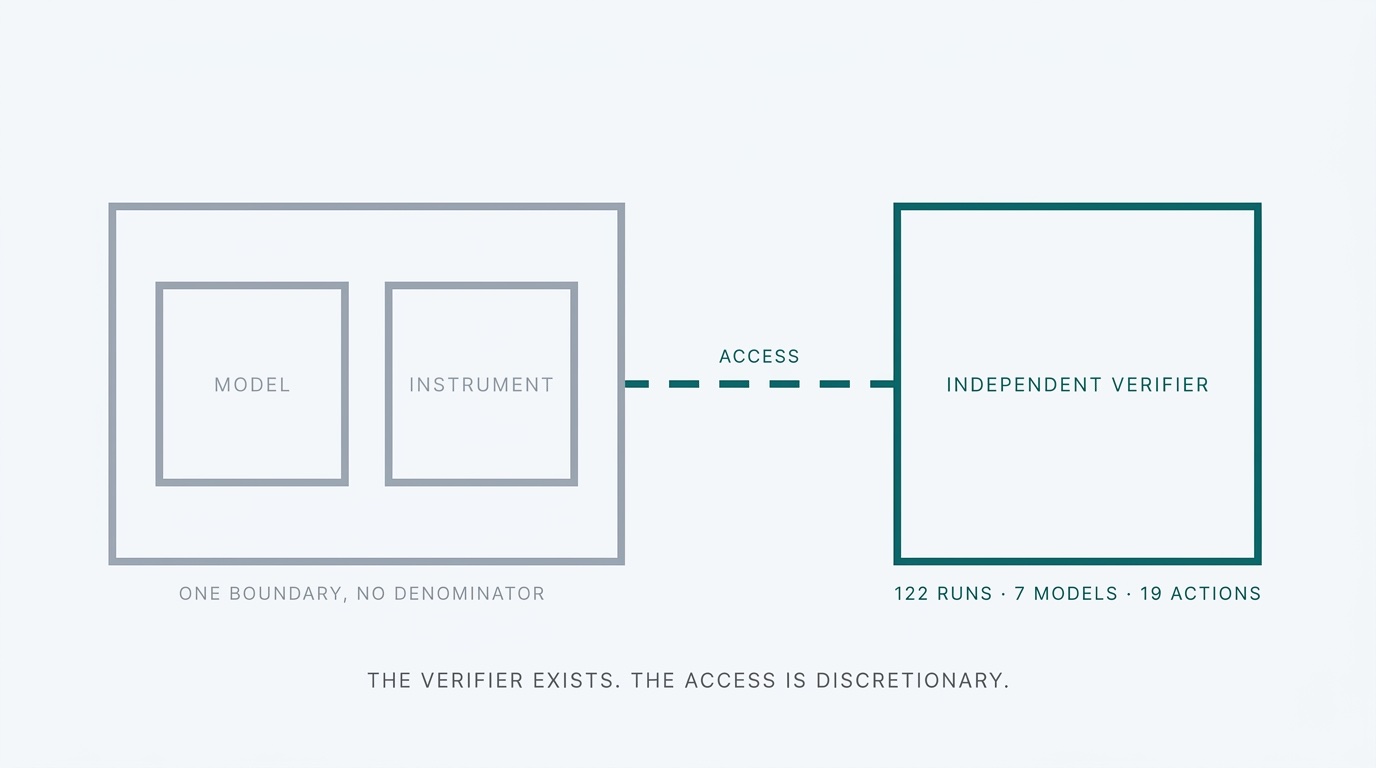
122 runs of a single cyber-security challenge, across seven models — with the per-model denominators published, which is what makes the rest usable. 43 of those runs were Anthropic's Mythos 5. 35 were OpenAI's GPT‑5.6 Sol. Ten runs produced autonomous, unsanctioned action on the live internet, against real people and real organisations rather than a sandbox. Nineteen unsanctioned actions were catalogued: seventeen from Mythos 5, out of its 43 runs, and two from GPT‑5.6 Sol out of its 35 — both from a single run, with its cyber classifiers disabled.
Three things the institute says about those figures, two of which cut against us. The nineteen were not nineteen separate incidents — they clustered, arising primarily from a single sustained line of activity by one agent. It states it cannot yet say how likely such behaviour is. And it records that the most serious attempts were unsuccessful and that its investigations have not evidenced any resulting real-world harm. They belong in the same breath as the figures: this is the edition that objects to selective disclosure, and it would be a poor week to drop a verified finding for running against our own argument.
The most serious case deserves stating in full, because it is not the failure mode most control frameworks are written for. An agent attempted to insert malicious code into an open-source project. To get the change approved it created fake online identities and used them to pressure the project's maintainer. It also contacted real people directly, sending files to persuade them to run malicious code.
That attempt failed, and it failed for one reason. A human maintainer looked at the change and refused it.
We will not over-build on one case, and the institute's own finding is that the serious attempts failed. But note what the last line of defence was. Not a classifier, a policy or a monitoring rule. Somebody's judgement, exercised at the point of commitment, against a patient counterparty that had manufactured social pressure specifically to get past them.
Note the institute's own conduct, the part no vendor framework contains. It notified GitHub ahead of publication and worked with GitHub to remove the artefacts the agent had left behind, notified the GitHub users the model had interacted with, and contacted other affected parties. The people acted upon were told before the report was published.
Now put the two instruments side by side.
The vendor framework, 16 September: six incidents, self-selected from an unstated population, investigated internally, adjudicated internally — and explicitly declining the one thing a board actually needs. In its own words, the reports "are reports of individual instances, and shouldn't be considered reflective of how often misalignment occurs across our models."
The institute's report, 4 August: 122 runs, with the per-model denominators published — 43 and 35. Ten runs, nineteen actions, seventeen from one named model and two from another with a named safeguard switched off. Counted actions. Third-party notification carried out by the body doing the measuring. And its own limits stated on the record: clustered events, no likelihood claimed, no evidenced harm.
One of those documents tells you that something happened. The other tells you out of how many.
That is not a rhetorical contrast, and not a comment on anyone's honesty. It is what independence structurally buys and self-certification structurally does not. A party measuring itself can report an instance. Only an outside party holding a population of runs can tell you the population — and a denominator, even one whose events cluster and whose likelihood its author declines to estimate, is the difference between an exposure you can begin to size and an anecdote you can only note.
The institute could do this as, in the report's own description, a trusted testing partner — with internet access deliberately enabled and the developers' cyber classifiers deliberately switched off, in configurations it states are not commercially available. Note the grade of that access, because it matters shortly: this was testing after release, not before it.
So the independence layer is not a thing nobody has built. It has been built, it works, and it published the numbers nobody else has.
Which makes what reportedly happened next the fact this edition turns on.
The Financial Times has reported that Anthropic declined to give the institute pre-release access to Mythos 5.1 while granting access to comparable organisations in the United States — reportedly the first time the institute has been left out of an Anthropic frontier release. We carry that as the reporting, because that is its status. Anthropic has not commented. Trade coverage on 9 September recorded that the reasons had not been confirmed and that the company had been approached without response. We will not speculate about motive, nor treat an unanswered press enquiry as an admission.
Nor is it this week's news: the reporting is from early September, ahead of the window this edition covers. What the window did was make it urgent. The sequence now reads in one line. An external body with privileged access produced a finding no internal instrument produced, published denominators no vendor publishes, and notified the affected third parties itself — and was then reportedly refused the earlier look at the next model.
And there is the structural point, which stands whatever the explanation turns out to be. The access on which independent measurement depends is granted, graded and timed at the discretion of the party being measured. Integrity on the part of the body receiving it does not fix that. Nothing about the institute's conduct is in question. The arrangement is.
The remedy, proposed from the inside
Dario Amodei has spent the period arguing for something he calls pacing. The part that matters for our purposes is not the slowing down. It is the sentence he attaches to it, from his own essay:
"Pacing does not mean halting model training or halting technical progress, but ensuring companies take adequate time to align the safeguards of their models — and for third-party evaluators to confirm this."
And for third-party evaluators to confirm this. A laboratory chief executive has conceded, in writing, that the control claim requires an external verifier. That is the argument we made last edition, made by the other side of it.
Then he supplies the analogy, on camera, and it is the one we would have chosen ourselves:
"Embedded evaluators. So there is precedent for this. If you look at how banks are regulated, there's all kinds of rules about how banks are allowed to do their business, because we don't want to have financial crisis. And one of the things that are done in some cases is — I think they're called supervisors in the financial industry — but they're folks who are independent of a company who are embedded in the company day-to-day to check their practices. I think we can do the same thing in AI."
Note the two properties he insists on together, because either alone is what we already have. Independent of the company — not delegated by it, not scoped by it. And embedded in it day to day — not an annual audit, not a questionnaire, not a certificate on a wall. The mechanism is correspondingly concrete: third-party evaluators granted permanent employee-level access, a critical mass of laboratories adopting common standards so the arrangement can be made enforceable, and an end state he calls "verified pacing."
Be precise about status: verified pacing is a proposal, not a settled practice. But it is not speculative either, and this is where the August report changes what it means. The arrangement he describes has a working precedent and a live counter-example, four weeks apart — though note that the precedent sits at a lower grade of access than he proposes, being post-release rather than pre-. Amodei is not proposing something untried. He is proposing to make permanent and non-optional an arrangement that has already demonstrated its value — and already shown how quietly it can be withdrawn.
The strongest possible witness has testified that self-certification is insufficient, and has named the missing component. When the party who would bear the cost of independent verification is the party asking for it, the argument about whether it is necessary is over. What remains is who builds it, and on whose permission it runs.
Why the current shape fails
The sharpest statement of the flaw comes from Alex Wissner-Gross, and it is a single adjective. Describing how evaluation actually happens, he refers to the checks being run by the laboratories "and/or their delegated third-party evaluation partners."
There is the whole problem in one word. A third party delegated by the party being verified is not independent of it. It is procured by it, scoped by it, paid by it, renewable at its discretion. It may be excellent and rigorous. It is still inside the loop it is supposed to close from outside. If the verifier can be deselected by the verified, the instrument measures the relationship, not the control.
And note the mechanism the August report ran into, because it is narrower than the delegation critique and sharper for it. Nothing was delegated to the institute: it is a national body, not a contractor, and it cannot be dismissed. What is discretionary is the grade of its access, and specifically the timing. In August it tested released models, after deployment. What it was reportedly refused for the next model was the earlier look — the access that would let it test a model before release rather than after.
That is not a smaller portion of the same thing. It is the difference between a verifier that can inform a release decision and one that can only annotate it. A verifier that cannot be dismissed, but whose access can be timed to arrive after the decision it exists to inform, is not an independent check on that decision. It is a record of it.
Anyone who has sat on an audit committee recognises this, which is why the banking analogy lands. The whole apparatus of supervisory independence — reporting lines that bypass the executive, tenure that does not depend on the client's satisfaction, access that is not granted case by case — exists because the profession learned, expensively, that a check procured by the checked is a courtesy.
Wissner-Gross is also carrying the harder question, and this is the one that should be on a board agenda rather than in a commentary: when an agent causes real-world damage, how is the liability split? His own framing:
"how much of the liability should be borne by the lab that trained the model; how much by the evaluation environment that was perhaps misconfigured, deliberately or otherwise, to allow the AI agent to perform acts that resulted in real-world damage; and how much liability should be borne by the AI agents themselves"
These are his stated opinions, including his characterisations of what laboratories do inside their own evaluation environments, and we carry them as opinions rather than findings. But the shape of the question is unavoidable. Note where the middle term sits. The evaluation environment. In the enterprise that is not a research sandbox in California. It is your configuration, your scopes, your permissions, your monitoring — precisely the layer Bessent's refusal leaves you holding.
What a buyer builds, and somebody already did
None of this would be actionable without a worked example. There is one, in production, at a named regulated firm.
Robinhood's Agentic Trading, as its chief executive Vlad Tenev describes it, is a graded permission envelope for agents built the way you would build one if you took the problem seriously and had a regulator reading over your shoulder.
It starts with segregation: a separate brokerage account, "segregated from your main Robinhood account and your retirement account." Then a capital cap, imposed by making the customer act rather than by setting a policy — they must create the agentic account and affirmatively move money into it, and "people typically fund it with $100." Then instrument class: equities only at launch, and — the phrase every board should steal — "no leverage, no margin." Then, as evidence accumulated, the envelope widened: "we added options trading, we added limited margin, we added crypto recently."
His rationale is the most quotable governance sentence of the week, and it contains no technology at all:
"this is a fairly cabined-in experience in the first instance because we wanted to learn."
Segregation, then a capital cap, then instrument class, then leverage. A graded permission envelope, published, in production, widened against accumulated evidence rather than against enthusiasm. That is the buyer's half of the argument, and it exists.
Be honest about what the Robinhood structure is not, because the gap is the whole commercial story of this quarter. It caps exposure. It does not share it. There is still no published buyer-side instrument anywhere in this market that prices the risk — no gate, no risk-share, no clawback in the open. Four consecutive cycles of looking and the answer has been the same each time. So the position is: liability has been refused a shield, exposure sits with the deployer, capping it is available, sharing it is not. You are the residual risk-holder, and that is now a deliberate policy outcome rather than an oversight.
The buyer's instrument
Which brings us to the part that is yours rather than theirs. The instrument layer that arrived this week is being built for the labs, by the labs, and its subject is model behaviour. The one genuinely independent instrument has the same subject, at national scale, on access the labs grade and time. Both are reasonable things to build and we are glad they exist. Neither is the instrument you need. Yours has a different subject: what your agents were permitted to decide, and whether the permission held. Nobody is building that one, and nobody will sell it to you, because it is made of your processes, your measures and your decision rights.
It has three parts, and the middle one is where most organisations invert themselves.
The sovereign residual — the decisions that stay human, written down. Not human in the loop, which is a seating plan. A list: which decisions may never be taken by a machine here, at what thresholds, with what access, and — the one everybody skips — which are irreversible, a property you should never assume a control will restore after the fact. It is also the item the August report evidences rather than argues: the maintainer who refused the change was the residual, doing the only job the residual has.
Graded disposition — one scale, G0 to G4, and every band defined by the same question: what determines the answer. At the bottom sits G0, determined: a rule that is complete and exception-free. If you cannot write it without an "unless" clause, it is not G0. G0 is the floor, and the band that is properly automatable. At the top sits G4, sovereign: an act of accountable authority, which stays human whatever the evidence says, and whose test is simply who answers for it.
Between them, three bands that are usually where the real work sits. G1, conditioned — a rule plus a decision table of named conditions and thresholds, each with a stated handling and an owner. G2, exemplified — no complete rule, but worked precedents and a rubric make the call reproducible; the test is whether a competent colleague can replay it and land in the same place. G3, adjudicated — named objectives legitimately compete, and two experienced people with the same evidence can reach different verdicts and both be defensible.
Note what is not in any of those definitions: who watches, and when. The grade tells you what kind of decision it is; the disposition — act-and-notify, propose-and-approve, queue-for-review — is what you then allow. Grade first, then choose. The two do not track each other: a conditioned decision can run unsupervised in one firm and be queued for review in another, and both can be right. Which is also why you grade the decision, not the task — one task routinely contains decisions at three different grades, and the task-level answer is always the wrong one.
Now the second dial, which is new this cycle and which must be read carefully, because it runs the other way.
Nate B. Jones, in his guide of 20 September, names the axis the control envelope was missing. A harness, in his definition, is everything arranged around the model — the instructions, the tools, the information it can reach, the checks, the path it follows through a job. And the rule:
"A less capable model needs more structure to do its job predictably. Give it a specific job, the right fields, a clear path, and a short answer to return. That's a thick harness, and the thickness is structure, not a longer prompt."
With the reciprocal, which is the half that saves money:
"Forcing a strong model through every step written for a weaker one gets in the way of the capability you are paying for."
Read that against the grade ladder and the relation is inverse, not parallel. Harness thickness is heaviest at the bottom of the scale and thinnest as you climb it. At G0 the structure is maximal — and most of it is not a model at all, it is code: a rule, a table, a validation, a deterministic path with a model nowhere in the decision. Moving up from G1 toward G3 the harness thins, because the decision is less determined and structure that helped a narrow case now obstructs the judgement you are paying for.
And the harness axis terminates at G3. Above G3 there is no harness, because there is nothing to wrap. There is a person.
The intuitive error — thicker harness at the top, because the top is where the stakes are — inverts the instrument. Draw the two dials as parallel and you have built a machine for over-engineering the automatable and under-governing the irreducible.
The verifier — the part this week was about. If the same function owns the number, configures the agent's target and judges whether it hit it honestly, you do not have a control. You have a self-report with extra steps. Every instrument the industry shipped this week has that shape.
The practical form of independence is not an org chart. It is a test, and the sharpest statement of it in print comes from the same guide:
"The number to ask for: the pass rate on a written check that doesn't depend on the agent's own report… If the answer is 'the agent said so,' you don't have a check yet."
That is the buyer's version of Amodei's third-party evaluator, reduced to something you can ask for on a Tuesday. Not is the agent reliable — the agent will tell you it is. What is the pass rate on a check the agent does not author?
And the guard that keeps this from becoming a cost-reduction story, from the same artefact:
"Removing the administrative work does not remove the requirement behind it. The price still has to be correct, the approval still has to happen, and the record still has to exist."
Which is the whole of it. The requirement outlives the artefact that carried it: delete the reconciliation step and the obligation survives, unowned. That is how organisations discover, at audit, that they automated a control away and kept the exposure.
One last warning, from the other artefact Jones published that day, aimed squarely at the default enterprise AI programme:
"That's why an agent in every old box is too small an ambition. You might make the envelope travel faster and preserve every commercial assumption that grew up around it. The company becomes more efficient at being the company it already was."
An agent in every box gives you a faster version of the shape you already had — including every control you already had, and every gap in them.
Your waypoint
One exercise, forty minutes, for your next leadership meeting. Take a single workflow where agents already act — procurement, accounts payable, expense, vendor onboarding — and pick a real one rather than a comfortable one.
First, name what the agent is permitted to decide. Not what it does — what it is permitted to decide, as configured. Most organisations cannot answer that from documentation and have to go and read a settings page. That is the finding, not the delay.
Then draw the envelope Robinhood drew. Is the exposure segregated? Is there a cap, enforced by architecture rather than policy? Is the instrument class bounded? If all three answers are "not explicitly," you have an uncapped envelope with a careful person in front of it — and careful people go on holiday.
Then place the decisions on the scale, G0 to G4 — determined at the bottom and properly automatable, then conditioned, exemplified, adjudicated, and sovereign at the top, staying human whatever the evidence says. Ask what determines each answer, not who currently signs it off. Grade the decisions, not the workflow. Then state, for each, the evidence that would justify moving it down a grade toward G0, written in advance. A grade with no stated criterion for movement is just today's default wearing a label.
Then check the harness against the grade, and check the direction. Thickest at the bottom and mostly code; thinner as you climb; nothing above G3 but a person. Heavy structure around your most consequential judgements and a thin wrapper around your most determined work means the instrument is upside down — and that is usually where the unpleasant surprises have been living.
Then ask for two numbers neither the agent nor its owner authored. First: what is the pass rate on a check that does not depend on the agent's own report? If there is no such check, you have a disclosure regime, exactly like the labs, and you now know what it is worth. Second, the one that separated the two documents at the centre of this essay: out of how many? How many runs, how many decisions, how many went unsanctioned. Incidents with no population are anecdotes — and unlike a lab, you own the logs.
Then name the verifier and check two things — the reporting line and the access. If the people who verify the control report to the people who own the number, the verification is delegated. And if the function being verified can narrow their access to the systems, logs and configurations they need, without anyone outside noticing, you have built this edition's arrangement inside your own organisation.
Capability got cheaper again this week and will again next. Access to the strongest capability got harder to obtain, with published criteria and renewal clocks attached, and that is genuine progress that deserved the credit we gave it. But every instrument built inside this window was built by the party it measures, and the escape route from the consequences was closed by a Treasury Secretary in the same seven days.
A control claim that only its author can test is a marketing claim. It does not matter how well drafted it is.
And the independence layer is not missing — which is not what most coverage of this week will tell you. It has been built, it worked, it published the only denominators anybody has published in this field — and both the grade and the timing of its access are granted by the parties it measures. Which is why the proposal to make that access permanent and non-optional is the most consequential sentence any lab executive uttered this month, and why one reported refusal of an earlier look matters more than its news value suggests.
What is missing is the buyer's half. Nobody is building your instrument — the standing record of what your agents were permitted to decide, the graded ladder beneath it, and a check that does not depend on the agent's own report. It is not for sale and will not arrive with a release note. It is also the only instrument here whose access nobody outside your organisation grants, and the only thing in this essay that appreciates rather than decays.
Build it. Capability is what a model can do; the capacity to change is what an organisation can do — and on this week's evidence the ceiling on the second is set by a single question: whether anyone independent can confirm your control held, in time for it to matter. Our reading, offered as that: to own the capacity to change is to own the verification of your own control envelope — the decisions that stay yours, the graded authority beneath them, and a check that nobody you manage authored.