Last week, in this space, we named a risk: the substrate you do not control can be switched off, and the depth of your integration is the depth of your exposure, not your protection. We named it from the cleanest evidence the argument had ever had — a model-layer cut-off by a government, a data-layer enforcement by a vendor, both in a single week. The honest expectation was that the model-layer outage would reverse quickly, the news cycle would move on, and the lesson would have to be carried on the strength of the structure alone.
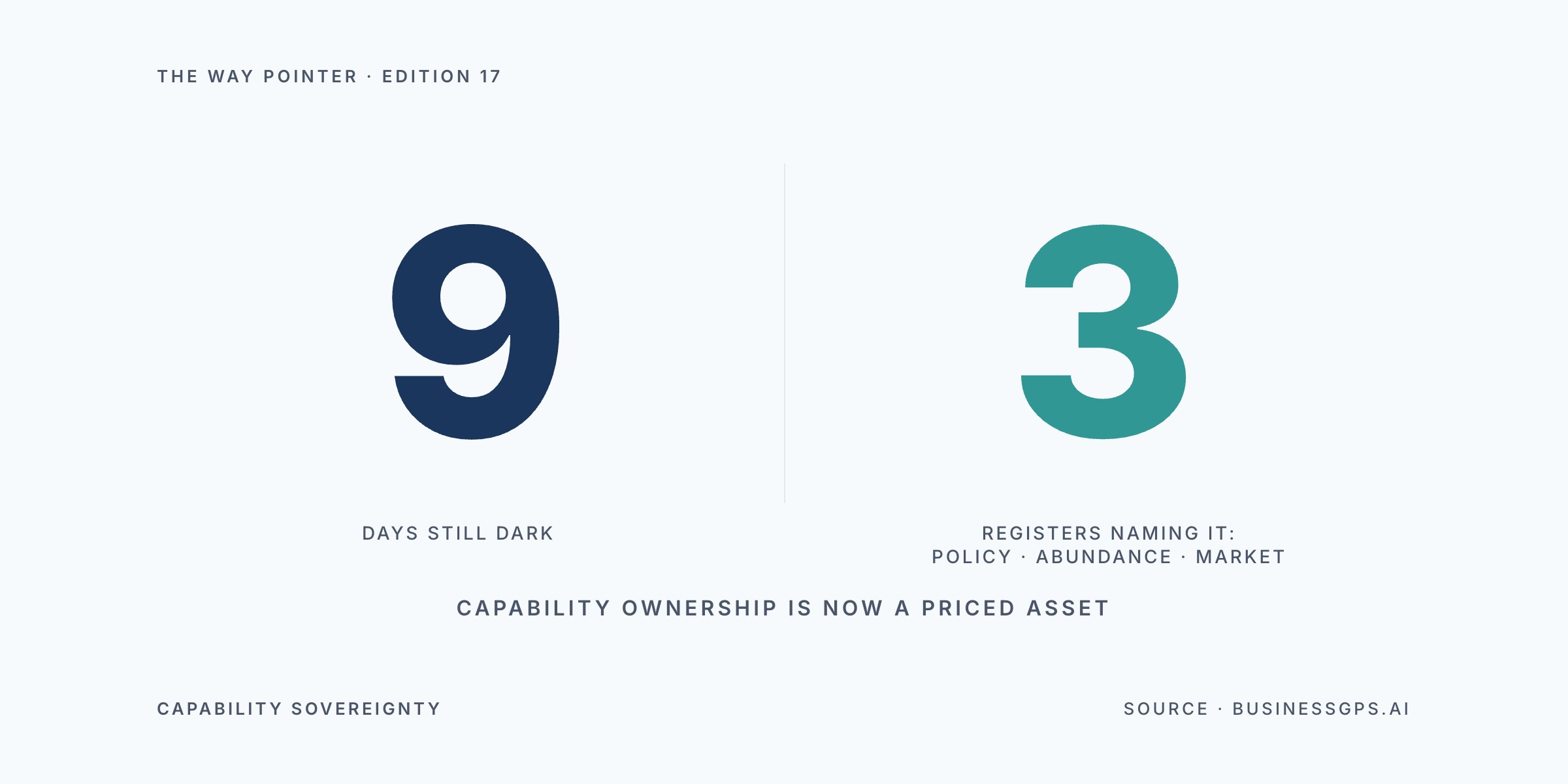
That is not what happened. In the seven days since, the story moved twice. The cut-off did not reverse — nine days on, it is still live — and in not reversing, it stopped being an incident and became something larger: a sovereignty policy fault line. And separately, in the same week, the market put a price on the fix. The gap we have been naming for six cycles is no longer visible at one register. It is visible at three at once — policy, abundance, and market — and that is the Way Pointer view of what this week actually changed.
The off-switch did not flip back — and that is the lesson
Start with the status, held precisely, because the precision is where the lesson lives. As of 21 June — Day 9 — the U.S. export-control directive that suspended Anthropic's two most capable models on the evening of 12 June is not reversed. The directive, issued by the Commerce Department's Bureau of Industry and Security under a "deemed export" rule, barred foreign-national access; because an API cannot screen its users by nationality across shared cloud infrastructure, the only way to comply was to disable the models for everyone, worldwide. Senior staff went to Washington. A head of state met the company's chief executive at a G7 lunch on 17 June. An executive said in Seoul on 18 June that "in the coming days, the models will become available again" — a single verbal, with no confirmed date.[^1]
We write this knowing access may be restored around the time you read it, and we will say it plainly: it may. The durable lesson does not depend on the outage continuing. Last week we said the threshold for intervention proved low and unpredictable. The nine days add the other end of the same fact: the threshold for restoration is negotiated and conditional. The most credible read of the resolution path is not that a customer holds a right to the model and the right is being honoured, but that access returns when a vendor demonstrates to a government that an underlying vulnerability is resolved.[^2] For the operator, that compresses to one sentence. Frontier-model access is not infrastructure you own. It is a permission that can be revoked overnight by a party you do not transact with, and restored on terms you do not set.
Two qualifications, carried with care because accuracy matters more than momentum. First, the dispute deserves a fair hearing. Anthropic characterises the triggering jailbreak as "narrow, non-universal" — "asking the model to read a specific codebase and fix any software flaws" — argues the same capability is elicitable from a competitor's model that is not controlled, and warns that recalling a commercial model over such a finding, applied across the industry, would "essentially halt all new model deployments." We take no position on the merits. We read the structure. Second, on attribution: the jailbreak was reportedly identified by security researchers at a firm that is also an investor in and cloud partner to Anthropic. We note that dual role strictly as observed and reported — not asserted, and not a claim of conflict — and the technical finding has not been published.[^3]
From incident to fault line: the same gap, now named at the level of states
Here is what nine days did that nine hours could not. A withdrawn model became a matter of state, in more than one register, in the same window.
The European Commission, on 14 June, called the cut "a shared challenge" and warned that contingency measures "should not be discriminatory against partners" — invoking technological sovereignty at the supranational-policy level, days after presenting an AI-sovereignty legislative package that now has its proof event. A legal-policy outlet, on 15 June, called the directive "a kill switch for frontier AI" and concluded that if a government is going to treat frontier models as national-security assets it can switch on and off, the legislature "will have to step in and establish a proper framework." A Washington think-tank, on 16 June, mapped the likeliest resolution as a negotiated retraction, with one official describing export controls as "a last resort." And at the G7 on 17 June, the chief executives of three frontier labs lobbied heads of state together for "structured access to frontier models for trusted democratic partners." The jurisdictional debate went global in the same window.[^4]
We are not reporting this to take a side in it. We are pointing at its shape. For six cycles we have argued that there is a layer the whole market keeps stepping around — the question of which capabilities an organisation owns above the substrate, so that when access is withdrawn, by a vendor's policy or a state's directive, its operating system survives the cut. That question used to be ours to raise. This week it was raised at the level of the European Commission and a G7 lunch table. The lane is not named yet — no analyst has named it, for a sixth consecutive cycle — but the demand for it is now being expressed by states. The gap did not close. It got large enough that governments started arguing about its edges.
The abundance register blinked
The most telling movement of the week came from the camp least likely to make it. For a year, the abundance and exponential-organisation voices have argued "stronger model, stronger you" and urged customers to lean harder into frontier capability. Covering the cut-off directly on 17 June, the most prominent of those voices asked: "who decides what level of intelligence you and your company are allowed to access?" A roundtable participant put it more flatly — asked who owns AI, the government or the corporations, and answered, "the government is saying, we do." The same summary surfaced a call for enterprises to hold on-premises fallback models.[^5]
Read it precisely, because the precision is the point. This is not a recantation. Nobody said abundance was wrong. The framing is that abundance is real, but access to it is now a government-controlled variable — a crack in the thesis, not its collapse. But it is the first time the "stronger model, stronger you" register has named the access and sovereignty layer as a real, separate question. And the convergence is the whole story: the abundance register is now asking the question; the customer-side discipline is the answer. Stronger models do raise the value of owning the layer around them — which is precisely why the layer, not the model, is where to invest. We read this as validation at the highest-profile abundance register, not competition for the lane. The register named the question. It has not yet adopted the discipline.
The market put a price on the fix
The third register is the one that turns a thesis into an asset class. This week, the market began pricing sovereign and self-host optionality as value, and single-substrate dependence as risk.
The cleanest signal came from a pure-play sovereign vendor, whose chief AI officer reported "a huge number of inbounds" from governments and investors in the days after the cut-off — and which shipped a self-hostable, Apache-2.0, open-weight model the same week, into an enterprise base of more than a thousand organisations concentrated in financial services, healthcare, and government. That is exactly the regulated-sector profile with the most to lose when a substrate is withdrawn. Open-weight models, several priced at a fraction of a frontier model's per-token cost, are now being marketed as an "instant second source." We note the durable point and decline the claim that has travelled alongside it — that one bloc's models have "overtaken" another's on some index is single-sourced, and we leave it there. The verifiable development is narrower and more useful: self-hostable open-weight models are now sold, explicitly, as substrate-cut-off insurance.[^6]
The sharpest reminder came as collateral. A major cloud had launched the now-cut frontier model on its managed service on 9 June; three days later, customers who had just onboarded it there were cut off globally under the same directive. Hosting on a neutral cloud did not insulate them — hosting is not control. A multi-model platform repositioned its swappable, 200-plus-model offering with one line that captures the week: "single-model dependencies are no longer just a technical-debt concern. They're a compliance-continuity concern." An analyst projection now circulating with the coverage holds that 40% of enterprises will adopt explicit AI-model-jurisdiction policies by 2027.[^7]
The repricing read is this. The week converted "sovereign deployment" from a compliance feature into a demonstrated continuity asset with commercial demand attached. When a sovereign or self-host option costs more per token than a hosted frontier model, that delta is not overhead — it is continuity insurance, and the week put a premium on it that buyers are now paying. But note carefully what the market is and is not naming. It is naming the symptom — single-substrate risk — and selling the substrate fix — self-host, in-jurisdiction weights. It is not yet naming the discipline: which capabilities to own above any substrate, including a sovereign one. A second model on a second cloud is still a rented model. The decision of which capabilities must never live solely on a substrate someone else controls is the customer's, and it remains unmade by the market now selling around it.
The practitioner named the asset
The engineering-side voice arrived at the same place, in its own vocabulary, against the most pointed possible backdrop — a wave of frontier-lab public-market filings premised on the idea that intelligence is the scarce asset. The load-bearing line, published 14 June: "the hard part is not always getting a smarter model. It is making the company ready to use the intelligence it can already buy." And the asset, named directly: "that layer around the model is the harness. The model supplies intelligence. The harness supplies the company: the context, documents, permissions, review standards, memory, budgets, decision rights, and accountability." Built for a board pack: "Smarter models raise the value of the harness. They do not remove the need for one." And the warning about renting it: "if you let a vendor own that layer by default, the vendor becomes more than a model provider."[^8]
Read against the week's two proofs — a government showing the model is revocable, a market showing the alternative has a price — the convergence is exact. The model is the variable: its price is falling, its access is revocable. The harness around it — the context, the runbooks, the routing, the review gates, the decision rights — is the constant the customer owns, and the asset that survives a model being switched off. The same voice pressed the point further the same week, into a place CFOs and COOs should hear it. On maintenance: "almost nobody is maintaining them, and the ones that quietly go stale are the ones that cost you" — capability decay as an operating risk, with one platform team noted to have deleted 80% of its agent's tools and watched the agent improve. And on ownership at the individual level: if your skills are going to live outside your hands, "they should not belong to a rent-a-brain," with the failure mode named as a new "skill lock-in" in which "everyone just becomes the migration layer." That is not a named framework. It is a populated, practitioner-grade description — built bottom-up, from enterprise to operations to the individual worker — of the exact customer-side layer no vendor governance plane occupies.
This is the same diagnosis at the data layer, too. SAP's 9 June interface enforcement sits at a second consecutive quiet — the technical block confirmed operative, no analyst verdict either way, and the real second boundary a December 2026 rollback expiry rather than the June trigger. We read it calmly: a contract-review checkpoint, not a fire drill. The point was never the size of any one week's disruption. It is who can absorb it.[^9]
What this asks of you
The pace will not slow, and the cost of indecision just went up. Last week the off-switch was a risk you could name. This week it has a price — paid by the buyers now queueing for sovereign and self-host capacity, and payable later, at a worse rate, by everyone who waits for their own switching event before deciding which capabilities they cannot afford to rent. Owning the harness is no longer a philosophical preference about build-versus-rent. It is a priced asset, and the market has started quoting it.
The full cross-layer reading of this week — the nine-day fault line, the abundance concession, the market repricing, and the practitioner convergence — sits inside The Capability Brief — Edition 13 and on the intelligence page.
Your Waypoint
One workflow. One failover. This quarter.
Take the single AI-dependent workflow your organisation is closest to relying on for live, consequential work — the one that would hurt most if the model behind it went dark on a Friday evening. Do two things to it, in order.
First, separate the harness from the model. Write down, explicitly, the part that is yours — the context, the runbooks, the routing, the review gates, the decision rights, the standing owner who holds the work regardless of which model is available this week — and the part that is the vendor's: the model itself. If you cannot draw that line cleanly, that is the finding; the line is where your sovereignty begins.
Second, stand up the failover. Identify one substitute substrate you could route that workflow to — a second model, a self-hostable open-weight option, an in-jurisdiction deployment — and prove, once, that the harness runs on it. Not as a migration project. As a fire drill. The objective is not to leave your primary model; it is to own a switch of your own, so that the next time someone else reaches for theirs, your operating system stays on. The off-switch has a price now. A failover you control is how you stop paying it under duress.
References
[^1]: U.S. Commerce Department / Bureau of Industry and Security export-control directive suspending Anthropic's Mythos 5 and Fable 5 for foreign nationals under a "deemed export" rule, 12 June 2026; because an API cannot screen users by nationality across shared cloud infrastructure, both models were disabled globally for all customers. Status as of 21 June 2026 (Day 9): not reversed. G7 AI lunch, Évian-les-Bains, 17 June 2026. Chris Ciauri (Anthropic MD International), Seoul, 18 June 2026 ("in the coming days, the models will become available again" — single-source verbal, no confirmed date), via Korea JoongAng Daily.
[^2]: CSIS, Department of Commerce Restricted Access to Anthropic's Latest Models: What Comes Next, 16 June 2026 — likeliest resolution path a negotiated retraction once the underlying vulnerability is demonstrated resolved; "export controls were a last resort" (unnamed senior official). We carry the negotiated-restoration reading as the most credible available, not as the only possible outcome; restoration may also return narrowed (vetted-consortium-only) or be litigated. The durable structural lesson holds across all three.
[^3]: Anthropic, Fable 5 / Mythos 5 Access statement, 12–13 June 2026 ("narrow, non-universal jailbreak … asking the model to read a specific codebase and fix any software flaws"; same capability "widely available from other models"; recalling a commercial model on such a finding would "essentially halt all new model deployments"; "working to restore access"). We take no position on the merits. On attribution: the jailbreak was reportedly identified by security researchers at a firm that is also an investor in and cloud partner to Anthropic; we note the dual role strictly as observed and reported, make no claim of conflict, and note the technical finding has not been published. Separate developer-community reports of prompt retention and silent model downgrades are reported, not confirmed, and we carry them only as such.
[^4]: European Commission — Thomas Regnier, 14 June 2026 ("a shared challenge"; contingency measures "should not be discriminatory against partners"; technological sovereignty), via Euronews / Agence Europe; the EU AI-sovereignty legislative package was presented days earlier. Lawfare, A Kill Switch for Frontier AI, 15 June 2026. CSIS, 16 June 2026 (negotiated-retraction path; "last resort"). G7 AI lunch, Évian-les-Bains, 17 June 2026 — frontier-lab chief executives with heads of state ("structured access to frontier models for trusted democratic partners"), via CNBC / Axios (CNBC direct fetch returned 403; corroborated secondary). Parallel sovereign-AI debates reported in India and Canada, June 2026.
[^5]: Moonshots / Metatrends summary, 17 June 2026 ("who decides what level of intelligence you and your company are allowed to access?"; roundtable participant: asked who owns AI, "the government is saying, we do"; on-prem fallback cited — the last attributed within the summary, not a strategic pivot). The framings are the source's own; the mapping to capability sovereignty is ours, used with attribution and without claim of endorsement.
[^6]: Cohere — Joelle Pineau, Bloomberg, 15 June 2026 ("a huge number of inbounds" from governments and investors); self-hostable, Apache-2.0 open-weight model shipped 9 June 2026; enterprise base of 1,000-plus organisations concentrated in regulated sectors; parallel positioning surges reported by peer European and Asian sovereign vendors. The "Chinese models overtook US models on OpenRouter" claim is single-source and not used; we carry only the verifiable development — self-hostable open-weight models marketed explicitly as a second source.
[^7]: AWS — the now-cut frontier model launched on its managed service 9 June 2026 and was suspended globally three days later under the same directive (collateral). MindStudio, 14 June 2026 ("single-model dependencies are no longer just a technical debt concern. They're a compliance continuity concern"; 200-plus-model, swappable-at-runtime platform). Gartner — 40% of enterprises to adopt AI-model-jurisdiction policies by 2027 (attributed 2025; secondary, not primary-verified).
[^8]: Independent practitioner analysis — Own the Harness, 14 June 2026 ("the hard part is not always getting a smarter model. It is making the company ready to use the intelligence it can already buy"; "that layer around the model is the harness … the context, documents, permissions, review standards, memory, budgets, decision rights, and accountability"; "smarter models raise the value of the harness. They do not remove the need for one"; "if you let a vendor own that layer by default, the vendor becomes more than a model provider"); Agent Maintenance, 17 June 2026 ("almost nobody is maintaining them, and the ones that quietly go stale are the ones that cost you"; the 80%-tool-deletion case); Open Skills, 19 June 2026 ("skill lock-in"; "everyone just becomes the migration layer"; "I can make the work travel"). The framings are the practitioner's own; the structural mapping to capability sovereignty is ours, used with attribution and without claim of endorsement.
[^9]: SAP interface-policy enforcement; security note effective 9 June 2026 ("disables non-intended use" of the legacy ODP data-replication interface); the real second boundary is a December 2026 rollback expiry, not the June trigger. As of mid-June there is no documented mass disruption and no analyst verdict either way; the quiet is the absence of noise, not confirmed absence of disruption. Contract-boundary reading carried from prior cycles. See The Capability Brief — SAP Compass, Edition 7, 22 June 2026, for the SAP-specific detail.
The Way Pointer is published by BusinessGPS — the transformation capability platform helping organisations make strategic choices about what they build, what they buy, and what they own.