Three weeks ago, in Edition 13, we named the distinction the substrate-vendor naming race was making necessary. Substrate sovereignty is what vendors sell — the four-dimension product line where the agent runs, what controls operate on it, what data sits inside the perimeter, who governs the audit trail. Capability sovereignty is what customers have to own — the discipline that decides which work belongs inside the organisation as a defensible Signature capability, which is coordinated against the cheapest reliable substrate, and which is precisely correct to delegate to a vendor. Substrate sovereignty is a purchase. Capability sovereignty is a discipline. They live at different altitudes of the same question.
Three weeks is a long time at the current pace of this market. By the calendar, the next instalment of a weekly column is supposed to refresh the picture with new vendor moves and new analyst commentary. We will do that. But we will do something else as well. We will say where the customer-side discipline stands today — not where the vendors have moved, but where the vocabulary has moved. Because the discipline only becomes operational when customers can name what they are doing. And the test of whether a name is doing real work is whether anyone else has needed to coin a different one.
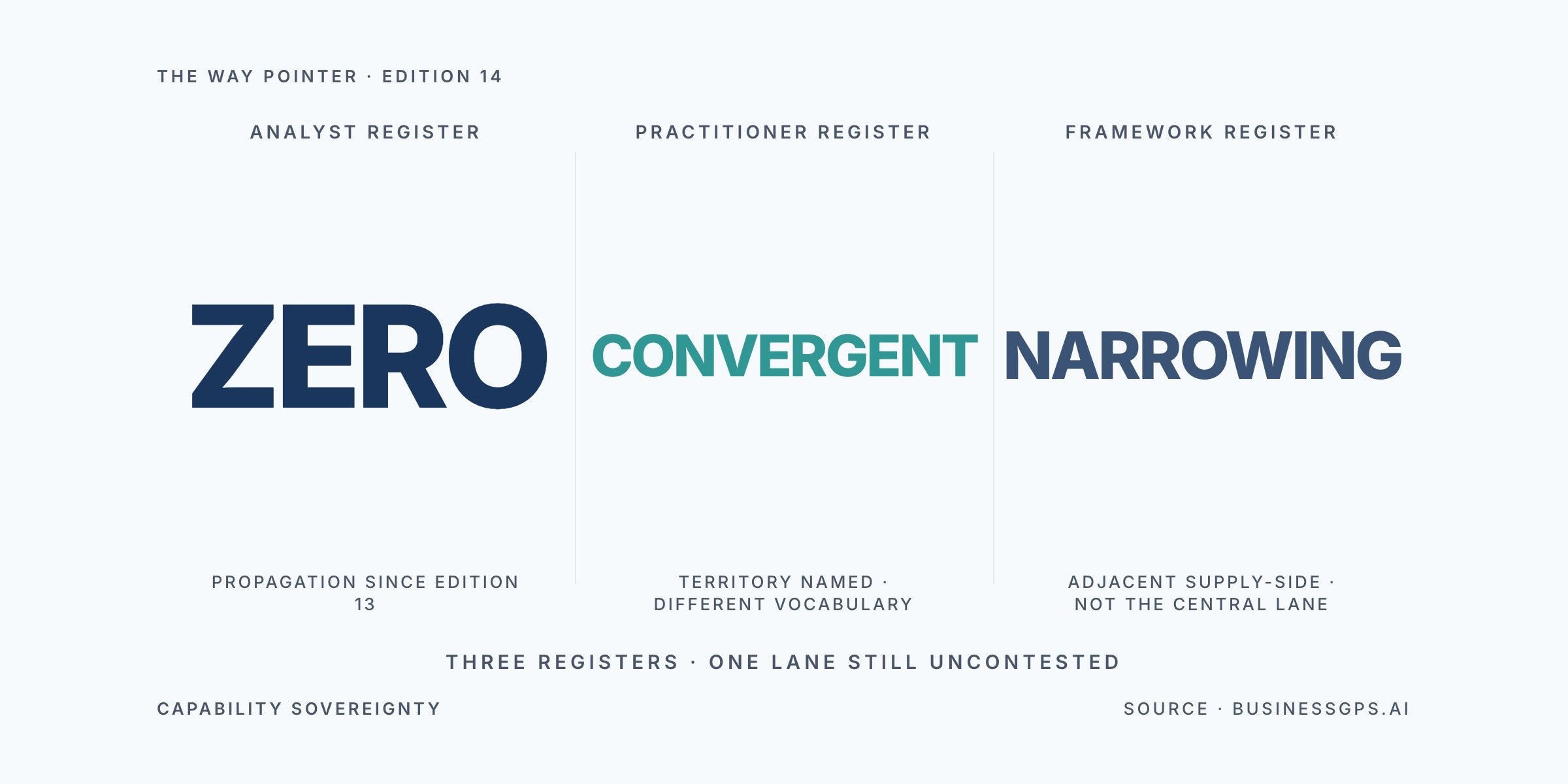
The short answer: the substrate vendors built more substrate, the analysts named more substrate, the practitioners described more of the customer-side territory in different words, and the lane the discipline sits in is still uncontested by any other name. We will walk through that picture in four parts — substrate layer, analyst register, practitioner register, competitor framework register — and then say what it means for the customer.
What happened at the substrate layer in three weeks
The substrate-vendor wave intensified. In the days around our Edition 13 publication, Microsoft completed the move that puts it level with the other three substrate-product vendors. Agent 365 went generally available on 1 May at $15 per user standalone, or bundled into the new M365 E7 SKU at $99 per user — three pillars (observe, govern, secure), control plane spanning Microsoft / AWS / Google Cloud agents, registry-approved publication after admin review of each agent's capabilities, data access, and security posture. Around it sit two earlier-shipped components of the same product line: Foundry Local large models running fully disconnected inside sovereign boundaries, and Azure Local Disconnected plus M365 Local Disconnected at worldwide GA.[^1]
Microsoft now joins SAP, IBM, and Workday as the fourth substrate vendor with a complete sovereignty-product stack. And Workday Q1 FY27 gave the market its first publicly disclosed financial-scale validation of the substrate-product thesis: $500 million annualised AI ARR, +200% year-on-year agentic ACV growth, 30.5% non-GAAP operating margin (raised from 30%), 25%+ Q1 expansion-ACV including AI with those deals 50% larger on average. Stock up 5%. The vendor naming layer is being priced.[^2]
The vocabulary is dense — Agent System of Record, EU AI Cloud, Sovereign Core, Sovereign Cloud, Agent 365, Foundry Local. Every term is a substrate claim. Every term answers the question where does your agent run, who governs it, what data sits inside the perimeter? None of them answers the question which work belongs to you?
What happened at the analyst register in three weeks
This is where the picture sharpens.
When we publish a distinction, the analyst register is the first place we look for adoption. If the language is naming something real, someone in the major-analyst houses usually finds reason to reach for it within a cycle or two. Customer-side discipline naming is exactly the work of the analyst register — Forrester's recommendations, Gartner's predicts notes, HFS's Three-Horizons frames, IDC's playbooks, Constellation's research notes, MIT Sloan Management Review's quarterly essays.
In the three weeks since Edition 13, we have searched the analyst register for our three distinguishing terms — capability sovereignty, substrate sovereignty, and the sovereignty product trap — and we have found zero propagation. Not zero adoption of the idea. Zero adoption of the vocabulary. No major-analyst house has used the customer-side capability question as a structured frame in published research.[^3]
What we did find, in volume, was adjacent vocabulary continuing to proliferate at the substrate altitude. Gartner has elevated Sovereign AI as a national / regulatory mandate frame in its Predicts 2026 note. Forrester named Google Cloud a Leader in its Q2 2026 Sovereign Cloud Platforms Wave on the strength of operational-sovereignty infrastructure. Deloitte's 2026 State of GenAI reports 83% of respondents see Sovereign AI as moderately or significantly strategically important. CIO Magazine has published a 120-day path to a "sovereignty operating model" aimed at CIOs reorganising around the substrate stack.[^4] These are real frames, rigorously researched. Each describes some part of the substrate decision. None names the customer-side discipline that has to sit above it.
The analysts are doing what they are paid to do — help buyers compare substrate products. That is honourable work. It is also downstream of the question we are naming. Three weeks of substrate motion produced three weeks of substrate naming. The customer-side question — which work belongs to you? — was named by no one else. We do not say this triumphantly. We say it descriptively, because it is the most important fact about where the discipline sits today.
What happened at the practitioner register in three weeks
The analyst register and the practitioner register are different markets. The practitioner register is the one read by the engineers and product leaders who actually have to make agents work inside operating organisations. It is faster, less ceremonial, and closer to the rough edges of the problem. It does not usually name disciplines as disciplines. It names practices — the specific files, schemas, and habits the people doing the work have to install.
In the three weeks since Edition 13, one of the most-read voices in the practitioner register has twice independently described the territory we call capability sovereignty without using the vocabulary.
On 24 May, in an executive briefing titled Your AI vendor contract isn't built for a capacity crunch, Nate B Jones reframed the AI substrate as an industrial business — hyperscaler capex in the hundreds of billions; AI vendor contracts as supply contracts in an industrial supply chain; three closing questions for the customer, the third of which is, in his phrasing: what discipline does the customer have to own so the supply constraint doesn't decide their strategy for them? That sentence is, structurally, capability sovereignty — asked from a different starting point (industrial supply economics rather than category architecture), in different vocabulary, to a partly different reader (the CFO in the procurement seat rather than the head of transformation in the design seat). The territory is the same.[^5]
On 25 May — the same day Edition 13 published — Jones followed with When AI makes everyone faster, an essay naming the platform-team bottleneck and the customer-side control layer. He set out four practical control-layer practices: an AGENTS.md file (standing-capability-owner documentation), action classes (the authority bar), provenance tracking (the audit trail), and sequestration of bad workloads (the reversibility precondition) — under what he called the asymmetric scaling laws of the work: upper layers on AI scaling laws, lower layers on human scaling laws. That sentence and the four practices beneath it name exactly the discipline split we are naming. The practices are not the substrate vendor's. They are the customer's. They are what an organisation has to install so the AI substrate operates on its capability rather than substituting for it.[^6]
This is not a BusinessGPS endorsement, and Jones has not endorsed our vocabulary. He uses his own — control layer, six protocols, control map, AGENTS.md — and he uses it well. Reading our work as his and his as ours would flatten a real distinction between two independent voices arriving at structurally similar answers from different directions. The honest description: the territory we call capability sovereignty is being named, in different vocabulary, by an independent practitioner register, from a different problem space, to a partly different reader. Vocabulary divergence with framework convergence. Both real.
When two independent voices, working from different inputs, with no shared incentive to align, arrive at the same answer in different words, the answer is probably correct and the words are probably negotiable. We are not invested in our words winning. We are invested in the discipline being installed.
What happened at the competitor framework register
The third register is where established analyst houses publish multi-tier frameworks intended to organise a market. This is where HFS Research's Horizons frameworks live. In the three weeks since Edition 13, HFS has continued its run — three Horizons frameworks in roughly sixty days now (Agentic Services late April, Agentic Technology 7 May, GCC Services 28 May), plus the Services-as-Software SaS Stars vocabulary continuing to be excerpted by EY and KPMG.
We have read each carefully and hold the same view we held three weeks ago. HFS is doing serious framework work in adjacent space, and it is narrowing the territory between the substrate-vendor world and the customer-side question further. But it does so on the supply side — naming what services providers must do — not on the demand side the customer occupies. Services-as-Software describes how a services market reorganises around agentic delivery. Capability sovereignty describes what the buyer of those services must own so the agentic delivery operates on the buyer's defensible work and does not absorb it. The two are compatible, not competitive. The supply-side framework narrows; the demand-side lane stays open.
Across all three registers, then, three weeks have produced exactly the picture the discipline is best served by — vendor naming intensified at the substrate layer; analyst naming added no new word for the customer-side; practitioner naming converged on the customer-side territory in different vocabulary; supply-side competitor frameworks narrowed without entering the central demand-side lane.
Why the silence matters
We do not read three weeks of silence in the analyst register as evidence the distinction is wrong. We read it as evidence the distinction is sitting in a structurally sheltered position — and the shelter is itself part of why the customer-side discipline is so important.
Three reasons.
First, the substrate vendors. Each of SAP, Microsoft, IBM, Workday — and the next vendor that joins this wave — has an enormous commercial reason to name its own substrate layer and an equally enormous commercial reason not to name the customer-side discipline upstream of it. Naming the discipline forces the conversation that comes immediately after: which of the work your product is doing should never have been delegated to a product in the first place? That conversation makes substrate selling harder.
Second, the analyst register's centre of gravity. Major-analyst houses follow vendor product motion. That is what the buying side pays them for. When four substrate vendors converge on four-dimension frameworks in ninety days, the analyst register's job is to compare and contrast those frameworks for buyers comparing those products. Naming the discipline upstream of the products is a different kind of work — closer to category design than product comparison — and tends to happen later, slower, and from voices whose centre of gravity sits closer to the strategy seat than the procurement seat.
Third, the practitioner register's centre of gravity. Engineering practitioners name practices, not disciplines. AGENTS.md is a practice. The control layer is a set of practices. These are the right level of resolution for the engineer reading on a Sunday evening — not for the board reading on a Tuesday morning. The practitioner register can name the territory in operational detail without ever naming it as a discipline, because discipline is not what the practitioner register is built to produce.
The structural shelter is what makes the lane consequential. The customer-side discipline is what every operating organisation is going to have to install over the next twelve months, and the vocabulary for it is not yet contested. That is rare. The longer it stays uncontested, the more decisively the discipline becomes installable on the customer's own terms — without inheriting a vendor's product-shaped definition of what the discipline is for.
What this means for the customer
The discipline operates whether or not it has a name. We want to be precise about what that means today.
On 9 June 2026, the SAP API Policy enforcement window opens — the change DSAG and others have been pushing back on since the policy was announced. The week before that, on 2 and 3 June, Microsoft holds Build, where the Agent 365 product family is expected to expand further. Between those two events, the most empirical piece of evidence we have seen this cycle on what customer-side discipline actually looks like in the field arrived from DSAG itself. In its 2026 investment survey, 77% of DSAG members reporting AI use in 2026 said they would use non-SAP AI solutions in their business. Only 3% said they rely on SAP's AI tools.[^7]
Read carefully, that is not a complaint about SAP. It is empirical evidence that the customer-side capability discipline is already operating across one of the largest, most engaged, most SAP-anchored customer estates in the world. Customers have already classified what belongs to SAP, what does not, and what they will keep open across vendors. They have made the multi-vendor capability decision. They have decided which work is defensible Signature work that must sit outside any single vendor's substrate, and which work is Core-but-Standardised work that can flow through whichever substrate is currently cheapest and most reliable. They have done this without naming what they are doing. They have done it under pressure, in the absence of an analyst-register category. They have done it because the substrate vendor's product portfolio could not safely be allowed to decide their capability classification for them.
The 77% datapoint is what capability sovereignty looks like when it is operating without a name. The remaining work — the work the discipline does — is the work of making the unnamed thing nameable, repeatable, and governable at portfolio scale. That is what the discipline gives you that the substrate purchase cannot: the structured language for what you have already, half-consciously, started doing.
The Way Pointer view
Substrate sovereignty is still what vendors sell. Capability sovereignty is still what you have to own. Three weeks later, that statement is more empirically validated, not less.
The vendors have built more substrate. The analyst register has named more substrate. The practitioner register has, twice, named the territory of the customer-side discipline in a different vocabulary. The competitor framework register has narrowed in the supply-side space adjacent to it. And the customer estate has shown — in the empirical signal of the DSAG investment survey — that the discipline is already operating in the absence of a vocabulary.
The lane the discipline sits in is still uncontested. The reasons it is uncontested are structural and durable. The discipline becomes more important, not less, the longer the substrate vendors keep adding substrate. And the question the substrate cannot answer — which work belongs to you? — is the only question whose answer is yours to give.
The full cross-vendor reading of this week — the Microsoft pre-Build stack at substrate altitude, the Workday Q1 FY27 financial validation, the analyst-register vocabulary inventory, and the DSAG 77% customer-side signal at SAP-specific altitude — sits inside SAP Compass — Edition 4 and The Capability Brief — Edition 10.
Your Waypoint
One register. One paragraph. Sixty minutes.
Open the most recent analyst note your organisation has paid for on AI sovereignty, agent governance, or operational sovereignty. Read the executive summary. In one paragraph, write the answer to a single question: does this note name the customer-side discipline that must sit upstream of the substrate purchase, or does it compare substrate products? If the answer is the second, write a second paragraph identifying the customer-side question the note does not answer. That is the unnamed territory the discipline lives in, and that paragraph is the start of your organisation's own answer to it.
The vocabulary will catch up eventually. The discipline cannot wait for the vocabulary. The 77% of DSAG members who have already classified their work across vendors did not wait. They classified, then they bought. The reading order is theirs to keep. It is yours to keep too.
References
[^1]: Microsoft, Microsoft Agent 365 now generally available — expands capabilities and integrations, Microsoft Security Blog, 1 May 2026. Foundry Local large models and Azure Local / M365 Local Disconnected GA per Microsoft Official Blog, 24 February 2026. May 2026 Agent 365 update per Microsoft Tech Community, What's new in Agent 365, May 2026.
[^2]: Workday, Q1 FY27 earnings release and conference call, 21 May 2026. Constellation Research's R. Wang originally named the "system of record for AI agents" framing in February 2025; carry-forward. Josh Bersin, The Reinvention of Workday: From System of Record to Platform of Agents, April 2026.
[^3]: Sources searched and surveyed in the three-week window for the terms capability sovereignty, substrate sovereignty, and sovereignty product trap: Forrester research portal, Gartner Predicts series, HFS Research site direct, IDC FutureScape, Constellation Research, MIT Sloan Management Review, plus secondary coverage in CIO Magazine, The Register, Computer Weekly, and SiliconANGLE. No instance of the customer-side capability discipline framed as a discipline by any analyst voice.
[^4]: Gartner, Predicts 2026: AI Sovereignty, 2026. Forrester, Allie Mellen et al., The Forrester Wave: Sovereign Cloud Platforms, Q2 2026. Deloitte, State of Generative AI in the Enterprise — 2026 Quarter 2. CIO Magazine, "A 120-day path to a sovereignty operating model", 2026. Each describes substrate-layer decisions in serious detail; none names the customer-side capability discipline as a structured frame.
[^5]: Jones, N. B., Executive Briefing: Your AI vendor contract isn't built for a capacity crunch — why AI is turning Big Tech into an industrial business, Substack / Executive Circle, 24 May 2026. The three closing questions and the industrial-supply framing are Nate's; the structural mapping to capability sovereignty is ours. Used here with attribution and without claim of endorsement.
[^6]: Jones, N. B., When AI makes everyone faster — the platform team bottleneck and the control layer, Substack, 25 May 2026. The AGENTS.md / action-classes / provenance / sequestration four-practice set and the "upper layers on AI scaling laws, lower layers on human scaling laws" framing are Nate's; used here with attribution.
[^7]: DSAG 2026 Investment Survey. Reported figures: 77% of DSAG members reporting AI use in 2026 will use non-SAP AI solutions; 3% rely on SAP's AI tools. Coverage: SAPinsider, Computer Weekly Germany, May 2026. DSAG represents approximately 60,000 SAP customers across the German-speaking region.
The Way Pointer is published by BusinessGPS — the transformation capability platform helping organisations make strategic choices about what they build, what they buy, and what they own.