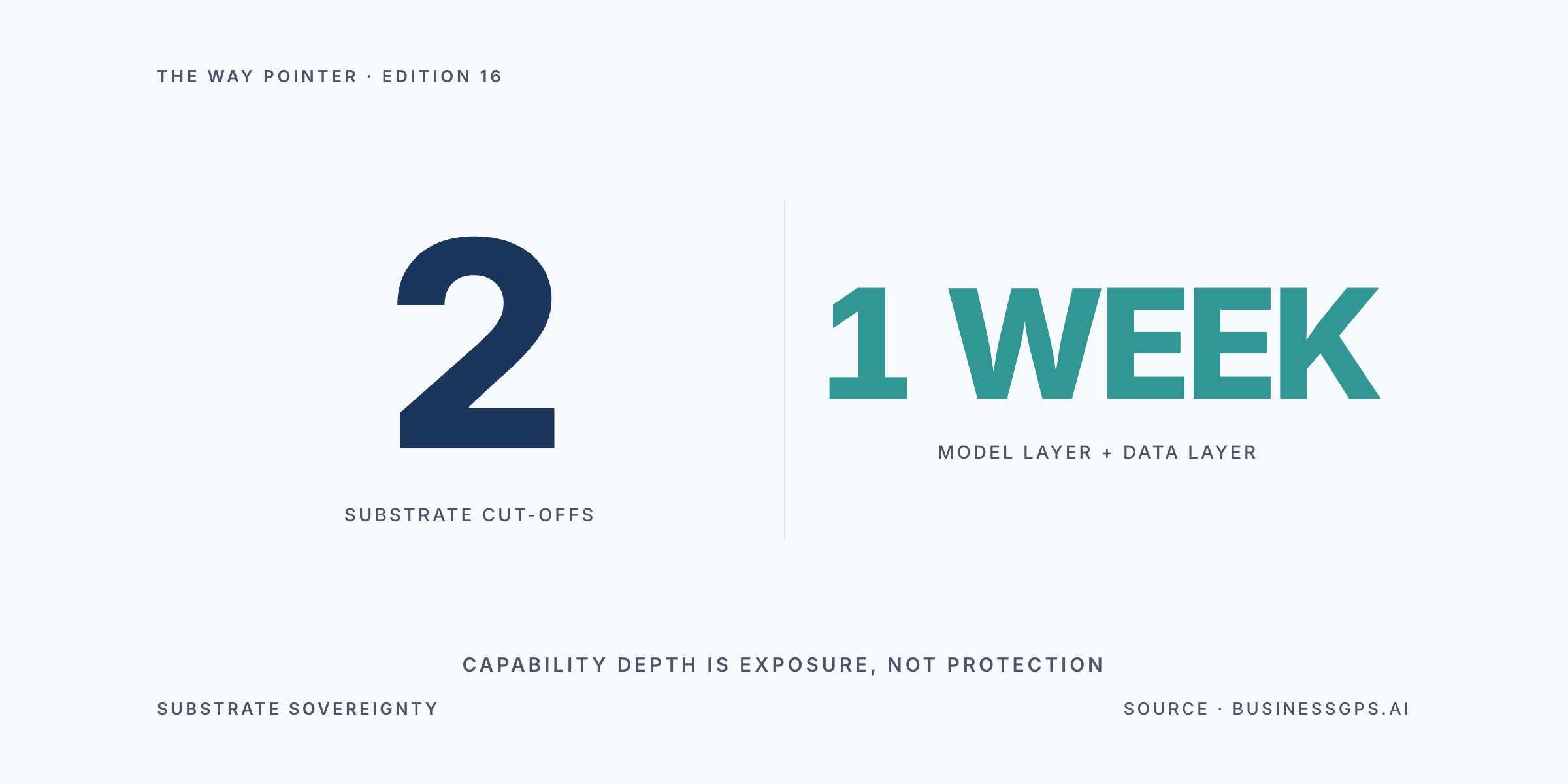
There is a particular kind of clarity that only arrives when something is taken away. For a year we have argued that the durable layer of an AI estate is not the model you rent but the capability you own above it. The argument was sound, and it was also, until last week, a forecast. Then in seven days the substrate was switched off twice — once at the model layer by a government, once at the data layer by a vendor — and the forecast became a transcript. The organisations with continuity were exactly the ones who owned their capability above the substrate. The ones who went dark had built their capability as the substrate. Nobody had to argue the point. The week argued it.
This is the Way Pointer view of what those two cut-offs proved together — and why the lesson is structural, not the outage, even though one of the outages may already be over by the time you read this.
Two cut-offs, one week, two kinds of authority
Start with the facts, held precisely, because the precision is where the lesson lives.
On 12 June, at 5:21 PM Eastern, a U.S. Commerce Department export-control directive required Anthropic to suspend access to its two most capable models — Mythos 5 and the three-day-old Fable 5 — for any foreign national, "whether inside or outside the United States, including foreign national Anthropic employees." Because an API cannot reliably filter its users by nationality, the only way to comply was to disable the models for everyone. Anthropic did so, under protest, for all customers globally; access ceased that evening, returning errors that redirected users to a still-available model. This was the first time a government has issued an export-control directive for model access — not chips, not training data, but the live availability of a deployed commercial model. The substrate was pulled from underneath every user at once, on a Friday evening, by a third party with no commercial relationship to most of them.[^1]
The same week, the data layer crossed its own threshold by a different authority entirely. A security patch shipped on 9 June that technically enforces SAP's prohibition on a specific legacy interface pattern — validating callers against an allowed list and blocking unauthorised ones at the protocol level. The two events are unconnected, and that is exactly the point. Enforcement at the model layer by a state, and enforcement at the data layer by a vendor, in the same seven days. The diagnosis does not care which authority does the cutting.[^2]
Two qualifications, because accuracy matters more than momentum. First, the model-layer cut is fluid. Anthropic says it is "working to restore access as soon as possible," argues that the triggering technique was a "narrow, non-universal" jailbreak — "asking the model to read a specific codebase and fix any software flaws" — and notes the same capability is elicitable from a competitor's model that is not export-controlled. We take no position on the merits; access may well be restored before you finish this piece. The durable lesson is structural, and it holds either way. Second, the SAP enforcement is being read calmly, and rightly: as of mid-June there is no documented mass disruption, enforcement appears phased rather than binary, and SAP says it respects existing contracts. This is a contract-review checkpoint, not a fire drill. The point is not the size of either week's disruption. The point is who could absorb it.[^3]
The reflex that says depth is safety — and why it inverts
There is an intuition almost everyone carries into an AI estate: that the deeper you integrate a capable model, the stronger your position. Commit harder to the best model, wire it further into your most valuable workflows, and you build advantage that competitors on weaker tooling cannot match. It is a reasonable intuition. The week ran it as a live experiment and showed it inverts.
The model that customers had integrated most deeply — into specialised, high-stakes work — was precisely the one whose withdrawal hurt most. The more specialised the deployment on a rented substrate, the less substitutable it is, and the higher the disruption when it goes. We have a name for this: the lock-in paradox. Depth of integration becomes depth of exposure. Committing harder to a more capable model does not make you stronger if your capability is the model. It makes you more exposed, because you have moved more of your operation onto a layer you do not control and cannot substitute under pressure.
This is the Sovereignty Product Trap in its purest published form — and what makes this instance unusually clean is that it sprang without any vendor acting in bad faith. The trap is usually illustrated by a pricing change or a roadmap decision, something a customer might at least have negotiated around. This time it was a government, overnight, with no commercial logic to negotiate. The trap does not require a vendor's bad faith to spring. It only requires that the capability you depend on lives somewhere you do not control. Substrate Sovereignty is what the vendor sells, and what a government can override. Capability Sovereignty is the question neither can answer for you: which capabilities you own above the substrate, so that when the substrate is cut, your operating system survives the cut.
Who had continuity, and who went dark
The directive ran the test, and the result is the cleanest evidence the customer-side thesis has had. The dividing line was not size, sophistication, or spend. It was whether the organisation owned its capability above the substrate.
The continuity cases owned capability above the model. One Australian legal-AI vendor noted its models had been "available for air-gapped self-hosting since launch," with deployments serving multiple government departments, and read the ban as straightforward validation of a sovereignty-first design. A sovereign-deployment vendor whose customer data and model weights stay in-jurisdiction was the company least affected: an export-control directive aimed at a different company's models simply did not reach it. These were not the players with the most capable model. They were the players who had architected for the model to be substitutable.[^4]
The dark cases were the ones whose capability was the substrate. Organisations that had built their workflows purely on top of a single model's API, with no model-agnostic layer beneath them, had no fallback when that model disappeared. Nothing about their prompting sophistication helped. The thing they had optimised was the thing that was withdrawn.
This answers a question we have carried in the research inbox all year: does "the stronger the model gets, the stronger we get" still hold? It does — on one condition. "Moving beyond the model" has to mean genuine workflow-level capability ownership, not sophisticated prompt usage on a hosted substrate. If your capability lives above the substrate, a stronger model makes you stronger and a withdrawn model does not break you. If your capability is the model, when the model goes, your capability goes with it. The strength of the model was, last week, simultaneously the source of value and the source of the withdrawal risk. Those are not two facts. They are the same fact, seen from two sides.
The brain got swapped and the wiring didn't move
We are not the only voice arriving here. The sharpest independent practitioner signal of the cycle reached the same conclusion from the engineering side, in its own vocabulary, the same week the ban proved the point. The load-bearing line, published 12 June: when the model sits in the middle of your work rather than beside it, "a new model ships and drops straight into your existing setup. Your skills load the same way they did yesterday. Your goals run the same way. Your pipelines do the same jobs … because the brain got swapped and the wiring didn't move."[^5]
Read that against the week's two cut-offs and the convergence is exact. The organisation that owns the wiring — the skills, the runbooks, the routing, the review gates, the cost instrumentation — benefits automatically from every model upgrade and survives a model being removed. The brain is rented and replaceable; the wiring is owned and durable. The same practitioner is unsparing about the alternative: "if your AI use is still paste-into-a-box, you are working at a 2023 pace with 2026 tools," and the workarounds teams build around any one model's limits "were a ledger" of debt that comes due at the next threshold. Every chunking ritual, every morning re-paste of context, every prompt hack written to route around a model's weakness becomes a liability the moment the model — or the access to it — changes.
The demand for this discipline is now being voiced from the bottom up, by the people closest to the work, before any analyst has named the lane. The metric they reach for is not benchmark score or adoption rate; it is "cost per shipped outcome," and the strategic line lands in a register built for a board pack: the leaderboard "doesn't move under your management." The numbers that do move under your management are whether your people can define a finish line, and whether what they learn lands in durable skills or "evaporates in chat." That is a populated, practitioner-grade description of the exact layer no vendor governance plane occupies — built bottom-up, in demand of precisely the discipline this article exists to name. The practitioners are describing Capability Sovereignty. They are building the demand for the term faster than the term is spreading.
What this asks of you
The pace will not slow. There will be another model release that you are tempted to integrate deeper than the last; there will be another enforcement event, from a vendor or a government or a court, that you did not plan for. None of that changes the shape of your decision. It only raises the cost of not having made it deliberately — because every workflow you wire onto a substrate you do not control is a workflow whose continuity now belongs to someone else's policy, and continuity is far harder to recover than it is to design in.
The full cross-layer reading of this week — the model-layer cut, the data-layer enforcement, the continuity-versus-dark divide, and the practitioner convergence — sits inside The Capability Brief — Edition 12 and on the intelligence page.
Your Waypoint
One audit. One question. Thirty minutes.
List the AI-dependent workflows your organisation is closest to relying on for live, consequential work. Against each one, write the answer to a single question: Who can switch this off? Be literal. Name the parties who could end your access to that capability tomorrow without asking you — a vendor changing a policy, a government issuing a directive, a price change you cannot absorb, an interface being deprecated. Then add the test that decides whether the entry is a risk or an exposure: Could we swap the underlying model or interface within a month without losing our operating system?
Where the answer is yes, you own the wiring; the brain is rented and replaceable, and that is a sound place to rent. Where the answer is no, your capability is the substrate, and you have found a workflow whose continuity you have quietly outsourced without deciding to. Those are the capabilities to bring above the substrate first — into the harness, the routing, the review gates, the standing owners who hold the work regardless of which model is available this week. The substrate can be switched off. The wiring, if you own it, stays on.
References
[^1]: U.S. Commerce Department export-control directive requiring Anthropic to suspend Mythos 5 and Fable 5 for foreign nationals, 12 June 2026, 5:21 PM ET; Anthropic disabled both models globally for all customers because an API cannot reliably filter by nationality. Anthropic, Fable 5 / Mythos 5 Access statement, 13 June 2026; Bloomberg Law, 13 June 2026; Simon Willison API documentation, 13 June 2026; TechCrunch, 12 June 2026. The "first export-control directive for model access" characterisation is widely reported across these outlets.
[^2]: SAP security patch enforcing the prohibition on a specific legacy ODP-via-RFC interface pattern, effective 9 June 2026; only that one interface is blocked, with the underlying protocol and other function modules remaining usable. The two enforcement events — model-layer and data-layer — are unconnected. SAP enforcement documentation; independent data-integration vendor commentary, 29 April 2026.
[^3]: Anthropic statement, 13 June 2026 ("working to restore access as soon as possible"; "narrow, non-universal" jailbreak; same capability elicitable from a non-controlled competitor model). We carry the dispute fairly and take no position on the merits. On the data layer: phased enforcement (fuller blocking forecast for July, exceptions through year-end, "minimal" immediate impact) per independent data-integration vendor commentary, 29 April 2026; SAP's stated respect for existing contracts; contract-boundary reading per Hunton Andrews Kurth, 26 May 2026. The DSAG Investment Report 2026 finding — of the ~43% of members who have implemented AI, 77% run them in production on non-SAP solutions and 3% on SAP — is a claim about implementers, not all members, surveyed December 2025–January 2026.
[^4]: Isaacus sovereignty-first blog, 13 June 2026 (air-gapped self-hosting since launch; government deployments; "frontier artificial intelligence ought to be accessible to everyone, rather than concentrated in the hands of a select few frontier labs"). The in-jurisdiction sovereign-deployment vendor least affected by the directive is described at vendor-agnostic altitude; the structural fact — that a directive aimed at one company's models does not reach a vendor whose weights stay in-jurisdiction — is not in dispute. On attribution: Axios and others report that Amazon's chief executive alerted officials to the jailbreak finding on the night of 12 June; Amazon has not confirmed this and Anthropic's statement does not name Amazon, so we carry it strictly as a report, not a fact. The "hundreds of millions" figure sometimes cited refers to the Claude platform overall, not to Fable 5, which was three days old with limited uptake when it was cut.
[^5]: Independent practitioner analysis: Codex Complete Guide, 12 June 2026 ("the brain got swapped and the wiring didn't move"; "if your AI use is still paste-into-a-box, you are working at a 2023 pace with 2026 tools"; "skills are durable"; "cost per shipped outcome"; "the leaderboard doesn't move under your management"); Fable 5 deep dive, 9 June 2026 ("bigger than our habits"; "every workaround you build for one model becomes a liability in the next one … a ledger"); Claude vs Codex, 10 June 2026 ("throughput problem and a truth problem at the same time"; "the handoff is where your judgment does the real work"); Uber token burn, 7 June 2026 ("adoption is not transformation"; "minimum effective intelligence"). The framings are the practitioner's own; the structural mapping to Capability Sovereignty is ours, used with attribution and without claim of endorsement.
The Way Pointer is published by BusinessGPS — the transformation capability platform helping organisations make strategic choices about what they build, what they buy, and what they own.