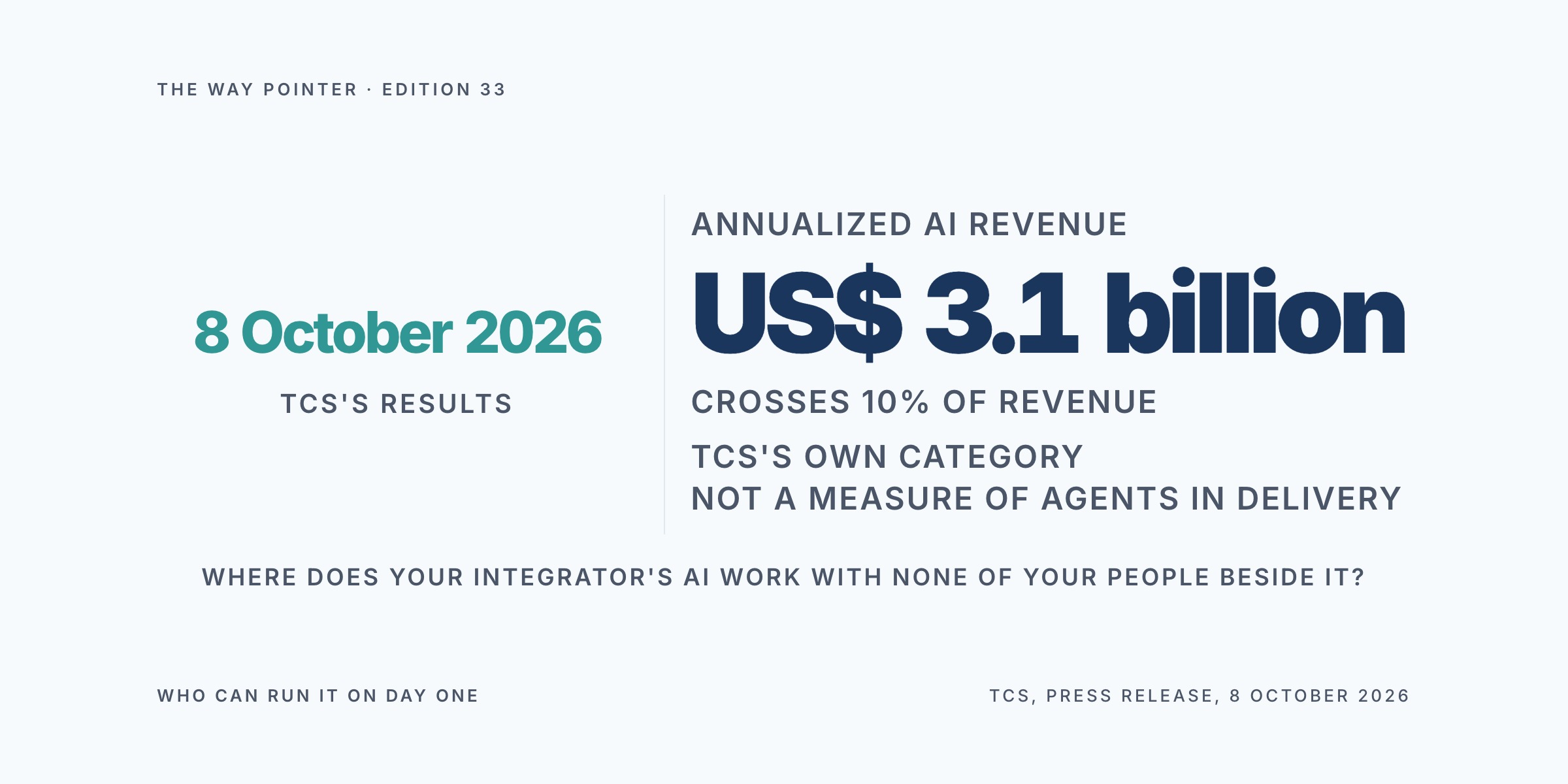
On 8 October 2026 Tata Consultancy Services reported "Annualized AI Revenue at US$ 3.1 billion in Q2FY27, crosses 10% of Revenue", which is a category TCS defines, one quarter annualised, and no measure of AI agents in delivery. EY published its results release the same day. Each release names kinds of work where the firm uses AI: TCS names application management and infrastructure operations, EY names audit. Neither says which tasks in a client's change programme the firm's agents do, and neither gives a measure of what the client's own staff can run afterwards.
We think the integrator's side of a programme is being industrialised, meaning more of its work is done by repeatable machinery, and neither release measures what is built on your side: your own capacity to change. The question for you is which of your own people are beside that work, and who can support the system on the day it goes live.
This article gives you one page to write before that day: each part of the system, the name of your person who supports it, who covers their day job, and what you sign completion against.
It is results season for the firms that build finance systems. Tata Consultancy Services (TCS) reported on 8 October 2026, and its release put a number on AI: annualised AI revenue of US$3.1 billion, a category TCS defines.[1]
More is due. HCLTech reports on Monday 12 October 2026, Accenture holds its Investor Day on Wednesday 14 October and Wipro reports on Thursday 15 October.[5]
If you sign for a programme, or own one, here is what the firms' pages say so far and what they leave out. The page at the end is yours to draft.
Each release names kinds of work where the firm uses AI; neither says which tasks in a client's programme its agents do
The firms' own pages read for this article are these:
- TCS, results press release, 8 October 2026
- EY, annual results press release, 8 October 2026
- Accenture, its transcript of its results call, 1 October 2026
TCS's call of 8 October 2026 was read in a transcript published by Investing.com, which is not TCS's page. The observation under the table is about the two releases. Accenture's transcript is read only for the sentences quoted from it.
An AI agent is software that carries out a task, such as drafting a design document or a test script. S/4HANA is SAP's finance and operations system. AMS is application management services, the running of systems already built.
| Who, where and when | Its own words | What it is | What it is not |
|---|---|---|---|
| TCS, press release, 8 October 2026 | "Annualized AI Revenue at US$ 3.1 billion in Q2FY27, crosses 10% of Revenue" | A revenue category TCS defines, one quarter annualised | A measure of agents in delivery |
| TCS, the same release: Aarthi Subramanian, President and Chief Operating Officer | "TCS' Human+AI Services Autonomy model for AMS earned top rankings from customers" | A kind of work TCS names: application management | The tasks in a client's change programme that its agents do |
| TCS, the same release, on infrastructure support for Aareal Bank | "Leveraging its AI-led delivery model, intelligent automation capabilities, and deep financial services expertise, TCS will help simplify technology operations" | A kind of work TCS names: infrastructure operations | A measure of what the client's own staff can run afterwards |
| TCS, earnings call, 8 October 2026: Aarthi Subramanian, in a transcript published by Investing.com | "Our priority is clear: use AI to create measurable value for our customers and to improve how we deliver work for them." | A priority, told to investors | A result |
| The same call and speaker | "In a large, complex S/4HANA enterprise transformation spanning 27 sites, more than 70 legal entities, we are using AI to redesign processes and accelerate implementation." | TCS's account of one unnamed client's programme, with nothing reported gone wrong | An account of what that client's staff do |
| The same call and speaker | "21 forward deployment engineers are now working directly with business on execution." | TCS's own people working with a client's business teams | An account of how the client's own staff are equipped |
| EY, press release, 8 October 2026 | "In FY26, sales from AI services grew by 49%" | Sales growth in a category EY defines | A measure of delivery |
| EY, the same release | "Within the Assurance Service Line, EY continued its multiyear transformation of audit services in FY26, including the global rollout of enterprise-scale agentic AI." | A kind of work EY names: audit | The tasks in a client's change programme that its agents do |
| EY, the same release | "Agentic AI is also expanding across internal workflows and client services." | A general statement, with the client services not specified | A measure of what the client's own staff can run afterwards |
| Accenture, results call, 1 October 2026: Julie Sweet, Chair and Chief Executive | "AI is making both our own delivery and the technologies we implement more efficient." | Accenture's account of its own delivery, with no figure given for its delivery productivity | A measure of what a client's staff can run |
| The same call and speaker, of one client | "rebuilding how work gets done around clear outcomes with people in the lead and agents on task — measuring the value of every change and reskilling its workforce in parallel" | Accenture's account of one client reskilling its people alongside the work | A measure, or a statement of who does the reskilling |
TCS reported in its release and told investors on its call. Accenture told investors. EY said it in a release.[1][2][3][4]
These are statements to investors and the press about each firm's own business, and that is what a results statement is for. Ms Sweet also said the productivity "creates greater value for our clients", and later in the call: "So we are definitely giving more productivity due to AI."[4] So Accenture says clients gain.
What is absent is narrower. Each release names kinds of work where the firm uses AI: TCS names application management and infrastructure operations, EY names audit. Neither says which tasks in a client's change programme the firm's agents do, and neither gives a measure of what the client's own staff can run afterwards. TCS's call comes nearest: it describes one unnamed client's programme and says AI is used there to redesign processes, without saying who of the client's is beside that work. Accenture's transcript is quoted here for AI in its own delivery, with no figure for its delivery productivity, and for one client's reskilling; this article claims nothing about the rest of it. That is an observation about two releases. It does not say that no integrator measures it.
Neither release says how a client's own staff are trained, equipped or supported during delivery. TCS's names places where clients can work with its teams; the training figures in both are the firms' own. The two calls go a little further, as the table shows: Accenture describes one client reskilling its workforce in parallel, and TCS describes its own engineers working with a client's business teams. Neither gives a measure.
Accenture speaks at length on Wednesday. On 1 October it described AI in its own delivery and gave no figure for its delivery productivity. We expect the same at its Investor Day: an account of AI in Accenture's delivery, and no measure of what a client's own staff can run afterwards. The date is Wednesday 14 October 2026, and we are wrong if it gives one.
More of the build done by AI can leave fewer of your people close to the detail
On a system programme, somebody works out how each job will be done: how a supplier is paid, how the month is closed. Whoever does that work ends up knowing the system.
We think the more of the build an integrator's agents take on, and the faster they take it, the harder it is for your own people to stay close to the detail. They review, test and sign off at the pace they always did, so they become the bottleneck or approve what they have not had time to check, unless your plan gives them the time and the help.
Nothing in the statements above says this has happened on any firm's programme. It is a risk to plan for, and the plan is yours to make.
Why closeness to the detail matters: one council's 2022 go-live, reported in 2025
Birmingham City Council went live with an Oracle system on 11 April 2022. Its auditor, Grant Thornton, reported on the programme on 11 February 2025.[6] On the design work the report says:
"the programme was heavily reliant on external providers for both programme management and functional content, with interim contractors being a significant part of the Council's resource involved in design activities. This meant that there were fewer of the Council's own officers who were sufficiently close to the detail to properly manage risk and safeguard knowledge retention."[6]
This is one council and one programme. The auditor puts governance first among the causes and gives no verdict on the suppliers, and in the passage quoted here it does not say the software failed. The report mentions no AI agents. It is here because it records, in an auditor's words, what an organisation's own people need to be close to the detail for: managing the risk and keeping the knowledge.
What a year of outside support costs
Suppose your system is live and your own staff cannot support it. Somebody else has to, at a day rate.
As an illustrative sum on example figures, 6 outside specialists at £900 a day for 220 working days come to £1,188,000 for one year. Put your own headcount and day rate in their place. The cost comes round again each year until your own people can do the work.
The page to write before you go live
We think these results leave you with a question to answer inside your own organisation: which of your people are close to the work your integrator's AI is doing, and which of them can support the system on go-live day.
You do not run your integrator's team or its agents, and you do not need to. You need one page, written before the go-live decision and kept in your own records. If you own the programme, it is your handover plan on one sheet.
Here it is filled in as an example. The names and the parts are invented.
| Part of the system | Who of ours supports it on day one | Who covers their day job meanwhile | We sign completion against |
|---|---|---|---|
| Supplier payments | Dana Okoye, accounts payable lead | Sam Reid, accounts payable clerk | Three payment runs made by our team without the integrator |
| Bank reconciliation | Imran Shah, treasury accountant | Lucy Marsh, assistant accountant | One month-end reconciled by our staff and signed by the financial controller |
| Payroll interface | Helen Park, payroll manager | Nobody yet | Two pay runs checked by Helen against the old system |
| Month-end close | Tom Avery, financial controller | Priya Nair, management accountant | One close completed by our staff inside the planned days |
| User access and roles | Nobody yet: the integrator's consultant holds it | Not applicable until there is a name | Not signed until a named person of ours holds it |
A blank is a finding. In this example nobody on the buyer's staff holds user access, so that certificate waits until somebody does. A certificate of completion is your signature that a piece of work is finished.
Your integrator can help you fill the page in. For each part, ask who or what on its side did the design, a consultant or an agent, and which of your people worked beside it. Where the answer is nobody of yours, you have found the next blank. Ask too what help your named people get to keep pace while the build is under way.
Your people will ask where the hours come from, since they are already running month-end and the workshops. The page has a field for it: who covers each named person's day job while they learn the system. A name with nobody covering for it is a blank too, as the payroll row shows.
Your contract may already define acceptance. On your own authority you can read its acceptance terms, see what each certificate is signed against today, and put the question on the next steering agenda. Where a test on your page goes beyond the contract, that is a change to agree with your integrator, and it is cheaper to find before go-live.
Done when: every part of the system has one of your people's names beside it or an honest blank, and every certificate has its test written in before anyone asks you to sign.
What stays when the help leaves
An integrator finishes a programme and moves to the next one. That is its business, and the statements above are about that business.
Here is one finance chief's published opinion on work of this kind. On 10 October 2026 the writer known as The Secret CFO, writing for other finance chiefs, listed "System implementations" among a finance chief's Events, meaning work "with a beginning, an end and a defined outcome." Of businesses where such events keep coming, the writer said:
"One of the keys to surviving it was building more permanent Everyday capacity around recurring types of Events. This is why acquisitive businesses build Corp Dev teams, or transformation-heavy businesses create dedicated transformation capacity."[7]
That is a view from one career, and it is about businesses in general.
We think it holds for a system too, and that this part is yours to own, alongside your integrator: what your own team can run stays when the help leaves.
Your integrator builds the system and then finishes. The names on the page are the people who will still be there.
References
Tata Consultancy Services, press release, International Growth and Strategic Wins Underpin TCS' Q2, 8 October 2026. https://www.tcs.com/who-we-are/newsroom/press-release/tcs-financial-results-q2-fy-2027. The figure is from the release's highlights.
Tata Consultancy Services, second-quarter earnings call, 8 October 2026, in a transcript published by Investing.com. https://www.investing.com/news/transcripts/earnings-call-transcript-tcs-posts-steady-q2-2026-growth-as-ai-revenue-tops-31b-93CH-4939361. A third party's transcript.
EY, EY global revenue increases 4.7% to US$57b for fiscal year 2026, 8 October 2026. https://www.ey.com/en_gl/newsroom/2026/10/ey-global-revenue-increases-4-point-7-percent-to-us-dollars-57b-for-fiscal-year-2026.
Accenture, Fourth Quarter Fiscal 2026 Earnings Conference Call Transcript, call of 1 October 2026; pages 6, 7 and 19. https://investor.accenture.com/~/media/Files/A/accenture-v4/investors/earnings-reports/2026/accenture-4q-fy26-conference-call-transcript.pdf.
The dates still to come are from the firms' investor pages: HCLTech, Accenture and Wipro.
Grant Thornton, Value for Money report in relation to the implementation of Enterprise Resource Planning System (ERP): Report in the Public Interest, addressed to Birmingham City Council, 11 February 2025. https://www.birmingham.gov.uk/downloads/file/30136/public_interest_report_-_erp_implementation_2025. Page 8 for the design work; page 5 for governance; page 37 for the separate report on suppliers; page 45 for the go-live date.
The Secret CFO, The Four Es: CFO Operating Modes, 10 October 2026. https://www.cfosecrets.io/p/the-four-es-cfo-operating-modes.