v2.1 (2026-05). This is the v2.1 refresh of the v2.0 paper. The thesis body is unchanged. v2.1 adds an appendix — Companion Observations (v2.1 — May 2026 External Validation) — absorbing Nate B Jones's May 2026 thesis on runtime sovereignty, workflow legibility, and meaning-definition as convergent external confirmation of the Five-Layer Model. The v2.0 base (formal bibliography, academic grounding (Polanyi, Nonaka, Zollo & Winter, DiMaggio & Powell, Hammer & Champy), 164,000-enterprise figure replacing the earlier 17,000 figure, canonical CCS v1.1 alignment, explicit boundary conditions, labour and ethics dimension, formal conflict-of-interest disclosure) is preserved unchanged. Published as part of the BusinessGPS 2026-Q2 trifecta alongside The Capability Reclassification Matrix and TCM Discipline: The Missing Discipline v2.0.
v2.2 (2026-05-14) — Three-zone reading added (Execution Substrate / Cognitive Frontier / Strategic Intent). Does not expand or restructure L1-L5 primitive. Replaces "above the line" / "below the line" v2.1 terminology with standalone-English terms aligned to Glossary v2.4 vocabulary upgrade.
v2.3 (2026-05-21) — Two Companion Observations added (L3-L5 as Cognitive Dimension convergence point + ExecMind / CorporateMind as canvas interpretation engines at L3-L5) absorbing the BusinessGPS Gate 1 Reconciliation Analysis between Programme Instantiation and Standing Org Instantiation engagement families. Thesis body and L1-L5 primitive unchanged. Existing v2.1 Companion Observations and v2.2 three-zone reading preserved.
Executive Summary
All enterprise work exists across five layers. Transformation programmes address two. Nobody addresses the other three — not because they are hidden, but because the consulting industry's revenue model depends on the gap.
The Five-Layer Activity Model classifies every activity in every enterprise function into five distinct layers, each with its own ownership, documentation state, technology footprint, data types, and AI deployment pattern:
| Layer | What It Is | Who Addresses It | AI Pattern |
|---|---|---|---|
| L1: Standard Software | System-enforced process (ERP) | Every transformation | Delegation (99.99%) |
| L2: SOPs | Documented procedures | Most transformations | Delegation (99.9%) |
| THE BLIND SPOT LINE | |||
| L3: Workarounds | What people actually do (Excel, manual) | Nobody (structurally) | Augmentation (80-95%) |
| L4: Judgment | Decisions, tacit knowledge | Nobody (no methodology) | Augmentation (human decides) |
| L5: Agentic Potential | Agent orchestration | Nobody (doesn't exist yet) | Orchestration |
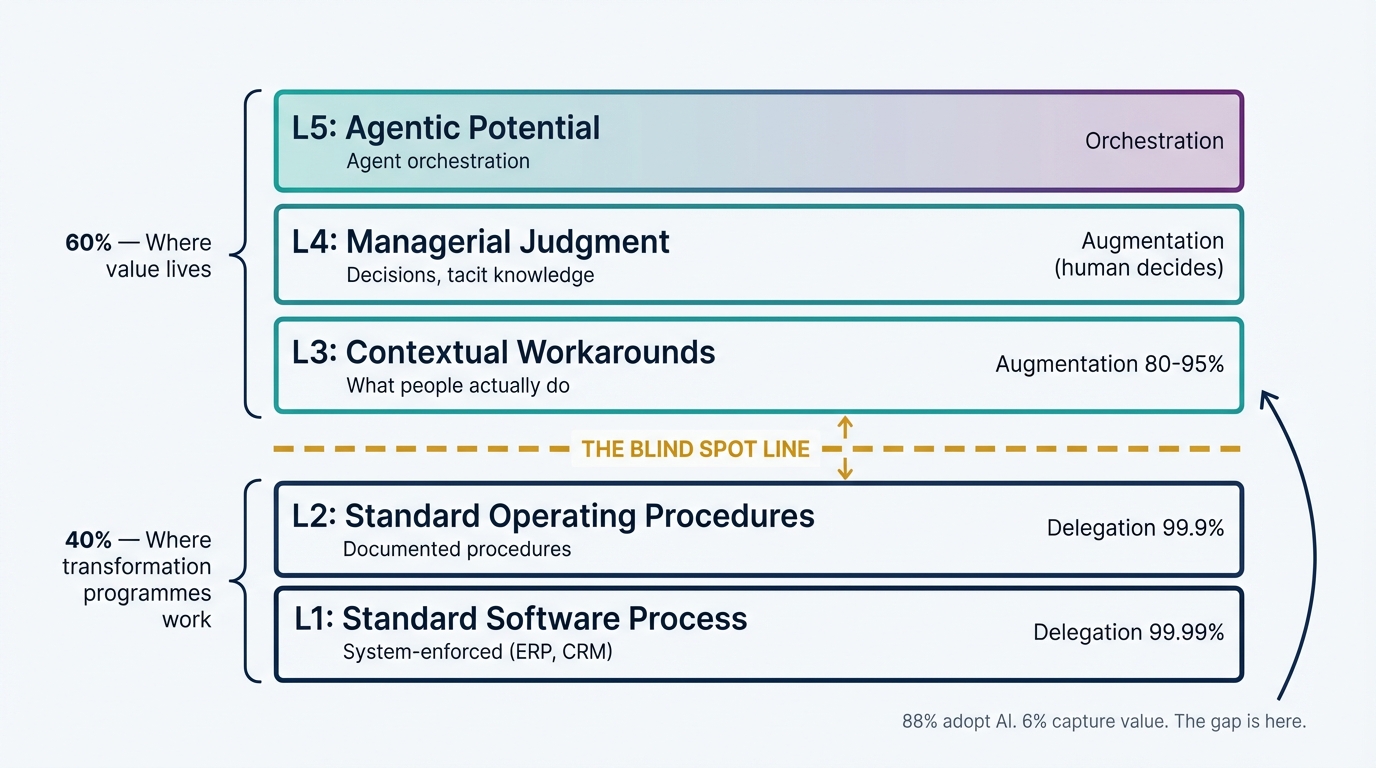
McKinsey's 2025 State of AI survey reports that 88% of enterprises have adopted AI. Six percent capture value. That 82-point gap IS the blind spot: AI deployed at Layers 1-2, value living at Layers 3-5. PE firms already operate at 80/20 — 80% AI tokens, 20% human salary. The 20% of humans who remain ARE the articulation layer: the people whose judgment directs what the AI does.
The Five-Layer discovery method has been validated through two rounds of six-persona cohort simulation. Round 1 returned CONDITIONAL GO. Round 2, after eight structural refinements, upgraded to GO FOR LAUNCH — completion rose from 75.1% to 83.6%, NPS from 7.4 to 8.2. The strongest finding: "start at Layer 4, work down" resonated universally across all six personas. Every persona produced specific, named, quantified Layer 3-4 content by Week 3.
This paper defines each layer in detail, maps the technology and agent deployment patterns, explains the four structural forces that preserve the blind spot, presents evidence from four public transformation failures, provides the complete 27-question articulation method, and connects the model to the O2O methodology, the Ambidextrous Operating Logic, and the Core/Context/Signature classification.
A note on positioning: the Five-Layer Model is a diagnostic for any enterprise transformation — ERP migration, operating model redesign, post-merger integration, digital transformation. The methodology uses AI as the instrument (agents that augment the discovery and classification work), not as the destination. Organisations whose goal IS AI adoption will find that articulating Layers 3-5 is the prerequisite for effective AI deployment — you cannot automate work you have not described. But the model applies equally to transformations where AI is not the primary objective.
The companion paper, The Transformation Capability Crisis, examines the broader market dynamics and historical precedent for TCM as a discipline. The full framework is available in the downloadable v7.5 PDF report.
1. The Problem Statement
Eighty-eight percent of enterprises have adopted AI in some form. Six percent are capturing value from it.
That gap is not a technology gap. Every major enterprise has access to the same models, the same platforms, the same hyperscaler partnerships. The technology is the commodity. The organisations that win are the ones that engineer their absorption capacity, not the ones that pick the best technology.
So where does the value disappear?
The answer lies in a structural blind spot that every transformation programme, every consulting engagement, and every systems integration shares. It is a blind spot preserved by the economics of the industry that profits from it.
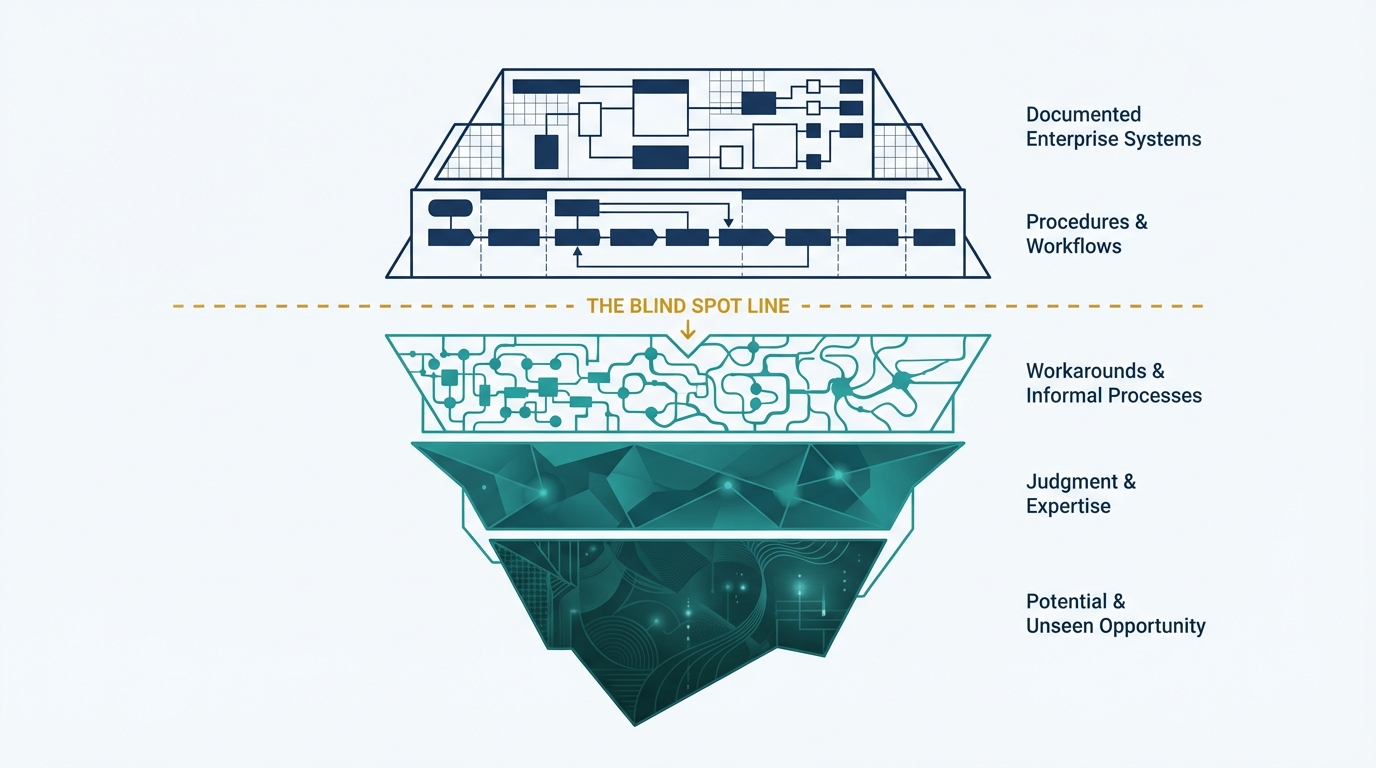
Every transformation programme addresses two things: the system (what the software does) and the procedures (how people are supposed to use it). These are the visible layers — the ones that get scoped, budgeted, delivered, and billed. They sit above what we call the Blind Spot Line.
Below that line is where 60% of the actual work happens. Contextual workarounds. Managerial judgment. Agentic potential. These layers are invisible to every standard delivery model — not because they are hidden, but because no standard delivery model has an economic incentive to make them visible.

The Urgency: Three Converging Signals
The 80/20 Token Economy. PE firms have already implemented — not planning, already doing — an 80% AI tokens / 20% human salary cost structure across portfolio companies (Dave Blundin, Link Ventures GP, March 2026). The remaining 20% of human workers are the most valuable people in the company — not because they do work, but because they direct it. They are the articulation layer. They are what makes the 80% effective.
The Fit-to-Standard Trap. The dominant enterprise transformation methodology — fit-to-standard — systematically evaporates an organisation's signature capabilities into workarounds. When you adopt vendor-standard processes, the 80% that is generic gets configured. The 20% that makes you distinctive migrates below the blind spot line. Agentic AI changes the economics of addressing those workarounds — but only if they are first articulated.
The $35 Brain. A year of human cognitive output costs approximately $35 in Claude tokens. The technology is not the bottleneck. Describing what to do with it IS. AI requires description to function. Agents can only do what you can describe. The description of Layers 3-5 work — the 27-step detail of how work actually happens in an organisation — is what does not exist. That description is what we build.
Simulation Validation
The Five-Layer discovery method has been validated through two rounds of six-persona cohort simulation testing the entry-level programme (Steps 1-5, Weeks 0-5). Round 1 returned CONDITIONAL GO: L3-4 discovery works universally, and every persona produced specific, named, quantified content by Week 3. Round 2, after eight structural refinements, upgraded to GO FOR LAUNCH — completion rose from 75.1% to 83.6%, NPS from 7.4 to 8.2, and conversion probability from 73% to 79%.
The strongest finding: "start at L4, work down" resonated universally across all six personas (CFO, CTO, PE-CEO, COO, Head of Transformation, Delegate).
2. The Five Layers — Detailed Definition
The Five-Layer Activity Model classifies all enterprise work into five distinct layers, each with its own ownership, documentation state, technology footprint, data types, and AI deployment pattern. The model was developed from direct BPO operating experience (a FTSE 250 multi-market ERP transformation), the Articulation Gap thesis, and Geoffrey Moore's Core/Context framework, extended with the Signature Process concept.
Layer 1: Standard Software Process
What it is. The work that the system enforces. When SAP says "this is how order-to-cash works," that is Layer 1. The process is configured into the software. Users follow it because the system gives them no alternative. It is the most rigid layer and the most visible — every ERP implementation project, every system migration, every go-live is primarily concerned with this layer.
Who owns it. IT and the system integrator. In operational state, IT Operations and the business process owners who govern configuration.
How it is documented. Extensively. System configuration documents, process flow diagrams, test scripts, technical design documents, functional specifications. This is the most-documented layer in any enterprise because it is the primary deliverable of every implementation project.
What technology sits here. ERP systems (SAP S/4HANA, Oracle Cloud, Microsoft Dynamics 365), CRM platforms (Salesforce, HubSpot), HCM systems (Workday, SuccessFactors), supply chain platforms. The core transactional systems that enforce business process execution.
What data types live here. Transactional data. Master data. System-enforced workflows. Configuration parameters. The structured, clean, governed data that ERP systems are designed to produce and consume.
What AI deployment pattern applies. Agentic automation — delegation. Agents executing standard transactions that the system already enforces. This is RPA evolved: agents that can process orders, post journal entries, execute reconciliations against defined rules. The reliability requirement is 99.99% because these are sequential, repetitive tasks. At 80% per-task accuracy, an agent running 50 sequential tasks has a 0.0014% success rate — one in 71,000. Layer 1 agents must be near-perfect or they break the system they are supposed to serve.
Finance example. Order-to-Cash enforced by SAP configuration. Record-to-Report with system-mandated close procedures. Three-way match in Procure-to-Pay driven by tolerance rules configured in the system.
What happens when transformation ignores this layer. It does not — this is where all transformations start. The entire ERP migration industry exists to address Layer 1. The problem is not that Layer 1 is ignored. The problem is that transformation stops here, or at most reaches Layer 2.
Layer 2: Standard Operating Procedures
What it is. The written procedures that tell people how to use the system. SOPs are the bridge between what the software can do (Layer 1) and what people need to do with it. They are system-specific, role-specific, and — in a well-run operation — maintained and versioned. The BPO world runs entirely on Layer 2: low-skilled operators who cannot improvise are given SOPs precise enough to execute consistently. Every BPO centre is a Layer 2 machine.
Who owns it. Process owners, business analysts, SOP writers. In a BPO model, a dedicated team maintains procedures against the system. Superusers resolve exceptions that fall outside the SOPs. In a non-BPO environment, ownership is often diffuse — SOPs exist in SharePoint folders nobody reads, maintained by nobody in particular.
How it is documented. Variable. In mature BPO operations, extensively documented with version control, change management, and regular validation against actual practice. In typical enterprise environments, SOPs exist but are outdated, incomplete, or contradicted by actual practice. The gap between documented procedure and actual behaviour is one of the earliest signals that Layers 3 and 4 are carrying load.
What technology sits here. Business Process Management (BPM) tools. Workflow engines. Documentation systems (Confluence, SharePoint). Process mining tools (Celonis, UiPath Process Mining). RPA platforms that automate documented procedures. Training and learning management systems.
What data types live here. Procedure documentation. Training materials. Compliance records. Workflow definitions. Audit trails of procedure execution.
What AI deployment pattern applies. Agentic automation — delegation, same as Layer 1. Agents following SOPs that are already written. The reliability requirement remains high (99.9%+) but with a critical addition: exception handling. A Layer 2 agent must know not only how to follow the procedure but when to escalate. The BPO parallel is precise: low-skilled operators execute SOPs, superusers handle exceptions, and management governs the boundary between the two. An agent architecture mirrors this exactly.
Finance example. Month-end close checklist. Reconciliation procedures with defined tolerance thresholds and escalation paths. Approval workflows for journal entries above a certain value. Intercompany elimination procedures.
What happens when transformation ignores this layer. People do the work but nobody knows HOW they do it. New systems get installed (Layer 1) without corresponding SOPs (Layer 2), and the organisation relies on tribal knowledge to bridge the gap.
The Layer 2 transition state problem. The description above is steady state. In practice, Layer 2 is where the most violent disruption occurs during transformation. During deployment, the organisation operates dual systems (legacy + new), dual data models (old GL mapped to new GL), dual reporting structures (legacy financial and managerial consolidation alongside new system reports), and dual SOPs. Standard pricing procedures that do not fit local laws or local practice degrade the global template — generating workarounds in L2 SOPs that become the norm.
The transition architecture is enormously complex: intercompany trading hubs where flows switch from legacy to new system entity by entity, month-end close running across two system states, AP, supply chain, demand management, budgeting, forecasting, and consolidation all operating across old and new simultaneously. Legacy data models mapped to new models (the GL in S/4, for example) then mapped back to old reporting structures for statutory consolidation while both systems are live. The manual reconciliation effort during this transition can implode and destroy value.
The critical failure mode: temporary workarounds created to manage the transition become permanent. They get documented in BPO operations manuals or simply become "how we work." Huge spreadsheets of manual reconciliations to approve intercompany invoices persist because the new system cannot handle the edge case — perhaps because no procedure exists to update purchase info records on annual price uplifts, causing mismatch errors that break automation. When the software impacts a signature process or an industry non-negotiable way of working, and the software cannot bend, the workaround becomes structural.
The design aspiration: touchless operations. In principle, the shift to touchless finance (or touchless operations in any function) means collapsing current L3 workarounds and L2 manual procedures into a fully automated L1. This is the design target. But as the Secret CFO correctly identified, ERP did not deliver the last 10%. That 10% is the tech debt carried forward — where the system does not meet the reality of real-world requirements. It is another driver of manual Excel-based workarounds. And the more granularly you track or automate, the more you have to change when things change — pushing toward granularity increases both value and volatility.
Layer 3: Contextual Workarounds
What it is. The work people actually do because the system cannot do it for them. Every enterprise has Layer 3 — the spreadsheets, the manual processes, the email chains, the shadow IT, the "we do it this way because the system can't." Layer 3 is the scar tissue of every incomplete system implementation. It is known by the operators who do the work, rarely documented, and structurally invisible to anyone who only looks at Layers 1 and 2.
Who owns it. The people who do the work. Finance analysts. Operations managers. Supply chain coordinators. The mid-level specialists who bridge the gap between what the system delivers and what the business needs. These are often the most valuable people in the organisation and the hardest to replace — because their value IS the workaround knowledge itself.
How it is documented. Rarely. Layer 3 lives in spreadsheets saved to personal drives, in email chains between people who know the workaround, in the heads of the three people who know how to do the monthly reforecast because the planning tool does not handle the edge cases.
What technology sits here. This is where the critical insight lives — and it is the intellectual contribution of this paper.
Layer 3 is not just Excel. Layer 3 is where the real analytical work of the enterprise happens. Consolidation systems (SAP BPC, Oracle HFM, OneStream). Planning tools (Anaplan, SAP IBP, Adaptive Insights). Forecasting platforms. Data warehouses. Data lakes. Data fabric architectures. BI and analytics platforms (Tableau, Power BI, SAP Analytics Cloud, Qlik). These are the systems that exist BECAUSE the core ERP (Layer 1) cannot do what the business needs.
The Secret CFO captured this precisely: "Excel is the pain relief for tech debt, not the cure." Every consolidation tool, every planning platform, every data warehouse is a Layer 3 technology — a workaround built over a gap in Layer 1. Some of these workarounds have become multi-billion-dollar product categories. Anaplan is a Layer 3 company. Tableau is a Layer 3 company. The entire business intelligence industry exists because Layer 1 systems do not deliver the analytical capability that Layer 4 decisions require.
What data types live here. Analytical data. Consolidated views. Forecasts. Budget scenarios. Data that has been extracted, transformed, and loaded from Layer 1 systems into something the business can actually use for decision-making. The 4,000-line spreadsheet marking up invoices because transfer prices were not loaded correctly (real example from a FTSE 250 multi-market ERP transformation). The reconciliation workbook mapping between three different chart-of-accounts structures because the global template does not fit the local business.
What AI deployment pattern applies. Decision support AI — augmentation. Agents working on planning data, consolidation, forecasting. Agents that can read the 4,000-line spreadsheet, understand why it exists, and either fix the upstream Layer 1 problem or automate the workaround. The reliability requirement shifts fundamentally at Layer 3. Unlike Layers 1-2, where agents must be near-perfect at sequential repetitive tasks, Layer 3 agents operate iteratively and collaboratively with humans. An 80-95% accuracy level is workable because the human validates the output. The agent proposes; the human validates.
Finance example. The Secret CFO's entire Tech Debt series is a Layer 3 catalogue. "We automated the downstream consequences" — RPA applied to reconciliation exceptions that exist because master data was never set up correctly at Layer 1. The FP&A system that was selected before requirements were written, evaporated with no post-mortem, and left a division still using Excel twenty years later. Every one of these is a Layer 3 technology solving a Layer 1 failure.
What happens when transformation ignores this layer. Workarounds multiply. Technical debt compounds. The gap between "what the system does" and "what people actually do" widens with every release. The Secret CFO's 90/10 problem: "The assumption for two decades was that we could bend the business to conform to the system's rules. Most got 90% there. But 90% is nowhere near enough to reap downstream benefits. The only way out is addressing the last 10%." That last 10% IS Layer 3.
Layer 4: Managerial Judgment
What it is. The decisions that people make using the information from Layers 1-3. When to override the forecast because you know the customer relationship is souring. Whether to accelerate the supplier payment because the supply chain is fragile. How to prioritise five transformation initiatives when the organisation can only absorb two. Which exceptions to escalate and which to absorb.
Layer 4 is largely unarticulated. It lives in people's heads. It is the accumulated institutional memory, political intelligence, and professional judgment that experienced managers bring to their work. It is the reason that a 25-year finance director produces different decisions from the same data than a three-year finance manager. The data is the same (Layers 1-3). The judgment is different (Layer 4).
This is where the "frozen middle" sits. The term has been validated by NBER, PwC, Deloitte, McKinsey, and Forrester independently — five separate research traditions converging on the same finding: middle management is the bottleneck in transformation. The Five-Layer Model explains why. Middle managers are Layer 4 operators. Their value is their judgment. Transformation programmes address Layers 1-2 (new system, new SOPs), sometimes Layer 3 (new BI tools), but never Layer 4. The middle manager is asked to make the same decisions with a new system — and they do. New inputs, same judgment process, same outputs. That is why the 88/6 gap exists. The value dies at Layer 4.
Who owns it. Middle managers. Department heads. Function leads. VPs. The people who make the daily and weekly decisions that determine whether the organisation's strategy actually executes.
How it is documented. Almost never. Layer 4 is the most valuable and least documented layer in any enterprise. Decision patterns are not written down. Exception handling heuristics are not codified. Political intelligence is not logged. Institutional memory is not captured. When a senior manager leaves, an irreplaceable body of Layer 4 knowledge walks out the door.
What technology sits here. Decision support tools. Analytics dashboards. Scenario modelling platforms. AI copilots. But mostly — nothing. This layer is largely unsupported by technology because the decisions it contains have never been articulated. You cannot build technology for work you have not described.
What data types live here. Tacit knowledge. Institutional memory. Political intelligence. Exception patterns. Decision heuristics. Relationship maps. Risk intuitions. The data that lives in the heads of experienced practitioners and has never been written down — because nobody has ever asked them to write it down, and no system exists to capture it.
What AI deployment pattern applies. Decision augmentation. Layer 4 agents surface options, model scenarios, and present trade-offs — but HUMANS decide. The agent advises; the human judges. The question is not "is the agent right?" but "does the agent help the human make a better decision?"
Finance example. The CFO deciding whether to override the forecast because they know the customer relationship is souring — judgment that no system captures. The finance director choosing to accelerate the month-end close for one entity because they know the group consolidation has a hard deadline that the system does not enforce. The controller approving a manual journal entry that breaks the automated reconciliation because they understand the commercial context behind the exception.
The finance function illustrates this precisely. The transition from "running the numbers" (Operator/Custodian — Layers 1-2) to "directing the business" (Driver/Leader — Layers 3-4) is a Layer 4 capability shift. Most finance organisations are stuck at Operator-Custodian because the industry has invested in Layer 1 systems and Layer 2 procedures without ever articulating the Layer 4 judgment that converts numbers into decisions. The Secret CFO captured this as "learned helplessness" — a perfectly rational response to repeated failure in a game stacked against them.
What happens when transformation ignores this layer. This is where transformation value dies. New systems get installed (Layer 1), new SOPs get written (Layer 2), new BI tools get deployed (Layer 3), but the DECISIONS do not change. People use the new system to make the same old decisions. That is why 88% adopt AI but only 6% capture value. The AI is at Layers 1-3. The value creation is at Layer 4. And Layer 4 was never addressed because no delivery methodology has a step for "articulate the managerial judgment that makes this system valuable" and no consulting firm has a revenue model for "make the client's managers better decision-makers."
Layer 5: Agentic Potential
A note on Layer 5 as aspirational. Layer 5 is emerging rather than established. BusinessGPS positions Layer 5 as the operational horizon that becomes available when Layers 2–4 have been articulated at agent resolution. As of 2026-Q2, Layer 5 is live in a small number of pioneer organisations and remains a forward-looking design target for most enterprises. Readers should treat Layer 5 as a direction of travel whose practical timescale is eighteen to thirty-six months for most organisations, dependent on the pace of Layer 3–4 articulation. Layer 5 is the quadrant where The Capability Reclassification Matrix names Capability Drift as the distinctive failure mode — the pattern of defaulting to vendor-driven orchestration architectures instead of building sovereign capabilities.
What it is. The future state — what becomes possible when Layers 2-4 are articulated at agent resolution. Layer 5 does not exist yet in most organisations. It is the potential that becomes available when the work at Layers 3-4 is described clearly enough that agents can participate in it. It is the orchestration layer that coordinates agents across all other layers, manages the workflow of the entire system, and learns from each cycle.
Who owns it. In most organisations today: nobody. In organisations that have begun articulating Layers 3-4, ownership sits with the transformation architect, the enterprise architect, or whatever role governs the intersection of technology capability and business operating model.
How it is documented. As codified expertise. Agent definitions. Skill files. Knowledge graphs. Decision frameworks. Vector databases. Markdown-based knowledge architecture. Layer 5 documentation is fundamentally different from Layers 1-2: it is not procedure documentation (how to do X), it is capability documentation (what the system knows, how it reasons, what judgment frameworks it applies).
What technology sits here. Agent orchestration platforms. Multi-agent systems. Workflow engines. Knowledge architectures: vector databases (Pinecone), knowledge graphs (Neo4j), markdown-based knowledge systems. The data type is not transactional or analytical — it is knowledge data.
What AI deployment pattern applies. Full orchestration. Agents coordinating agents, managing workflows, governing the entire stack. Not just doing tasks (L1-2), not just supporting analysis (L3), not just advising decisions (L4) — but MANAGING the system of tasks, analysis, and decisions.
Finance example. An agent ecosystem that orchestrates the month-end close across multiple entities, multiple currencies, multiple regulatory regimes. The orchestration agent knows which entities are ready, which are blocked, what exceptions have been flagged, which human decisions are pending, and what the overall timeline looks like. It coordinates transaction agents (L1), procedure agents (L2), analytics agents (L3), and decision support agents (L4) into a coherent workflow. This does not exist today. It will exist within 18 months for organisations that articulate their Layers 3-4.
What happens when transformation ignores this layer. The opportunity cost is invisible because the opportunity is not yet real for most organisations. Organisations that never articulate Layers 3-4 will never reach Layer 5. They will continue to deploy AI at Layers 1-2 and wonder why the value capture remains at 6%.
3. The Technology Stack Mapping
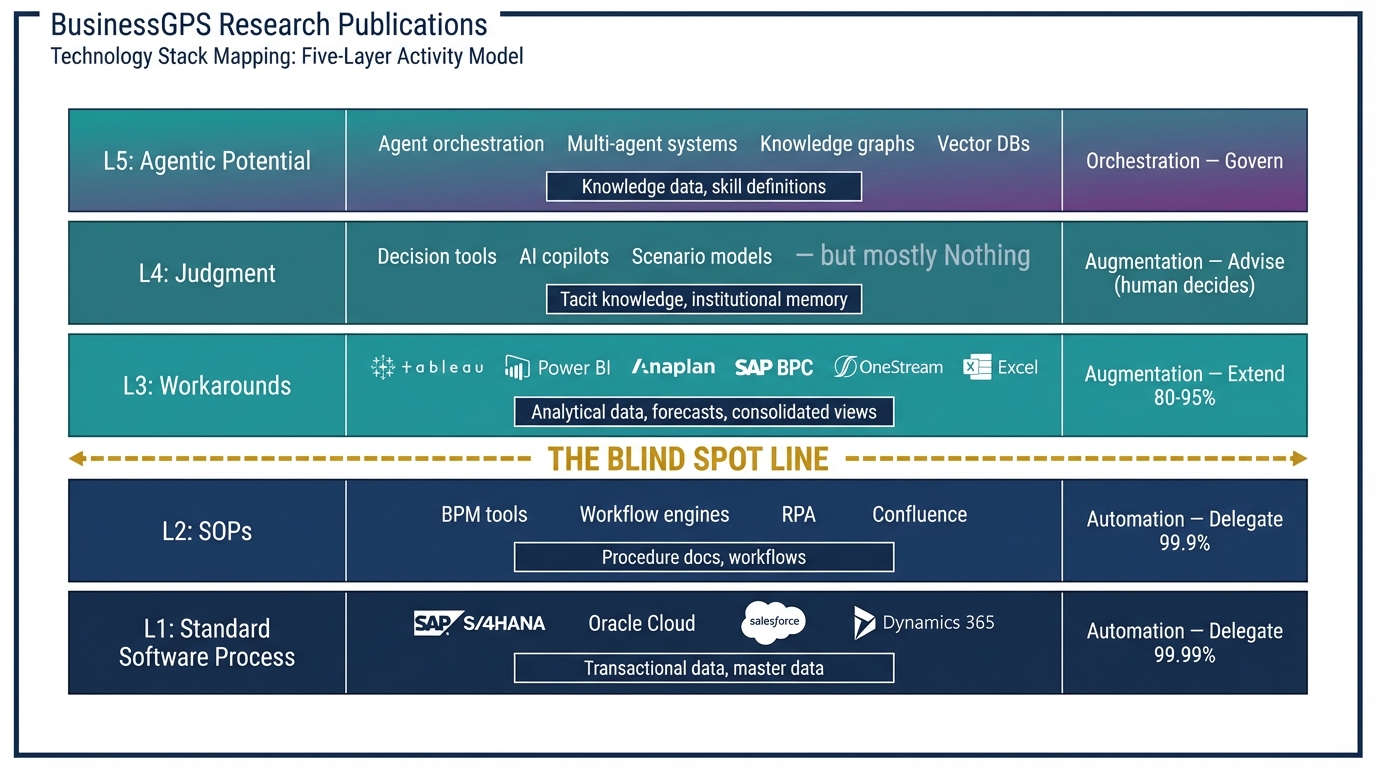
The Five-Layer Model creates a technology architecture that has not been mapped before. Every enterprise has technology at every layer — but the technology is rarely understood as a layered stack with fundamentally different deployment patterns at each level.
How Agents Deploy Differently at Each Layer
The critical finding — informed by METR benchmark reliability data — is that agent deployment patterns are fundamentally different at each layer. Treating "AI deployment" as a single category is the category error that leads directly to the 88/6 gap.
| Layer | Agent Type | AI Pattern | Reliability Need | Human Role |
|---|---|---|---|---|
| 1 | Transaction agents | Automation (delegation) | 99.99% — sequential tasks | Monitor only |
| 2 | Procedure agents | Automation (delegation) | 99.9% — with exception handling | Exception handler |
| 3 | Analytics/planning agents | Augmentation (extension) | 80-95% — human validates | Validator and director |
| 4 | Decision support agents | Augmentation (extension) | N/A — agent advises, human decides | Decision maker |
| 5 | Orchestration agents | Orchestration | System-level governance | Architect and governor |
The WHERE Dimension: Sourcing Model Per Layer
The Five-Layer Model adds a fourth dimension to strategic classification. Beyond WHAT (the five layers), WHY (Core/Context/Signature), and WHEN (as-is to transition to target), there is WHERE: where does the work get done?
| Layer | Context Sourcing | Core Sourcing | Signature Sourcing |
|---|---|---|---|
| L1 | Standard config, SSC/outsource | System-enforced, in-house | Custom config, protect |
| L2 | Standard SOPs, BPO candidate | Documented, maintained in-house | SOPs are IP, protect |
| L3 | Outsource or automate | Articulate + agent-ready | Keep in-house, articulate |
| L4 | Simplify/eliminate | Decision support agents | NEVER outsource |
| L5 | Automate fully | Augment + govern | Augment carefully, protect IP |
4. The Blind Spot Line
The Blind Spot Line between Layer 2 and Layer 3 is not accidental. It is preserved by four structural forces that are unlikely to change without a new discipline addressing them.
1. Economics
Layers 1-2 are where the billable hours are. ERP migrations run into the hundreds of millions. Process redesign engagements run into the tens of millions. Layers 3-5 are messy, unarticulated, and hard to bill for. You cannot write a statement of work for "articulate the managerial judgment your mid-level leaders carry in their heads."
2. Methodology
Every major delivery methodology — SAP Activate, Oracle's Unified Method, Agile frameworks, PRINCE2, MSP — is designed for Layers 1-2. No standard methodology has a step for "discover what people actually do that is not in the SOPs" or "codify the judgment patterns that make this system valuable." TCM is being built to fill this gap.
3. Incentives
Systems integrators are paid to deliver systems (Layer 1) and train users (Layer 2). Their revenue model ends at the Blind Spot Line. More precisely: their revenue model depends on the Blind Spot Line existing.
4. The Dependency Trap
The blind spot is not just an oversight. It is a preserved feature of the consulting business model. Independence is the only underserved desire in enterprise transformation. Every competitor's revenue model depends on client dependency. No competitor can address Layers 3-5 without cannibalising their own business model. This is emergent behaviour from incentive structures, not conspiracy.
The IT Services Value Chain Friction
The broader IT services value chain has eight friction points between buyer and seller: awareness gap, articulation gap, competitive bid waste, sales-to-delivery handover, delivery-to-value gap, knowledge loss, and the 10-year amnesia cycle. Major systems integrators win approximately one in three competitive bids, meaning two-thirds of their most expensive pre-sales people invest time that produces zero revenue — costs that are loaded onto the deals they do win through inflated day rates. This structural waste is passed to clients and has not fundamentally changed since the industry's formation.
Independent Validation: The Secret CFO
The Secret CFO independently validated every dimension of the blind spot in a two-part Tech Debt series (March 2026), without having encountered the Five-Layer Model:
- "Excel is the pain relief, not the cure" = Layer 3 catalogued
- "Learned helplessness" = Layer 4 paralysis named
- "90% implementation is nowhere near enough" = Layers 3-5 quantified
- "They don't have customers. They have hostages" = the dependency trap identified
- "We automated the downstream consequences" = fixing L1 symptoms of L3-4 root causes
- His eight diagnostic questions approximate the systematic uncovering method
The Secret CFO described a four-layer finance stack — ERP at the base, then process layer, then analytics/BI, then decision layer on top — with "agents inside layers" handling automation and "agents across layers" handling orchestration. This maps precisely to the Five-Layer Model: L1, L2, L3, L4, with L5 as the cross-layer orchestration. The independent convergence is the strongest external validation available.
5. The Articulation Gap
Definition. The Articulation Gap is the delta between what people actually do (Layers 3-4) and what is documented and codified (Layers 1-2). Closing this gap IS Transformation Capability Management.
The Articulation Gap has always existed. What makes it critical NOW is that AI requires description to function. An agent can only do what you can describe. Layers 1-2 are described. Layers 3-4 are not. That is where the 88/6 gap lives.
The BPO Parallel
The BPO world solved the articulation problem for Layers 1-2 because economics demanded it. The hierarchy maps directly to an agentic architecture:
| BPO Role | Function | Agentic Equivalent |
|---|---|---|
| SOP writers | Articulate the work | The articulation layer — what TCM builds |
| Low-skilled operators | Execute the SOPs | Agents — execute codified procedures |
| Superusers | Resolve exceptions | Human-in-loop — handle what agents cannot |
| Management | Decide and prioritise | Orchestration — governance, constraint management |
The AI era demands the same articulation for Layers 3-5 that BPO demanded for Layers 1-2. And no methodology exists for that articulation — except TCM.
The Expert Window
There is an 18-month window — roughly through to the end of 2027 — during which experienced practitioners can still direct AI better than AI directs itself. Organisations that articulate their Layers 3-4 during this window will capture the expertise of their most experienced people in a form that agents can use. Organisations that wait will face the risk that those experienced people retire, move on, or burn out — and the institutional knowledge goes with them, unarticulated and unrecoverable.
6. Core/Context/Signature Classification
Geoffrey Moore's original Core vs Context framework (Dealing with Darwin, 2005) classifies every business activity as either core or context. BusinessGPS extends this with a third category — Signature — defined in full in the canonical Terms of Reference (CCS / O2O / Three Forges v1.1, BusinessGPS, 2026-04-22) and summarised here.
- Signature is exclusive to the business — cannot be replicated in any system or platform. Must be owned. It may be a competitive moat (unique methodology, proprietary IP, firm-defining judgment) or a constraint-born necessary uniqueness (bespoke statutory or compliance architecture that the firm's specific situation requires). Both must be owned. The v1.1 refinement of Signature to include constraint-born uniqueness is load-bearing for multi-jurisdictional firms whose unique legal or regulatory structure does not fit standard tooling.
- Core captures capabilities whose design and ownership materially affect business outcomes, even when standard tooling exists for execution. Revenue-facing and back-office capabilities can both be Core; what makes them Core is the strategic weight of the ownership decision, not the revenue line. Core is the conscious-decision layer — rent, buy, borrow, or build decided deliberately per capability.
- Context is commodity. Industry-standard, fully standardised, no differentiation value in the design or ownership decision. Always rent at lowest credible cost. Context classification is not the same as "cross-industry commodity" in the narrower original sense; Context under canonical v1.1 is any capability where the ownership decision carries no strategic weight, horizontal or vertical.
The distinction is critical: renting Context is the only rational choice. Renting Signature is existential. The Core decision — rent, buy, borrow or build — is where the strategic-weight choice lives, and canonical definitions are documented in the companion Rent / Buy / Borrow / Build — Practical Definitions v1.0 protocol.
CCS classification is firm-specific, not capability-generic. Pricing is Context for a commodity retailer, Core for most mid-caps, Signature for a specialist insurer whose risk model is the business. Business partnering is Context for a shared-services function, Core for most firms, Signature where the CFO-to-business-unit partnership model is itself a competitive asset. Every engagement produces its own firm-specific CCS map.
CCS is also a snapshot plus a trend. Every capability carries both a current label and a directional vector. Four canonical movements matter: Core → Context (commoditisation), Signature → Context (leakage — the sovereignty risk), Context → Core (re-strategisation under regulatory/geopolitical pressure), and Unclaimed → Signature (emergence — the exit-multiple generator). The companion paper The Capability Reclassification Matrix (v1.0) operationalises CCS in a 2×2 geometry and provides the full treatment of directional movement, quadrant-specific failure modes, and the map that CCS labels alone cannot produce.
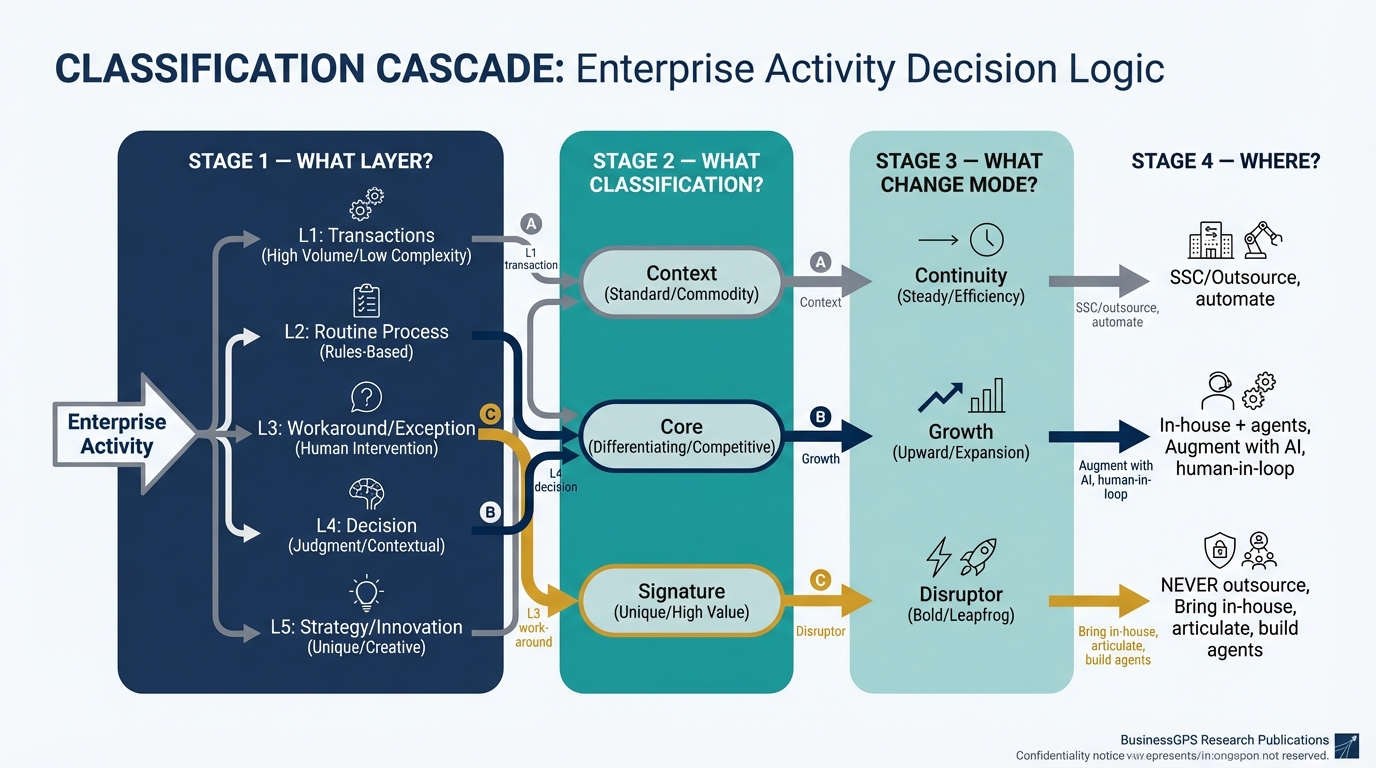
The Classification Cascade
What layer? -> What classification? -> What change mode? -> WHERE does it get done?
Example chains:
- Layer 3 workaround -> Signature -> Disruptor mode -> Bring in-house, articulate, build agents
- Layer 1 transaction -> Context -> Continuity mode -> SSC/outsource, automate
- Layer 4 decision -> Core (revenue) -> Growth mode -> Augment with AI, human-in-loop
The Signature Boundary Shift
AI shifts the signature boundary. What WAS signature — "our people are really good at X" — may become context when agents can do X. New signature becomes "our ability to articulate and orchestrate X at scale" — a management capability (Layers 4-5), not an operational capability (Layers 1-2). The signature process shifts upward.
This creates an amplification opportunity. Standard software (Layer 1) plus a custom agentic layer for signature work (Layer 5) equals the best of both worlds: commodity foundation with proprietary intelligence on top. Now that coding is accessible through AI-assisted development, signature processes that previously could not be custom-coded because it was too expensive now CAN be.
The 80/20 Filter
- Start with signature. What are the two or three processes that embody your competitive strategy?
- Find the largest Articulation Gap. Where is the delta between documented (L1-2) and actual (L3-4) largest?
- Find the highest-value agent opportunity. Score using the Cognitive P&L: cost of current human effort, value of the output, risk if the agent gets it wrong, ease of articulation.
The Capabilities Layer
The Five-Layer Model operates at the activity level. But activities sit within a hierarchy:
- Value streams / value chains identify capabilities
- Capabilities decompose into processes
- Processes decompose into activities
- Activities are where the Five-Layer classification applies
The Core/Context/Signature classification primarily operates at the capabilities level, not the activity level. You do not classify individual journal entries as signature — you classify the financial planning and analysis capability, which then cascades down to determine how its constituent activities are treated across the five layers.
Tools and Methods Inventory
| Tool | What It Does | Layer Application |
|---|---|---|
| Theory of Constraints (Five Focusing Steps) | Identifies the binding constraint in any system | All layers — which layer is the bottleneck? |
| Logical Thinking Process (CRT, FRT, TT, PRT) | Maps cause-effect chains and designs transition paths | Layers 3-5 — transition state management |
| Value Stream Mapping | Visualises flow and waste across a process | Layers 1-3 — where does value leak? |
| Wardley Maps (evolution axis) | Maps components by visibility and evolution stage | All layers — commodity vs custom? |
| Cognitive P&L | Scores activities on automation/augmentation potential | Layers 2-4 — where should agents deploy? |
| Process Mining | Discovers actual process execution from system logs | Layer 3 — what do people actually do? |
| Decision Mapping | Maps who makes what decisions with what information | Layer 4 — articulating managerial judgment |
7. Evidence: Four Transformation Failures Through the Five-Layer Lens
The Five-Layer Model is not a theoretical construct. We tested it against four public case studies presented by practitioners at the Business Transformation World Summit 2026. Each case describes a transformation that failed despite competent leadership, adequate funding, and proven technology. In every case, the failure occurred below the Blind Spot Line. We applied multi-framework diagnostic analysis (Kotter, ADKAR, Heath, Lencioni, Bridges) to each case, and the Five-Layer Model explains what every individual framework sees only partially.
A note on case presentation. Some cases in this section are identified by the originating practitioner presentation venue (Dentsu, Roche); others are treated as composites. BusinessGPS is progressively moving to consistent de-identification across all published cases. The diagnostic interpretation attached to each case is BusinessGPS's own and should not be read as endorsement by the presenting organisations.
A note on the Five Archetypes. The five diagnostic archetypes introduced below — Identity Violation, Champion Trap, Sovereignty Violation, Leadership Vacuum, Governance Theatre — are presented here in summary form. The full treatment, including archetype-by-archetype discussion of the structural causes and intervention design, appears in the companion paper TCM Discipline: The Missing Discipline v2.0 (2026-Q2). This paper uses the archetypes as illustrative evidence for the Five-Layer diagnosis; the companion paper owns the full discipline-level treatment.
Dentsu: The Identity Violation
A global operations platform was designed to replace fragmented, locally-crafted Excel processes with an integrated enterprise system. The initiative addressed Layer 1 (new platform) and Layer 2 (global process blueprint) comprehensively.
What it missed: the Excel processes were not deficiencies. They were Layer 3 contextual adaptations that local teams had built over years to handle market-specific requirements. More critically, those workarounds represented Layer 4 — professional competence and local expertise that constituted the operational identity of each market team.
The programme delivered a system. It displaced a body of unarticulated knowledge. Within months, adoption stalled, teams created new workarounds, and confidence in the platform collapsed. What was diagnosed as "silent resistance" was, through the five-layer lens, a rational response: people were defending the Layer 3-4 knowledge that the programme had classified as waste.
The subsequent finance transformation — applying lessons learned — achieved over 90% adoption in the first year through a "trust-led" rather than "tech-led" approach. The technology did not change. The absorption architecture changed.
Archetype: Identity Violation — transformation that displaces Layer 3-4 knowledge without recognising it as organisational identity.
Roche (Previous Company): The Champion Trap
An operational excellence programme at a billion-dollar manufacturer delivered tens of millions in savings and certified over 150 Lean Six Sigma practitioners. By every Layer 1-2 metric — savings generated, belts certified, projects completed — the programme was a success.
Then the programme leader left. The programme disintegrated. The team was disbanded.
The five-layer analysis reveals why: the programme generated Layer 1-2 outputs (documented savings, certified skills) but never transferred Layer 4 judgment — the decision-making capability, the organisational instinct for continuous improvement — to the broader organisation. The champion held the Layer 4 knowledge. When she left, it left with her. Fifteen years of accumulated managerial judgment about how to run an excellence programme, how to navigate political resistance, how to sequence improvement initiatives — all of it unarticulated, all of it concentrated in a single person.
The conventional diagnosis was "failure to embed in culture." The five-layer diagnosis is more precise: failure to articulate and distribute Layer 4 knowledge across the organisation. You cannot certify your way to culture change. 150 belts. Zero behavioural definitions. The organisation had more certified practitioners than most consultancies — and none of them practised without programme compulsion.
Archetype: Champion Trap — programme that generates outputs through a single champion's Layer 4 judgment without ever transferring that judgment to the organisation.
Volvo: The Sovereignty Violation
A global IT support transformation addressed Layer 1 comprehensively — a central platform to replace fragmented local support models across 50+ operating companies, each with its own CIO.
The contract was signed centrally. The operating company CIOs — who had built their own Layer 3-4 models over years, adapted to local regulatory environments, business requirements, and team capabilities — were not consulted. Their accumulated judgment about what worked in their context was not captured, classified, or preserved. It was simply overridden.
Resistance was immediate and structural. This was not change fatigue. It was a rational response from people whose Layer 4 sovereignty — their authority to make decisions about their own operations — had been violated without negotiation. Five independent diagnostic frameworks (Kotter, ADKAR, Heath, Lencioni, Bridges) all converged on a single finding: the programme treated a federation as a hierarchy. Every framework's diagnosis was a symptom of the same architectural error.
The programme was eventually restructured into a modular franchise model — common core, local adaptation, voluntary adoption — which succeeded precisely because it restored sovereignty at Layer 4 while maintaining standards at Layer 1.
Archetype: Sovereignty Violation — transformation that centralises Layer 1 in a federated organisation without negotiating Layer 4 sovereignty.
Innovation Stall: The Leadership Vacuum
A specialist manufacturer attempted to transition from niche market leader to innovation-driven platform company. An external consultant was engaged. Layer 1-2 analysis was extensive — weekly review cycles, R&D portfolio assessments, market analysis.
But no decisions were made. The CEO rarely attended briefings. Product leadership had no incentive to take risks. The consultant produced Layer 1-2 analysis in abundance, but Layer 4 — the executive judgment required to commit to a direction, accept risk, and force trade-offs — was structurally vacant.
The team was frozen in what we term "analysis-as-avoidance": comfortable weekly reviews that produced no decisions because the person with Layer 4 authority was absent and the structural incentives rewarded inaction. Five frameworks converged: leadership absence created a structural vacuum that no amount of consulting expertise could fill.
The same consultant later succeeded in a different role — as the leader of a public sector transformation — where he modelled the behaviour personally and made it safe for others to take risks. Same person, different structural position, opposite outcome. The variable was not capability. It was Layer 4 presence.
Archetype: Leadership Vacuum — transformation where Layer 1-2 analysis continues indefinitely because Layer 4 decision authority is absent.
The Five Archetypes
These four cases, plus patterns observed across additional transformations, yield five diagnostic archetypes:
| Archetype | What Happens | Layer Failure | Signal |
|---|---|---|---|
| Identity Violation | L3-4 knowledge displaced, classified as waste | L3-4 ignored | Silent resistance, workaround recreation |
| Champion Trap | Outputs through single champion, no transfer | L4 concentrated | Programme collapses on departure |
| Sovereignty Violation | Central L1 imposed on federated L4 owners | L4 overridden | Immediate structural resistance |
| Leadership Vacuum | L1-2 analysis continues, no L4 decisions | L4 absent | Analysis paralysis, comfortable reviews |
| Governance Theatre | Governance structures exist without L4 authority | L4 performative | Meetings without decisions, escalation without resolution |
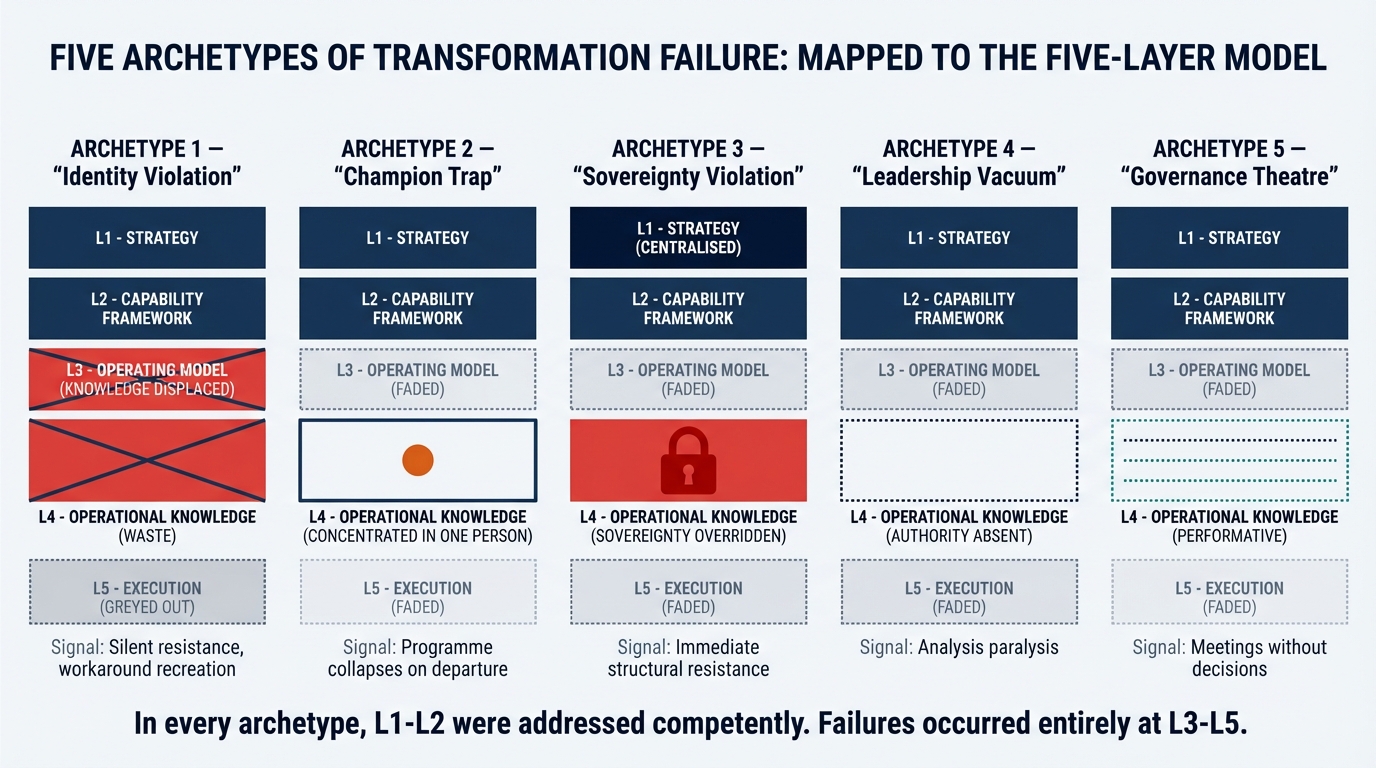
In every archetype, Layers 1 and 2 were addressed competently. Systems were implemented. Procedures were written. Methodologies were applied. The failures occurred entirely at Layers 3 through 5 — the layers that no standard transformation programme includes in scope.
8. The Articulation Method — L4 to L1 Discovery
The preceding sections define what exists at each layer and how to classify it. This section defines how to find it. This is the crown jewel of the Five-Layer framework: the operational method for discovering what lives below the blind spot line.
Discovery method matters because the industry's default approach — start at the system, work up — structurally guarantees that Layers 3 and 4 remain invisible. The articulation method reverses the direction. It starts where the knowledge lives and works down to where the systems sit.
8.1 The Front-Loaded Articulation Precedent
The principle of front-loaded articulation is not new. Between 1998 and 2020, a predecessor SAP reseller operation developed a three-tier questionnaire system that attacked the most expensive waste in enterprise IT: the gap between what buyers need and what sellers deliver.
| Tier | Audience | Purpose | Output |
|---|---|---|---|
| Executive Questionnaire | C-suite, MDs | Qualify, educate, build business case | Maturity classification, business checklist, scorecard |
| Level 1 | Functional leads | Articulate business processes by SAP module | ~1,017 questions across 12 modules |
| Level 2 | Technical/config leads | Detailed specification for configuration | Configuration-level technical specification |
The questionnaire answers became the legal contract baseline. There was no sales-to-delivery handover because the sales process was the delivery setup.
Five principles made this work — none are technology-specific:
| # | Principle | What It Means |
|---|---|---|
| 1 | Front-load articulation | Pull articulation work left — selling becomes delivering |
| 2 | Self-qualifying filter | Only serious prospects invest the effort |
| 3 | Generous value exchange | Client gets answers usable with any vendor |
| 4 | Flow into contract | Questionnaire answers become the legal baseline |
| 5 | Compound value | L1 feeds L2, L2 feeds contract, contract feeds delivery |
That system operated entirely above the blind spot line. All ~1,017 questions addressed Layers 1-2. The evolution trajectory tracks progressive deepening:
| Era | Method | Target | Approach |
|---|---|---|---|
| 1998-1999 | R/3 Questionnaires | Layers 1-2 | Static questionnaire (paper/Word). 12 SAP modules, ~1,017 questions. |
| 2020 | S/4HANA CFIN v5 Questionnaire | Layers 1-2 + beginning of Layer 3 | Static questionnaire with business management section. Added: pain points, opportunity points, FTE effort, process maps. |
| 2026 | TCM / Five-Layer Articulation Method | Layers 3-5 (with L1-2 validation) | Agent-guided conversation + structured capture. Capability-based, not module-based. |
The BusinessGPS platform already embodies these principles: front-loaded articulation, self-qualifying filter, generous value exchange, flow into engagement scope, and compound value accumulation.
8.2 The Direction: Start at Layer 4, Work Down
Every standard transformation methodology starts at Layer 1 and works up. The articulation method reverses this:
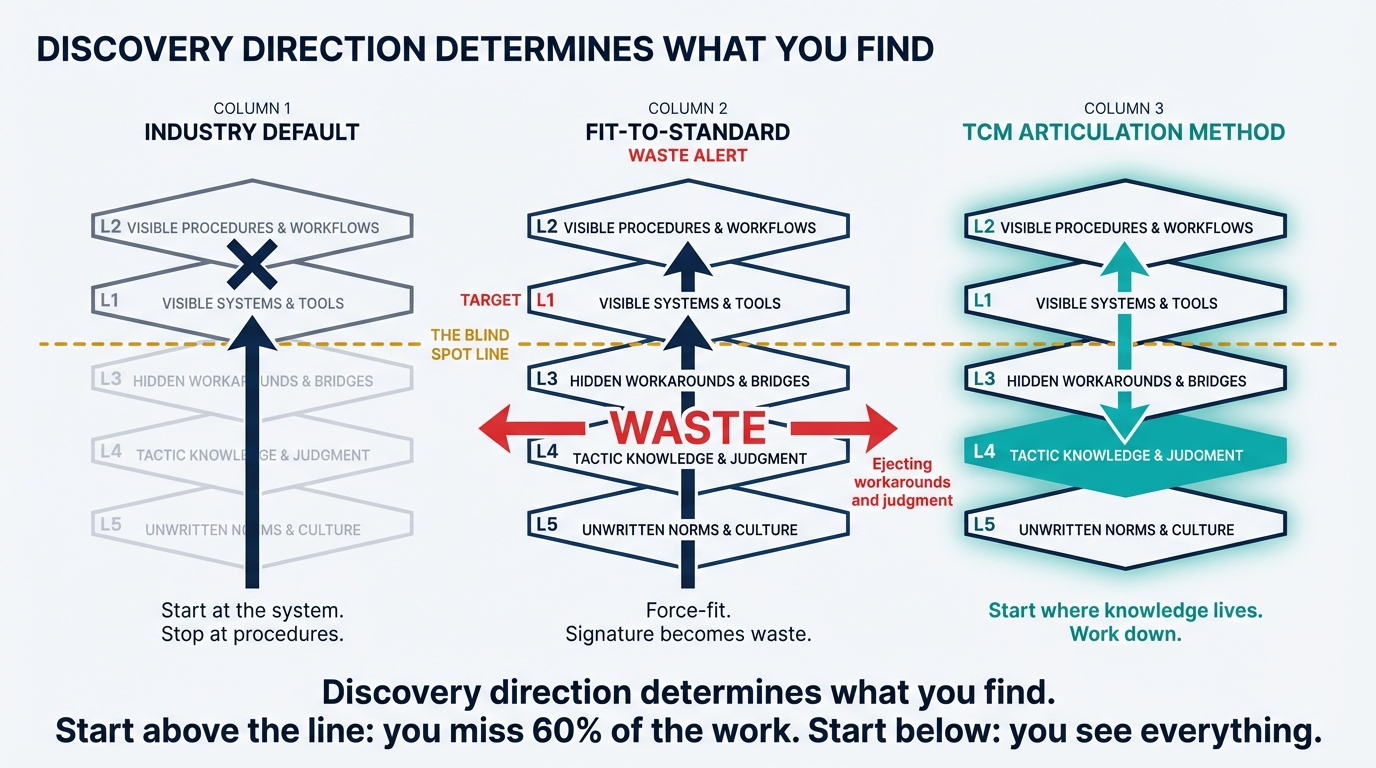
The Fit-to-Standard Trap. When an organisation adopts standard processes, its signature capabilities get pushed into workarounds (L3) and undocumented judgment (L4). The standard process handles the 80% that is generic. The 20% that makes the organisation distinctive migrates below the blind spot line.
Agentic AI changes the economics. An agent that automates a workaround costs a fraction of what custom development cost five years ago. But agents cannot automate what has not been articulated. The prerequisite for agentic automation is articulation. Articulation requires starting where the unarticulated knowledge lives — at Layer 4 — and working down.
8.3 Layer-by-Layer Discovery Protocol
Classification rule: As each finding surfaces, tag it Core/Context/Signature. This classification determines what happens to the finding: standardise (Context), automate (Core), protect and codify (Signature).
Layer 4: Managerial Judgment
What we are looking for. Decisions that are made regularly but never documented. Overrides of standard process. Judgment calls dependent on experience. Institutional memory that would be lost if a key person left.
Discovery questions:
| # | Question | What It Surfaces |
|---|---|---|
| 4.1 | "When the system tells you one thing but your experience tells you another, what do you do?" | Override patterns, trust boundaries |
| 4.2 | "If [key person] left tomorrow, what decisions would nobody know how to make?" | Single points of failure |
| 4.3 | "What do you check before signing off on [critical process]? Not the procedure — what do YOU actually look at?" | Judgment criteria in heads, not documents |
| 4.4 | "When was the last time you approved an exception to standard process? Walk me through your reasoning." | Exception logic, risk assessment |
| 4.5 | "What information do you wish you had when making [decision X] that the system does not give you?" | Data gaps that force judgment |
| 4.6 | "Which of your team's decisions have the biggest financial impact but the least documentation?" | High-value undocumented judgment |
| 4.7 | "What patterns do you recognise from experience that a new person would miss for two years?" | Tacit pattern recognition |
| 4.8 | "If you could teach an AI assistant to handle one recurring decision, which one would free the most time?" | Automation candidates |
Simulation finding: Question 4.2 scored 9.5/10 across all six personas in cohort simulation — the single most powerful discovery question in the protocol. It consistently surfaces the highest-value, least-documented judgment in any function. One Head of Transformation called it "the most dangerous question I have ever been asked."
Method: Agent-guided conversation. Judgment cannot be captured in multiple-choice forms.
Output: Decision inventory — decisions, decision-makers, criteria (stated and actual), frequency, financial impact, documentation state. Each tagged Core/Context/Signature.
Layer 3: Contextual Workarounds
What we are looking for. Spreadsheets supplementing or replacing system functionality. Manual data transfers. Reconciliation processes outside official procedures. Shadow IT. "The way we actually do it."
Discovery questions:
| # | Question | What It Surfaces |
|---|---|---|
| 3.1 | "What spreadsheets does your team maintain that feed into or correct system data?" | Shadow data, system gaps |
| 3.2 | "Where do you download data from one system to upload it into another?" | Integration gaps, manual bridges |
| 3.3 | "What reconciliation processes does your team perform outside the official close procedure?" | Undocumented reconciliation |
| 3.4 | "Which processes take significantly longer than they should because the system was not designed for your reality?" | Friction between standard and actual |
| 3.5 | "What tools has your team adopted that IT did not provide?" | Shadow IT, unmet needs |
| 3.6 | "Walk me through what happens when [standard process X] does not cover a real situation." | Exception handling, workaround triggers |
| 3.7 | "If I followed one of your team for a full day, what would I see that is not in any procedure manual?" | Actual vs documented practice |
Method: Agent-guided conversation to identify categories; structured follow-up to capture specifics. Spreadsheet audits validate findings.
Output: Workaround register — trigger, method, frequency, time cost, owner, dependencies, risk. Each tagged Core/Context/Signature.
Layer 2: Standard Operating Procedures
Discovery questions:
| # | Question | What It Surfaces |
|---|---|---|
| 2.1 | "When were your SOPs last reviewed against what people actually do?" | Documentation currency |
| 2.2 | "Which procedures do new joiners find most confusing or incomplete?" | Onboarding gaps |
| 2.3 | "Are there processes your team follows with no written procedure?" | Documentation gaps |
| 2.4 | "Which SOPs do people routinely work around, and why?" | Procedure-reality gaps |
| 2.5 | "How do exception cases get handled when the SOP does not cover the situation?" | Escalation paths, L4 triggers |
| 2.6 | "If you had to hand over your operation next month, what would you need to write from scratch?" | Missing documentation |
Method: Document audit + gap analysis. Process mining validates where behaviour deviates from documented procedures.
Output: SOP coverage map — processes vs documentation state. Gap items feed L3 workaround register or L4 decision inventory.
Layer 1: Standard Software Process
Discovery questions:
| # | Question | What It Surfaces |
|---|---|---|
| 1.1 | "Which system configurations do users complain about most?" | Pain points, workaround triggers |
| 1.2 | "What data do you not trust in the system, and what do you do instead?" | Data quality gaps |
| 1.3 | "Which integrations require manual intervention to keep working?" | Integration gaps |
| 1.4 | "What system functionality do you pay for but do not use?" | Implementation gaps |
| 1.5 | "What has changed in the business since implementation that the system does not reflect?" | Configuration drift |
| 1.6 | "Which system reports do people not trust, and what do they use instead?" | Reporting gaps (L3 signal) |
Method: System scan + configuration review. By the time discovery reaches L1, findings from L4-L3 provide context. A configuration that looks correct in isolation may be the root cause of a signature workaround identified at L3.
Output: System fitness assessment — configuration health, integration map, data quality scorecard, usage analysis. Cross-referenced against L3 workaround register.
8.4 Business Context Adaptation
The discovery protocol adapts to four common entry conditions:
| Entry Condition | Discovery Emphasis | Starting Point |
|---|---|---|
| Greenfield (buying new systems) | L4 heavy — capture judgment before it gets buried | "What decisions drive your business?" |
| System unfit (heavy workarounds) | L3 heavy — the workarounds ARE the operating model | "Show me the spreadsheets" |
| AI-first | L4 and L3 — find automation candidates | "What decisions consume the most time?" |
| Post-fit-to-standard | L3 and L4 — fit-to-standard created the problem | "What changed after go-live that nobody planned for?" |
Selective questioning. This is not an exhaustive mapping exercise. Apply the 80/20 filter: start with the 2-3 processes that embody competitive strategy, follow the TOC constraint, expand from findings rather than a predetermined scope.
8.5 The Acorn Principle: Read, Don't Ask
A critical lesson from activity-based costing applies directly to Layer 3-4 discovery. In the 1990s, attempts to capture indirect activity costs through surveys and interviews largely failed — people could not accurately describe how they spent their time, and many resisted the exercise. The breakthrough came from Time-Driven Activity-Based Costing: instead of surveying people, read the transaction data and derive the activity through business rules and time equations. No manual top-down surveys. No estimates. Read the organisational DNA from the transactions.
The articulation gap has the same structural problem. Asking people to describe their Layer 3-4 work has poor precedent. People cannot fully articulate tacit knowledge (that is why it is tacit). They may resist articulating judgment calls (knowledge is power). And self-reported activity data is notoriously inaccurate.
The implication: read first, then confirm. Use system logs, email patterns, calendar data, spreadsheet analysis, and process mining to INFER what people actually do. Then use agent-guided conversation not to discover from scratch but to VALIDATE and ENRICH what the data already reveals. This inverts the method from "ask then validate" to "read then confirm" — the same inversion that made TDABC succeed where traditional ABC failed.
In practice:
- L3 workarounds: Process mining + spreadsheet audit identifies the workarounds. Conversation identifies the WHY.
- L4 judgment: Decision logs, exception reports, and escalation patterns identify THAT decisions are being made. Conversation captures the REASONING.
- L1-2: System scans and document audits are already data-driven.
Simulation confirmation: Cohort simulation confirmed that the conversational approach works effectively even without full process mining data as a precursor. When questions are specific and evidence-based, participants articulate Layer 3-4 knowledge that they could not have described from a blank prompt. The "read then confirm" principle holds, but "ask with specificity" also works when read data is not yet available. Every persona in both simulation rounds produced named, quantified L3-4 content by Week 3 using discovery questions alone.
8.6 Agent-Augmented vs. Static Questionnaire
Layer 3-4 knowledge resists static questionnaires. A finance director who overrides the forecast every quarter does not think of it as a "judgment call." A static questionnaire gets "sometimes." A conversational agent gets the reasoning, the data sources, the criteria, the triggers.
| Aspect | Static Questionnaire | Agent-Guided Conversation |
|---|---|---|
| Best for | L1-2 (structured) | L3-4 (judgment-laden) |
| Follow-up | None | Immediate, adaptive |
| Captures reasoning | Rarely | By design |
| Scales | Easily | Harder |
The hybrid model: L4 discovery uses agent-guided conversation -> structured capture -> decision inventory. L3 uses agent-guided conversation -> structured questionnaire -> workaround register. L2 uses document audit -> structured gap analysis -> agent-guided validation. L1 uses system scan -> structured review -> cross-reference against L3.
8.7 Transition States and Versioning
Design for transition states, not end states. An end-state design assumes you can define the destination before you understand the starting point. But Layers 3-4 are not fully understood at the start. Each discovery pass reveals more. The target must evolve.
| Version | What It Contains | Timing |
|---|---|---|
| v0.1 | Initial L4 conversations — first decision inventory | Week 1-2 |
| v0.5 | L4 complete, L3 in progress — workaround register forming | Week 3-4 |
| v1.0 | L4-L3 complete — full below-blind-spot picture, signature identified | Week 5-6 |
| v1.1 | L2 audit complete — SOP gaps cross-referenced | Week 7-8 |
| v1.2 | L1 review complete — system fitness in L4-3 context | Week 9-10 |
| v2.0 | First transformation cycle complete — agents deployed | Quarter 2 |
Like a product's first release: it ships, it works, every subsequent version improves on the foundation. There is no final version. The organisation that treats articulation as continuous builds a compounding advantage. Each snapshot of articulated knowledge is more valuable than the last because it builds on everything that came before — what we call snapshot compounding.
9. The Ambidextrous Dimension
Explore/Exploit Mapping Per Layer
The Ambidextrous OS — developed from the eFinity Cycle, Context Model, and ambidextrous leadership theory — provides the operating logic within which the Five-Layer Model operates.
| Layer | Dominant Mode | Operating Logic |
|---|---|---|
| L1: System | EXPLOIT | Standardised, optimise |
| L2: Procedures | EXPLOIT | Follow process, improve incrementally |
| -- THE BLIND SPOT -- | -- MODE SHIFT -- | Below here requires BOTH |
| L3: Workarounds | EXPLORE -> EXPLOIT | Cannot optimise unsurfaced work |
| L4: Judgment | SIMULTANEOUS explore + exploit | Ambidextrous leadership lives HERE |
| L5: Potential | EXPLORE (primarily) | Innovation / future operating model |
The Simultaneity Principle — that both exploit and explore must operate at every layer simultaneously, in different ratios — is the core contribution. The "frozen middle" is Layer 4 stuck in exploit mode. Middle managers default to exploit because Layer 4 has never been articulated, so it cannot be governed, so it defaults to the lowest-risk mode.
Context Model Traversal Across Layers
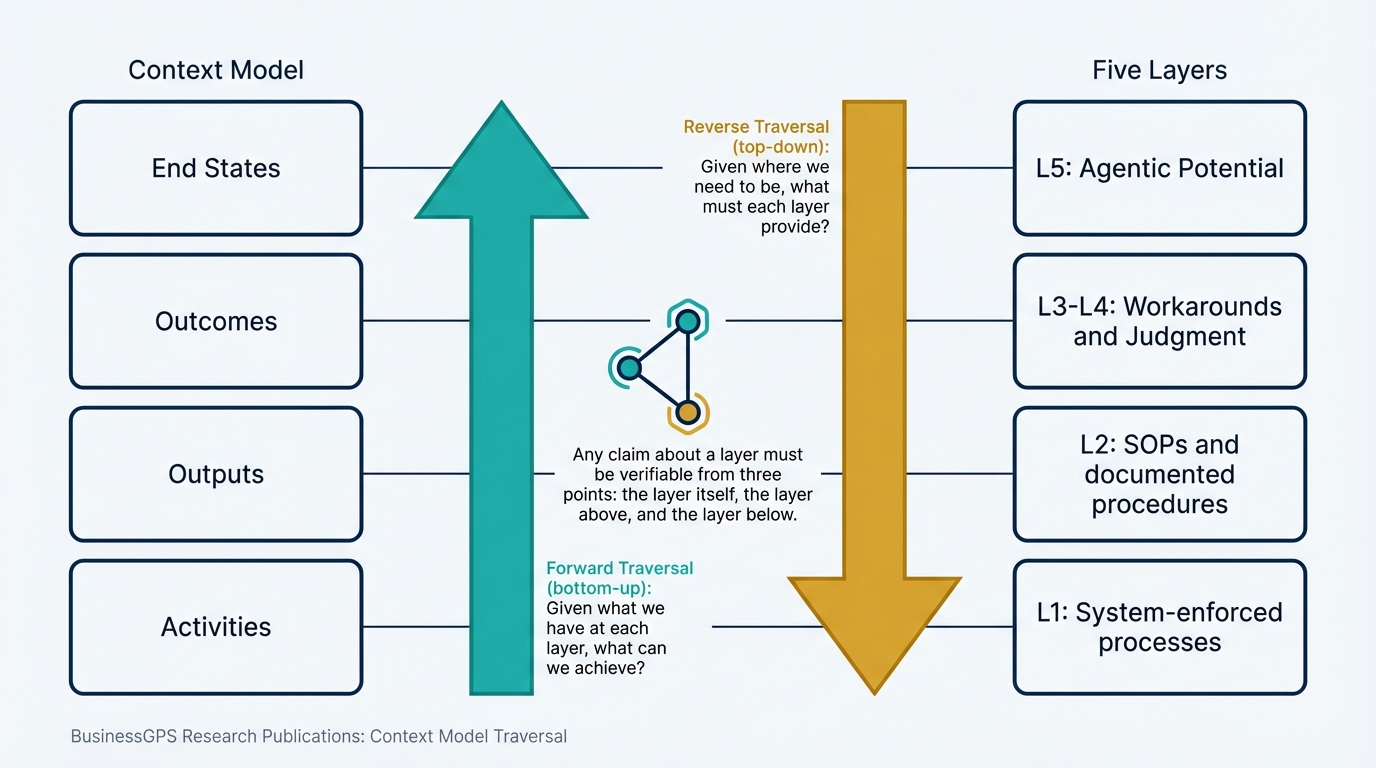
The Context Model — End States, Outcomes, Outputs, Activities — maps directly to the five layers and provides the validation mechanism that prevents layer drift during transformation.
Forward traversal (bottom-up):
| Context Model | Layer Mapping | What It Answers |
|---|---|---|
| Activities | L1: System-enforced processes | What does the system actually do? |
| Outputs | L2: SOPs and documented procedures | What documented outputs does the operation produce? |
| Outcomes | L3-L4: Workarounds and judgment | What results does the organisation actually achieve? |
| End States | L5: Agentic potential | What becomes possible when all layers are articulated? |
Forward traversal answers: "Given what we have at each layer, what can we achieve?"
Reverse traversal (top-down):
| Context Model | Layer Question | What Must Be True |
|---|---|---|
| End States (L5) | What is the target operating model? | Agent orchestration architecture is defined |
| Outcomes (L4) | What judgment must L4 deliver? | Decision frameworks are codified, not tacit |
| Outcomes (L3) | What must L3 surface? | Workarounds are identified, dispositioned, resolved or managed |
| Outputs (L2) | What SOPs must exist? | Procedures are written, validated, maintained |
| Activities (L1) | What must the system configure? | Platform configured to enforce required processes |
Reverse traversal answers: "Given where we need to be, what must each layer provide?"
Three-point validation. Any claim about a layer must be verifiable from three points: the layer itself, the layer above it (what it serves), and the layer below it (what it depends on).
TOC Constraint Identification Across Layers
At any point in the articulation journey, one layer is the binding constraint. Theory of Constraints logic applies:
- Identify the constraint layer — which layer's limitation governs transformation throughput?
- Exploit the constraint — extract maximum value from the constraining layer without adding resources
- Subordinate all other layers — every non-constraint layer adjusts pace and scope to serve the constraint
- Elevate the constraint — invest to expand the constraining layer's capacity
- Repeat — once the constraint shifts, return to step 1
The constraint shifts as articulation progresses. Early in transformation, the constraint is typically L3-4 (visibility — cannot see current reality). As articulation deepens, the constraint may shift to L1 (system fitness) or L4 (decision-maker alignment). The constraint location is diagnostic: it tells you what to work on next.
10. O2O Steps 1-9 Mapping
The Five-Layer Model is the diagnostic. O2O is the methodology. This section connects the two.
Steps 1-9 are not a planning exercise. They are an articulation exercise. Each step forces a different part of the organisation's hidden operating reality into explicit, describable form.
The Three Architecture Domains
The O2O methodology operates across three co-equal architecture domains: Business Architecture (BA), Enterprise Architecture (EA), and Change Architecture (CA). Each domain has a natural layer focus and approaches the layers from a different direction.
| Architecture | Steps | Discovery Direction | Layer Focus |
|---|---|---|---|
| BA (Steps 1-3) | Business Discovery | Top-down: L4->L3 | Starts where knowledge lives. Surfaces the unarticulated. |
| EA (Steps 4-6) | Platform Response | Bottom-up: L1->L3 | Starts at the system. Maps upward to where workarounds form. |
| CA (Steps 7-9) | Change Delivery | Full stack: L1-L5 | Plans transition across ALL layers simultaneously. |
BA discovers below the blind spot line. EA designs above it. CA bridges both. This is why the O2O process works where other methodologies fail — BA does not start with "what system do you want?" (Layer 1). It starts with "what is actually happening in your business?" (Layer 4). By the time EA begins at Step 4, it has Layer 3-4 context that no standard implementation methodology provides. Starting with EA — which is what every SI does — means designing systems for a reality you have not seen.

Change Architecture as a formal, co-equal architecture discipline alongside BA and EA has no established equivalent in TOGAF, BizBOK, MSP, Prosci, or any academic framework. The individual elements within CA are well-established; the architectural elevation is original to BusinessGPS. The Five-Layer Model provides the structural framework that connects all three domains below the blind spot line.
Step-by-Step Layer Mapping
| Step | Primary Layers | What Gets Articulated | Constraint Check |
|---|---|---|---|
| 1: Business Context | L3, L4 | The operating environment as it actually exists | "Can we see our current reality clearly enough to act?" |
| 2: Business Goals | L4, L5 | Strategic intent with decision-maker alignment | "Is the constraint strategic clarity or absorption capacity?" |
| 3: Business Change | L3, L4 | The change narrative and commitment structure | "Is the binding constraint commitment or capability?" |
| 4: Platform Strategy | L1, L2 | Platform strategy responding to L3-4 reality | "Is the constraint system fitness or organisational readiness?" |
| 5: Platform Assessment | L1, L2, L3 | Ecosystem curation with workaround awareness | "Does platform selection address the constraining layer?" |
| 6: Platform Decision | L1, L4 | Commitment decision with governance framework | "Is the constraint the platform choice or execution ability?" |
| 7: Initiative Alignment | All (L1-L5) | Cross-initiative portfolio alignment | "Which layer is the portfolio bottleneck?" |
| 8: Initiative Structure | L1, L2, L5 | Delivery architecture with agent roles | "Is the constraint the architecture or the team?" |
| 9: Initiative Planning | All (L1-L5) | Execution plan with layer-aware milestones | "Is the identified constraint reflected in the plan?" |
The Triad Mapping
| Triad | Steps | Layer Focus | What Happens |
|---|---|---|---|
| Business Discovery | 1-3 | L3-L4 (below the blind spot) | Current reality surfaces. Workarounds are named. Judgment patterns identified. |
| Platform Response | 4-6 | L1-L2 (above the blind spot) | System and procedural response designed, informed by L3-4 discovery. |
| Portfolio Integration | 7-9 | All layers (L1-L5) | Alignment, structure, and planning integrate discovery with response. L5 scoped. |
Discovery before response. Below the blind spot before above. The O2O journey IS the articulation journey.
The Articulation Completeness Check
After Step 9, verify all five layers were addressed:
| Layer | Steps 1-3 | Steps 4-6 | Steps 7-9 |
|---|---|---|---|
| L1: System | -- | Primary | Secondary |
| L2: SOPs | -- | Primary | Primary |
| L3: Workarounds | Primary | Primary | Primary |
| L4: Judgment | Primary | Primary | Primary |
| L5: Potential | Secondary | -- | Primary |
Gap rules:
- If L3 was not surfaced in Steps 1-3, it will not appear in Steps 4-9
- If L4 patterns were not mapped in Steps 1-3, they cannot be designed for in Steps 4-6
- If L5 was not scoped in Steps 7-9, execution defaults to human-only delivery
11. Practical Application
The Human/AI Continuum
Every organisation sits somewhere on a human/AI ratio spectrum. The articulation journey moves them along it:
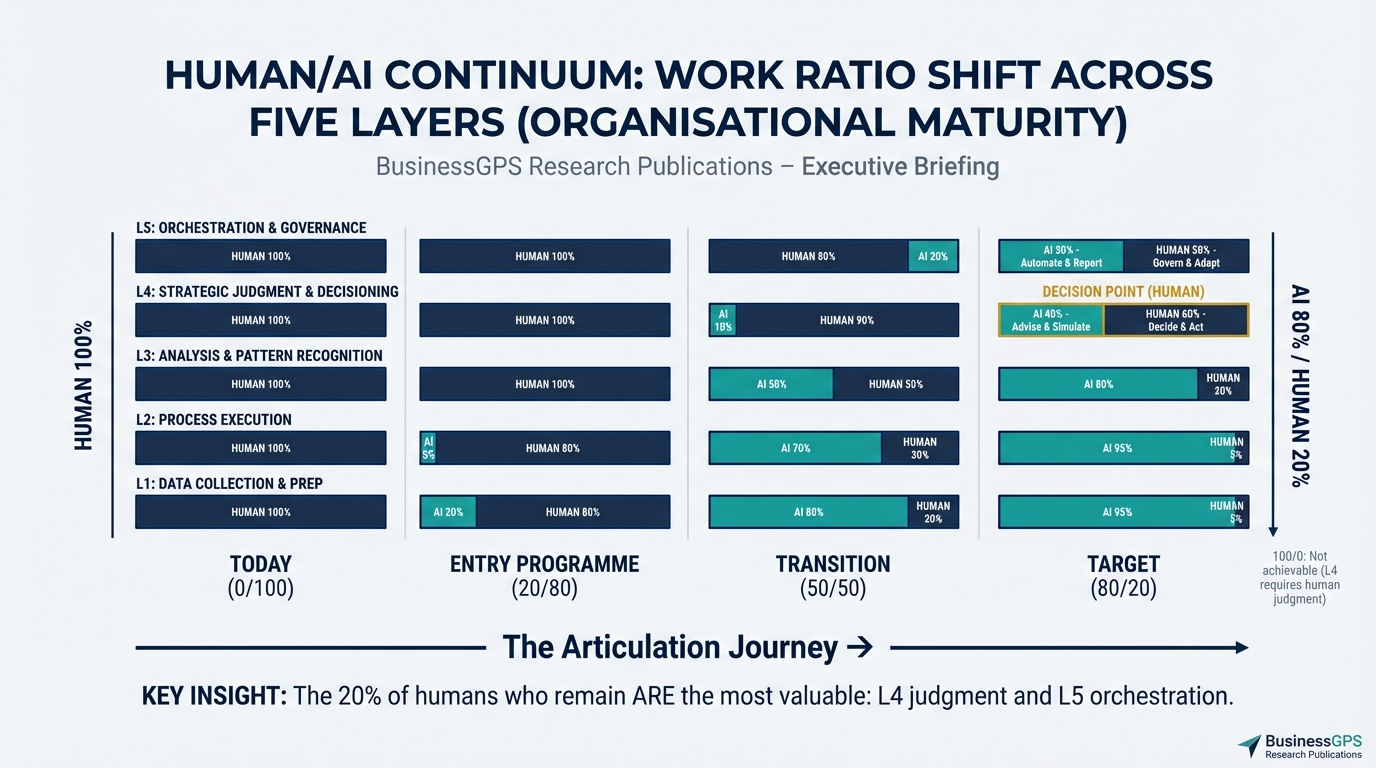
| Ratio | What It Means | Who Is Here |
|---|---|---|
| 0/100 (all human) | No AI augmentation. All work manual or system-assisted at L1 only | Most enterprises today |
| 20/80 | AI handles 20% of cognitive load (L1-2 automation, basic L3 analytics) | Entry-level programme target: first 30 days |
| 50/50 | AI and humans share cognitive load equally. L3 workarounds being automated, L4 judgment being augmented | Transition state: full programme works toward |
| 80/20 | AI handles 80% of cognitive load. Humans focus on L4 judgment and L5 orchestration | Where BusinessGPS operates today: small team + ~50 agent workers |
| 100/0 | Full automation | Not achievable (L4 judgment requires human) |
At 80/20, the 80% AI consumption is distributed across the layers: L1 transaction automation, L2 procedure execution, L3 analytics and workaround resolution, and L4 decision support. The 20% human focus is concentrated at L4 (judgment, decisions, exceptions) and L5 (orchestration, architecture, innovation).
The Cognitive P&L: Scoring the Journey
The Cognitive P&L scores each activity across the five layers on four dimensions to prioritise the articulation journey:
| Dimension | What It Measures | How It Drives Prioritisation |
|---|---|---|
| Cost of current human effort | Time, salary, opportunity cost | Higher cost = higher priority for agent augmentation |
| Value of the output | Revenue impact, decision quality, risk reduction | Higher value = protect and augment, don't just automate |
| Risk if the agent gets it wrong | Financial, regulatory, reputational exposure | Higher risk = human-in-loop required (L4 stays human) |
| Ease of articulation | How describable is this work today? | Easier = faster to deploy; harder = higher long-term value |
The Cognitive P&L is applied after the Layer Discovery produces the gap register. It scores each finding and determines what gets automated (L1-2 delegation), what gets augmented (L3-4 extension), what stays human (L4 judgment), and what gets orchestrated (L5).
Where the 20/80 to 80/20 journey plays out by layer:
| Layer | At 0/100 (today) | At 20/80 | At 50/50 | At 80/20 (target) |
|---|---|---|---|---|
| L1 | System-assisted | Agents handle routine transactions | Agents handle all standard transactions | Fully delegated |
| L2 | Human follows SOPs | Agent follows documented SOPs | Agent handles SOPs + known exceptions | Agent-driven, human for novel exceptions |
| L3 | All manual workarounds | Key workarounds identified | Priority workarounds automated | Most workarounds resolved or agent-managed |
| L4 | All human judgment | Judgment patterns surfaced | Decision support agents active | Agents advise, humans decide on signature only |
| L5 | Does not exist | Architecture scoped | First orchestration agents deployed | Full orchestration across layers |
For organisations seeking to assess their own Blind Spot exposure, the Athena self-assessment provides a structured entry point. The companion paper, The Transformation Capability Crisis, examines the broader TCM framework and the meta-capability thesis — that the ability to continuously reclassify core, context, and signature IS the core capability of the AI era.
12. The Finance Function Value Ladder
The finance function provides a concrete illustration of how the Five-Layer Model maps to functional maturity. We define a five-level Value Ladder — Operator, Custodian, Driver, Leader, Financier — that maps directly onto the Five-Layer Activity Model and reveals why most finance organisations are stuck in the lower tiers.
| Value Ladder Level | Five-Layer Mapping | Finance Activity | What Gets Stuck |
|---|---|---|---|
| Operator | Layers 1-2 | Transaction processing, compliance, close execution | This works. ERP does this. |
| Custodian | Layers 2-3 | Control, risk management, reporting accuracy | Workarounds start here — "90% is not enough" |
| Driver | Layers 3-4 | Business partnering, analytics, insight generation | Requires articulating Layer 3 workarounds |
| Leader | Layer 4 | Strategic finance, enterprise decision support | Requires codifying Layer 4 judgment |
| Financier | Layers 4-5 | Capital allocation, M&A, portfolio strategy | Requires Layer 5 orchestration |
Approximately 164,000 US mid-market enterprises sit in the Frozen Middle — AI installed, value unrealised. The derivation is straightforward: 200,000 US mid-market companies ($10M–$1B revenue, per the National Center for the Middle Market) × 88% AI adoption (McKinsey 2025 State of AI survey) × (1 − 6% value-capture rate, same source) ≈ 164,000 with AI installed but value unrealised. The 88/6 ratio is cross-validated by NBER Bloom et al. 2026 (6,000 executives, 80–90% zero productivity impact despite 70% actively using AI), by PwC's 2025 AI Jobs Barometer, by Deloitte's State of Generative AI surveys, and by Forrester's 2025 AI Enterprise Readiness report. Five independent research traditions converge on the same finding: AI adoption is near-universal, AI value capture is not.
These 164,000 enterprises are stuck precisely because the transformation programmes they have run address Layer 1 (new system) and Layer 2 (new procedures) but do not address Layers 3–5. The Value Ladder makes this visible: migration delivers Operator capability but does not — cannot — deliver Driver or Leader capability because those require Layer 3–4 articulation that no system migration methodology includes.
13. Attribution
Five-Layer Activity Model. BusinessGPS original work (2026). Developed from BPO operating experience, the Articulation Gap thesis, and Moore's Core/Context framework. The five layers, blind spot line, technology mapping, agent deployment patterns, and L4-to-L1 articulation method are original contributions.
Signature Process. BusinessGPS original work. The distinction between core revenue-generating and core signature-embodying processes. Not Geoffrey Moore's term — his framework provides Core/Context; the Signature subdivision is ours.
Articulation Gap. Daniel Miessler's framing. Application to enterprise transformation and thesis that closing it IS Transformation Capability Management: BusinessGPS contribution.
Ambidextrous Leadership Dimension. Joint contribution: ambidextrous leadership theory (O'Reilly/Tushman via Dosanjh) combined with the eFinity Cycle, Context Model, and Simultaneity Principle.
Finance Function Value Ladder. BusinessGPS original work. The five-level Value Ladder (Operator through Financier) and its mapping to the Five-Layer Activity Model.
Compression / Extension / Delegation Framework. Ignacio de Gregorio. Mapping to the Five-Layer Model: BusinessGPS contribution.
Front-Loaded Articulation Precedent. Developed through predecessor SAP reseller operations (1998-2020). The three-tier articulation system, five front-loading principles, and evolution from L1-2 to L3-5 targeting.
Transformation Case Diagnostics. Multi-framework diagnostic analysis (Kotter, ADKAR, Heath, Lencioni, Bridges) applied to BTWS 2026 case studies. The five archetypes (Identity Violation, Champion Trap, Sovereignty Violation, Leadership Vacuum, Governance Theatre) are original diagnostic categories.
Appendix A: Independent Validation
| Source | Key Finding | Five-Layer Correspondence |
|---|---|---|
| Secret CFO (March 2026) | Four-layer finance stack, "kill the term ERP," tech debt series | L1-4 direct mapping, agents inside vs across layers |
| Daniel Miessler | Articulation Gap, Capability Stack, Expertise Ratchet | L3-4 = where the gap lives; Knowledge/Understanding/Intelligence/Creativity maps to L1-L5 |
| Dosanjh | Ambidextrous leadership, Capital x CI | Exploit/Explore maps to layers; TCM provides the operating architecture |
| Finance Function Value Ladder | Five-level Value Ladder | Operator-Financier maps to L1-5 progression |
| NBER, PwC, Deloitte, McKinsey, Forrester | Frozen middle, 88/6 gap, AI adoption failure | All explained by L3-5 neglect |
| Dave Blundin / Link Ventures | 80/20 token economy | The 20% human layer IS L4-5 articulation |
| OpenAI PE deal (March 2026) | 17.5% guaranteed returns for AI adoption | Proves articulation gap is the bottleneck |
| BTWS 2026 Case Studies | Four transformation failures | All four fail below the Blind Spot Line |
| Cohort Simulation (March 2026) | Two rounds, GO FOR LAUNCH verdict | L3-4 discovery works universally across six personas |
| BusinessGPS Internal Validation (March 2026) | Change Architecture as co-equal discipline | No equivalent found in TOGAF, BizBOK, MSP, Prosci, or academic literature |
| LGA Transformation Capability Framework (2024) | Sector-wide competency framework for 300+ UK councils | Validates "transformation capability" as emerging institutional concern; addresses workforce competency but not knowledge architecture |
Appendix B: Miessler Capability Stack Mapping
Daniel Miessler's human capability stack — Knowledge, Understanding, Intelligence, Creativity — maps onto the Five-Layer Model in a way that provides a useful human cognitive lens alongside the organisational activity lens. The mapping below is BusinessGPS's own interpretation and should not be read as Miessler's endorsement of the Five-Layer Model. Miessler's framework was developed independently; BusinessGPS has mapped it onto the layered structure for analytical convenience.
| Miessler Capability | Definition | Five-Layer Mapping | AI/Human Split |
|---|---|---|---|
| Knowledge | Facts, data, documented information | L1-L2 (Standard Software + SOPs) | AI excels. Delegation pattern. Near-perfect reliability. |
| Understanding | Context, relationships, patterns | L3 (Contextual Workarounds) | AI augments. Humans validate. Extension pattern. |
| Intelligence | Judgment, decisions, wisdom | L4 (Managerial Judgment) | Human-led, AI-augmented. Agents advise; humans decide. |
| Creativity | Innovation, orchestration of the unprecedented | L5 (Agentic Potential) | Shared. Humans set vision; agents explore; humans judge. |
The Optimisation View
| Layer | Knowledge (AI) | Understanding (Shared) | Intelligence (Human) | Creativity (Shared) |
|---|---|---|---|---|
| L1 | AI owns | -- | -- | -- |
| L2 | AI owns | AI assists | Human validates | -- |
| L3 | AI reads | AI surfaces | Human confirms | Human innovates |
| L4 | AI retrieves | AI models | Human decides | Human + AI explore |
| L5 | AI stores | AI connects | Human governs | Human + AI co-create |
Miessler identifies seven systemic problems that exist because expertise is trapped in human minds. Each maps to a specific layer failure: unclear vision (L4 — judgment not codified), absent processes (L2 — SOPs missing), inconsistent output (L3 — workarounds produce variable results), wrong people in roles (L4 — talent judgment unarticulated), plans without execution (L3-L4 — gap between intent and practice), departmental conflict (L4 — competing frameworks never reconciled), leadership visibility crisis (L4-L5 — orchestration absent).
These seven problems ARE what happens when Layers 3-5 are unarticulated. Miessler named the symptoms. The Five-Layer Model explains the structure.
Appendix C: Academic Grounding (added v2.0)
The Five-Layer Activity Model is not, and has not claimed to be, a novel theoretical contribution. It is an operational synthesis that stands on top of a substantial academic and practitioner literature. The v2.0 refresh makes that grounding explicit. This appendix situates the model inside the broader intellectual ancestry.
Tacit knowledge (Layers 3–4 foundations). Michael Polanyi's The Tacit Dimension (1966) established the distinction between knowledge that can be articulated and knowledge that cannot — "we can know more than we can tell." David Autor's Polanyi's Paradox and the Shape of Employment Growth (NBER, 2014) extended the distinction to automation, showing that work depending on tacit knowledge resisted automation precisely because it resisted specification. The Five-Layer Model operationalises Polanyi's distinction across organisational work: Layers 1–2 are describable and therefore automatable; Layers 3–4 are less describable and require articulation before automation becomes possible. Nonaka and Takeuchi's The Knowledge-Creating Company (1995) — the SECI model of knowledge conversion between tacit and explicit — is the closest prior framework to the discovery protocol in Section 8. Zollo and Winter's Deliberate Learning and the Evolution of Dynamic Capabilities (2002, 6,900+ citations) established knowledge articulation as a learning mechanism; the Five-Layer Model positions it as a root cause of AI failure when absent at organisational scale. Chris Argyris's Theories of Action (1974) — the distinction between espoused theory and theory-in-use — is a direct ancestor of the L2-vs-L3 distinction (documented procedure vs actual practice). Lippman and Rumelt's Uncertain Imitability (1982) established the concept of causal ambiguity — the reason competitive advantage persists — as itself a form of unarticulated capability.
Institutional theory (the 88/6 convergence). DiMaggio and Powell's The Iron Cage Revisited: Institutional Isomorphism and Collective Rationality in Organizational Fields (1983) explains why enterprises adopt practices and technologies under pressure that is not strictly economic. Their three isomorphic mechanisms — coercive, mimetic, and normative — predict exactly the pattern of 88% AI adoption regardless of demonstrable value capture. Boards and CEOs adopt AI because other boards and CEOs are adopting AI (mimetic), because analysts and regulators pressure for adoption (coercive), and because professional networks normalise the adoption agenda (normative). The Five-Layer Model does not contradict DiMaggio and Powell's prediction. It complements it: isomorphic pressure explains the 88% (ceremonial adoption), and the Articulation Gap explains the 6% (value capture). The two accounts are complementary, not competitive.
Technology and productivity. Erik Brynjolfsson's The Productivity Paradox of Information Technology (1993) established that IT investment produces productivity gains only with accompanying organisational change. The observation has been confirmed at every major technology transition since. Alfred Chandler's The Visible Hand (1977) showed that management structures emerge from technology revolutions, not alongside them. Carlota Perez's Technological Revolutions and Financial Capital (2002) distinguished between the installation phase of a technology revolution (infrastructure deployment) and the deployment phase (organisational absorption). The Five-Layer Model positions the current agentic moment as the installation phase: AI is everywhere, but the organisational form that captures its value — the deployment phase — has not yet materialised. This aligns with McKinsey's April 2026 framing AI Is Everywhere, the Agentic Organization Isn't Yet and with the NBER Coasean Singularity working paper (Shahidi, Rusak, Manning, Fradkin and Horton, 2025).
Business process re-engineering as cautionary precedent. Hammer and Champy's Reengineering the Corporation (1993) launched the business process re-engineering movement — a genuine attempt to codify capability change at enterprise scale, with a reported 70% failure rate by its own adherents within five years of launch. BPR is the load-bearing cautionary precedent for any transformation discipline. It identified the right problem (discontinuous capability change), produced the right diagnostic vocabulary (process redesign), and failed at execution because the discipline assumed the work could be specified top-down from executives and consultants, rather than articulated bottom-up from the people doing it. The Five-Layer Model incorporates this as a structural lesson: articulation must start where the knowledge lives (Layer 4), not where the specifications live (Layer 1–2). Transformation Capability Management is designed to succeed where BPR failed — not because the underlying insight was wrong, but because the discipline of articulation was inadequate.
Contemporary convergence. The USAII's naming of "AI Management" as an emerging sub-field (January 2026), the OpenExO Organisational Singularity work (Ismail, 2026), and Karpathy's practitioner writing on Software 2.0 and 3.0 all converge on the same structural finding: the organisational form that captures AI value has not stabilised. The Five-Layer Model contributes to that emerging literature by offering an operational diagnostic rather than a further description of the gap.
Appendix D: Boundary Conditions (added v2.0)
The Five-Layer Model does not apply uniformly to every organisation. Honest about limits, BusinessGPS identifies four conditions under which the model is less useful or requires adaptation.
Digital-native organisations. Firms founded inside the SaaS and agent-native era — built on cloud-native infrastructure with codified operational practice from inception — often have small Layer 3–4 surfaces by design. Their Blind Spot is narrower, their workarounds fewer, and their tacit knowledge more recently articulated. The Five-Layer diagnosis still applies but returns different proportions: the 60% of work-below-the-line that shows up in legacy enterprises is typically 20–30% in a digital-native. The model's diagnostic power is reduced in direct proportion to how much of the organisation's work is already specified. Digital-natives tend to need different emphasis — more Layer 5 orchestration design, less Layer 3–4 articulation — and the engagement shape adapts accordingly.
Highly codified industries. Sectors where extensive regulatory and safety specification has already forced articulation of Layers 3–4 — commercial aviation, nuclear power, pharmaceutical manufacturing, clinical medicine — have smaller Layer 3–4 surfaces than general enterprise work. The Five-Layer Model still diagnoses usefully in these sectors but the gains from articulation work are smaller because much of the articulation has already been done, for reasons unrelated to AI. The marginal value of a TCM engagement in a highly codified industry is lower than in a lightly codified one.
Single-person or very small organisations. The Five-Layer Model is a framework for understanding organisational capability where tacit knowledge is distributed across multiple people and institutional memory matters. In a single-person firm or a firm of fewer than five people, the framework collapses — all layers are effectively held by the same individual, and the articulation work becomes personal rather than organisational. The model is not a useful tool at that scale. Sole traders, micro-businesses, and very early-stage startups should use simpler frameworks designed for that context.
Firms in active crisis. The Five-Layer Model is a diagnostic for organisations with enough operational stability to reason about capability reclassification. In active crisis — liquidity events, regulatory investigation, catastrophic system failure — the framework's analytical horizon is too long to be useful. Crisis management comes first; capability reclassification later. BusinessGPS explicitly does not recommend TCM engagements during active crisis; the instrument is for stable organisations planning deliberate change, not for organisations firefighting.
The four conditions do not invalidate the Five-Layer Model. They calibrate its applicability. Readers evaluating whether the framework applies to their context should start with the binary question: does the organisation have significant unarticulated Layer 3–4 work whose value would be captured by making it explicit? If yes, the framework applies; if no, lighter-touch instruments or different frameworks are likely to produce better returns.
Appendix E: Labour, Ethics and the Question of Who Benefits (added v2.0)
The Five-Layer Model is operationally neutral. Its ethical implications are not. A diagnostic that makes tacit work articulable carries consequences for the people whose work it articulates. BusinessGPS treats those consequences as legitimate research subject matter rather than as downstream externality.
Articulation changes the ownership of work. When Layer 3–4 work is articulated, the tacit knowledge that was held inside experienced practitioners becomes organisational property — capturable, transferable, and in principle automatable. This is a transfer of value. Who benefits from the transfer is a governance question, not a technical one. In the traditional BPR failure mode, articulation benefited the organisation (documented capability) and disadvantaged the articulators (whose value was extracted and whose roles were then redesigned or eliminated). A transformation discipline that ignores this distribution question repeats BPR's ethical failure.
The ethics-aware alternative. BusinessGPS positions the Core / Context / Signature classification as an ethical decision framework as much as an operational one. Articulating Context is value-creating for the organisation with limited distributional consequences — commodity work was never the articulator's competitive asset. Articulating Core changes the ownership of design decisions but typically leaves individual practitioners with augmented rather than substituted roles. Articulating Signature is where the distributional question sharpens: the tacit judgment that is the practitioner's competitive asset becomes the organisation's asset once articulated, and the practitioner's bargaining position changes. An ethically-conscious TCM discipline builds the distributional question into the engagement design — compensation, career path, participation in the articulation process, and ownership of the articulated artefacts all need to be on the table at engagement scope, not after.
The apprenticeship question. The Blind Spot's junior-to-senior pipeline collapse trap (named in the companion Capability Reclassification Matrix paper) is a labour-market problem as much as a capability-reproduction problem. AI automation of entry-level Layer 1–2 work is removing the rung through which junior practitioners historically acquired tacit knowledge. An ethically-conscious transformation discipline treats the redesign of the apprenticeship path as part of scope, not as externality. The firm that articulates its tacit knowledge, automates the entry-level work, and does not redesign the apprenticeship is capturing short-term value at the cost of long-term capability reproduction.
Who holds the artefacts. Articulation produces artefacts — decision logs, workaround registers, judgment frameworks, skill files. Whether those artefacts remain inside the firm, become portable with the practitioners who created them, or become proprietary to the TCM discipline provider is a live governance question. BusinessGPS's stance is that articulated artefacts remain firm property, but the practitioners whose knowledge they embody retain appropriate recognition and participation in any downstream use. This is a principle rather than a contractual template; it shapes engagement design rather than bolt-on.
The labour and ethics dimension is addressed briefly in this paper because it is load-bearing for the legitimacy of the discipline, and because the companion paper TCM Discipline: The Missing Discipline v2.0 treats it at greater length. Readers for whom this is the critical question should consult the companion paper.
Appendix F: Conflict of Interest Disclosure (added v2.0)
BusinessGPS is a commercial firm. This paper presents a framework that BusinessGPS sells engagement services around. The reader is owed explicit disclosure of the conflicts inherent in that position, so that the argument can be evaluated on its merits rather than on the commercial context.
Direct commercial interests. BusinessGPS sells productised engagements (Sophina, SR30, Bridge Module, TP90, Portfolio tier) that operationalise the Five-Layer Activity Model, the Capability Reclassification Matrix, and the TCM discipline. A reader who concludes that the framework is correct may well become a buyer of those engagements. BusinessGPS earns revenue from that conversion. The authorial institution therefore has a direct financial interest in the framework being accepted as correct.
Indirect commercial interests. BusinessGPS uses this paper and its trifecta companions as demand-engineering assets — instruments that generate inbound enquiry, qualify potential buyers, and anchor sales conversations. The paper's publication is part of a commercial programme, not a purely academic contribution. The external framework scan conducted in April 2026 explicitly tested whether the category position was open partly because BusinessGPS intended to claim it commercially.
IP architecture. The core IP of BusinessGPS is the operational methodology (O2O 27-step framework, Three Forges, Five-Layer Activity Model, Capability Reclassification Matrix, Core/Context/Signature classification, Ambidextrous OS). The frameworks in this paper are intentionally offered as open intellectual property contributed to the category of Transformation Capability Management. The productised delivery, the benchmark dataset, the agent-augmented discovery tooling, and the engagement operating model are BusinessGPS-specific and are not given away.
Case-study relationships. Several cases referenced in this paper (Dentsu, Roche, composite cases) relate to engagements or observations in which BusinessGPS or its principals have been involved. Where the originating practitioner publicly presented the case (as at the Business Transformation World Summit 2026), BusinessGPS cites the public presentation. Where the engagement involved BusinessGPS directly, BusinessGPS has de-identified materially. Readers should assume commercial relationships may exist behind any case and should evaluate the diagnostic claim on its own merits rather than on the case's weight.
Practitioner authority cited. Daniel Miessler, Dave Blundin, the Secret CFO, Nate B Jones, Ignacio de Gregorio, and other named practitioners are cited as independent voices. None have endorsed the Five-Layer Model or the broader TCM framework; their work is cited as convergent evidence, not as institutional sponsorship. Any implication of endorsement would be an error in this paper's framing; readers encountering such implication should treat the reference as citation rather than endorsement.
Simulation evidence. The cohort simulation validation described in Section 1 is BusinessGPS Internal Validation. It is not independent. It has not been peer-reviewed. It is labelled transparently throughout the paper to avoid any implication that the simulation evidence carries the weight of independent third-party validation. Independent validation is a goal for subsequent editions and will be marked as such when it occurs.
BusinessGPS considers the above disclosures a necessary condition of publishing research under an institutional by-line. The conflicts are real; they are declared; they inform but do not invalidate the argument. Readers are entitled to weight the argument against the commercial context and to seek independent corroboration before acting.
Appendix G: References and Bibliography (added v2.0)
Reference style is practitioner-visible (author, date, venue, URL where available) rather than academic-footnote. References are grouped by theme. A consolidated forty-reference library underpins the full 2026-Q2 trifecta and is cross-referenced across all three papers.
Theoretical foundations — tacit knowledge and organisational learning.
- Polanyi, Michael. (1966). The Tacit Dimension. University of Chicago Press.
- Autor, David H. (2014). Polanyi's Paradox and the Shape of Employment Growth. NBER Working Paper 20485.
- Nonaka, Ikujiro and Takeuchi, Hirotaka. (1995). The Knowledge-Creating Company. Oxford University Press.
- Zollo, Maurizio and Winter, Sidney G. (2002). Deliberate Learning and the Evolution of Dynamic Capabilities. Organization Science, 13(3): 339–351.
- Argyris, Chris. (1974). Theory in Practice: Increasing Professional Effectiveness. (With Donald Schön). Jossey-Bass.
- Lippman, Steven A. and Rumelt, Richard P. (1982). Uncertain Imitability: An Analysis of Interfirm Differences in Efficiency under Competition. Bell Journal of Economics, 13(2): 418–438.
Institutional theory.
- DiMaggio, Paul J. and Powell, Walter W. (1983). The Iron Cage Revisited: Institutional Isomorphism and Collective Rationality in Organizational Fields. American Sociological Review, 48(2): 147–160.
Technology, productivity and capability classification.
- Moore, Geoffrey A. (2005). Dealing with Darwin: How Great Companies Innovate at Every Phase of Their Evolution. Portfolio.
- Prahalad, C.K. and Hamel, Gary. (1990). The Core Competence of the Corporation. Harvard Business Review, May–June.
- Porter, Michael E. (1985). Competitive Advantage: Creating and Sustaining Superior Performance. Free Press.
- Brynjolfsson, Erik. (1993). The Productivity Paradox of Information Technology. Communications of the ACM, 36(12): 66–77.
- Chandler, Alfred D. (1977). The Visible Hand: The Managerial Revolution in American Business. Harvard University Press.
- Perez, Carlota. (2002). Technological Revolutions and Financial Capital. Edward Elgar.
- Hammer, Michael and Champy, James. (1993). Reengineering the Corporation. HarperBusiness.
- Goldratt, Eliyahu M. (1990). What Is This Thing Called Theory of Constraints. North River Press.
AI-era structural analyses.
- Shahidi, K., Rusak, G., Manning, B., Fradkin, A. and Horton, J. (2025). The Coasean Singularity: Demand, Supply and Market Design in the Age of AI Agents. NBER Working Paper.
- McKinsey QuantumBlack. (June 2025). Seizing the Agentic AI Advantage. McKinsey & Company.
- McKinsey QuantumBlack. (April 2026). AI Is Everywhere, the Agentic Organization Isn't Yet. McKinsey & Company.
- McKinsey. (2025). The State of AI: How Organizations Are Rewiring to Capture Value. McKinsey Global AI Survey.
- MIT Center for Information Systems Research. (2025). The AI Decision Rights Matrix. MIT CISR research briefing.
- Bloom, Nicholas et al. (2026). AI and Productivity in the Large Enterprise: A 6,000-Executive Panel. NBER Working Paper.
- Ismail, Salim. (2026). Organisational Singularity. OpenExO publication.
- USAII (United States Artificial Intelligence Institute). (January 2026). AI Management as an Emerging Sub-Field. USAII publication.
Practitioner frameworks and convergent sources.
- Jones, Nate B. (2025–26). 5 Levels of AI Coding, 7 Skills for the Agentic Era, 5 Safe Places to Build. Substack / LinkedIn publications.
- Miessler, Daniel. (2025–26). The Articulation Gap, Capability Stack, Expertise Ratchet. Unsupervised Learning publications.
- The Secret CFO. (March 2026). Tech Debt two-part series; ongoing newsletter.
- Mollick, Ethan. (2024–26). Co-Intelligence and ongoing writing on AI in the enterprise.
- Karpathy, Andrej. (2023–26). Software 2.0 / Software 3.0 talks and essays.
- Diamandis, Peter and Ismail, Salim. (various). OpenExO and Exponential Organizations publications.
- Dosanjh, G.S. (2025–26). Ambidextrous Leadership writing; Capital × CI framework.
- Blundin, Dave. (March 2026). 80/20 Token Economy. Link Ventures publication.
- Duncan, K., Anderson, E. and Saviano, M. (September 2025). AI Is Changing the Structure of Consulting Firms. Harvard Business Review.
- Andreessen Horowitz (a16z). (March 2026). Why the World Still Runs on SAP. a16z Enterprise.
Market signals and industry reports.
- Gartner. (October 2025). IT Predictions — AI Sovereignty Framing. Gartner Symposium research.
- PwC. (2025). AI Jobs Barometer. PwC research.
- Deloitte. (2025). State of Generative AI in the Enterprise. Deloitte research.
- Forrester. (2025). AI Enterprise Readiness Report. Forrester research.
- National Center for the Middle Market (NCMM). (2024). The Middle Market in the United States — Market Sizing. Ohio State University Fisher College of Business.
- Local Government Association (LGA). (2024). Transformation Capability Framework for UK Councils. LGA publication.
- Business Transformation World Summit 2026 practitioner case studies.
- BusinessGPS Capability Brief. Editions 1–6 (Q1–Q2 2026). capability.ai/intelligence.
BusinessGPS foundational — trifecta companion papers and protocols.
- BusinessGPS. (2026-Q2). The Capability Reclassification Matrix — Diagnosing Work in the Agentic Era v1.0. BusinessGPS Working Paper.
- BusinessGPS. (2026-Q2). TCM Discipline: The Missing Discipline v2.0. BusinessGPS Working Paper.
- BusinessGPS. (2026-04-22). Terms of Reference — CCS / O2O / Three Forges v1.1. Canonical protocol.
- BusinessGPS. (2026-04-22). Rent / Buy / Borrow / Build — Practical Definitions v1.0. Canonical protocol.
Companion Observations (v2.1 — May 2026 External Validation)
This appendix, added in v2.1, absorbs three Nate B Jones essays from May 2026 as convergent external observations on the Five-Layer Activity Model. The thesis body of the paper is unchanged. The pattern is the BusinessGPS Companion Observations convention: external public frameworks from senior practitioners are not competitors to the Five-Layer Model; they are readings of the same underlying shift through complementary lenses, mappable INTO specific layers of the Model. The Five-Layer Model is the structural instrument; Nate's three essays are independent confirmatory readings from outside the enterprise-transformation domain. Subsequent editions will integrate further companion observations as the field matures.
Companion Observation 1 — L5 as runtime sovereignty layer (Nate, 2026-05-07)
Nate B Jones, writing on his Substack on 7 May 2026 ("OpenClaw Crossed the Runtime Line"), describes the runtime-and-memory architecture emerging in consumer/builder AI tooling — where the model is a swappable brain, the channel is a swappable surface, and memory must live outside both for the architecture to hold together.
"If the model can change, memory should not live inside the model provider. If the agent can move across Slack, Telegram, Discord, GitHub, and a browser, memory should not live inside one channel… When agents become workers, shared memory becomes infrastructure… If [memory] lives in a user-owned memory layer, you have an architecture."
"OpenClaw is the action/runtime layer. The model is a swappable brain. TaskFlow is the durable work loop. The channel is where the human interacts. Memory is the continuity layer. Permissions and provenance are the trust layer."
Map this to the Five-Layer Model: Nate's runtime/memory architecture for builders is the consumer-grade mirror of L5 Agentic Orchestration. The principle "memory must live outside the model" is the customer-side analog of L5 as the layer the enterprise must own — not rent from any single vendor. Where the Five-Layer Model frames L5 as the enterprise architecture of agentic potential (orchestration, sovereignty, capability stewardship), Nate frames it as runtime sovereignty for builders. The two framings converge on the same structural conclusion: the agentic layer is customer-sovereign or it collapses into vendor lock-in. The named trap in this paper — Capability Drift via vendor defaults filling the L5 Authority layer — is exactly the trap Nate is naming at the builder scale.
Source URL: https://natesnewsletter.substack.com/p/openclaw-agent-runtime-model-swapping
Companion Observation 2 — L3-L4 as workflow legibility frontier (Nate, 2026-05-09)
Nate B Jones, writing on his Substack on 9 May 2026 ("Codex Plugins Matter Because the Bottleneck Moved"), observes that the binding constraint on agentic capability has moved from model capability to workflow legibility — the work itself has to be packaged clearly enough for the model to act well.
"The workflow lives in your head, and you reload it every thread. From here, the work has to meet the model halfway… The workflow is trapped in the human. What the user is actually doing is repeatedly reconstructing the operating context that makes the work legible. The instructions are only the surface. That context includes preferences, standards, source hierarchy, tool selection, verification habits, format expectations, and institutional judgment."
"The bottleneck moved from whether the model can act to whether the work has been packaged clearly enough for the model to act well."
Map this to the Five-Layer Model: Nate's "workflow trapped in the human" is the articulation gap by another name — specifically the L3 (Contextual Workarounds) and L4 (Judgment) territories where 60% of actual work happens and where 82% of AI deployment value gets lost (per the Layer 3-5 blind-spot data in this paper). Nate independently confirms the central thesis of the Five-Layer Model: the bottleneck is not model capability but the legibility of L3-L4 work. The "preferences, standards, source hierarchy, tool selection, verification habits, format expectations, and institutional judgment" he enumerates are precisely the L3-L4 contents that the Five-Layer Model's 27-question L4-to-L1 discovery protocol exists to articulate. Two independent practitioners — Nate writing from the consumer/builder side, BusinessGPS writing from the enterprise-transformation side — name the same frontier.
Source URL: https://natesnewsletter.substack.com/p/codex-plugins-bottleneck-moved
Companion Observation 3 — L4 as architects-of-meaning layer (Nate, 2026-05-08)
Nate B Jones, writing on his Substack on 8 May 2026 ("The End of Trusted Human Code"), observes that the role of the human in software production is shifting from author of code to architect of meaning — humans become responsible for the structure within which implementation can be produced and verified, not for the implementation itself.
"Programming has long been one of the few creative acts where expression and execution are the same thing… AI threatens to split that fusion apart. Humans may remain responsible for the idea, but the executable realization may increasingly belong to a machine process."
"Humans become responsible for specifying the structure within which implementation can be produced and verified. They define the durable concepts, the invariants, the threat model, the authority model, the data lifecycle, the user promises, the recovery behavior, and the social purpose of the system. They decide what must never happen. They decide which tradeoffs are acceptable."
"The future of software will not be built on the belief that humans write safe code. It will be built on the ability of humans to define meaningful systems."
Map this to the Five-Layer Model: Nate's "architects of meaning" elevates L4 (Judgment) from "what humans still do alongside AI" to "what only humans can define." In agent-era enterprise work, L4 expands as the substrate beneath shrinks via L1-L3 automation. The Five-Layer Model already names L4 as managerial decisions / tacit knowledge / human-leads territory; Nate's framing sharpens why L4 cannot be delegated — not because humans happen to do it today, but because meaning-definition is structurally what the agentic stack cannot self-supply. The invariants, the threat model, the authority model, the data lifecycle, the user promises, the recovery behavior, the social purpose — these are L4 contents at their most concentrated. The capability that survives the agentic shift is meaning-definition, not execution.
Source URL: https://natesnewsletter.substack.com/p/ai-code-trust-verification-shift
Closing — convergent external validation
These three Companion Observations are convergent external validation of the Five-Layer Model thesis. Nate's analysis comes from outside the enterprise transformation domain — consumer/builder AI tooling — and yet arrives at structurally identical conclusions: the bottleneck is workflow legibility (L3-L4), the discipline is meaning-definition (L4), and the architecture must be customer-sovereign (L5). The Five-Layer Model is the enterprise-grade naming of what Nate is observing across the builder ecosystem.
Companion Observations (v2.3 — May 2026 Gate 1 Reconciliation Findings)
Two further Companion Observations are added in v2.3 to absorb the BusinessGPS Gate 1 Reconciliation Analysis findings of 2026-05-21. Where the v2.1 observations bound external validation from the consumer/builder ecosystem into the Five-Layer Model, the v2.3 observations bind BusinessGPS's own internal structural analysis into the Model — specifically, the canonical convergence between the two BGPS engagement families (Programme Instantiation and Standing Org Instantiation) at the Cognitive Dimension. The thesis body of the paper remains unchanged. The Five-Layer Model is the diagnostic substrate; these observations document where the substrate carries load that prior editions had left implicit.
Companion Observation 4 — L3-L5 as the Cognitive Dimension convergence point (Gate 1 Reconciliation, 2026-05-21)
BusinessGPS positions two canonical customer engagement families. Programme Instantiation is initiative-led — the buyer with a specific transformation to deliver, taken through the BGPS 27-step O2O methodology one initiative at a time. Standing Org Instantiation is discipline-led — the buyer installing standing organisational capability that generates and delivers initiatives as they arise, anchored on the customer's whole-firm capability matrix. The two families pass through the same pipeline; they differ in the lens at strategy entry, the number of initiatives entering the portfolio tile, and the object emphasis (the programme for the first; the organisation that owns the portfolio for the second). The BGPS Gate 1 Reconciliation Analysis between these two families surfaces a canonical convergence at the Cognitive Dimension — the L3-L5 zone of the Five-Layer Model. The Programme family delivers transformation programmes through the Cognitive Dimension; the Standing Org family installs the standing capability that operates at the Cognitive Dimension. The convergence is structurally inevitable: every step of the BGPS 27-step methodology traverses L3-L5 (judgment, tacit, deep-expert work); both families execute through every relevant step; therefore both families converge at the Cognitive Dimension regardless of entry pattern or engagement scope. The Five-Layer Model's L3-L5 zone is where this convergence happens. The structural fact that both BGPS engagement families converge there validates the Model's positioning of L3-L5 as the load-bearing zone for AI-era enterprise work — and reframes the Model itself: it is not merely a diagnostic of where transformation programmes miss value, it is also the canonical convergence map for how engagement families and methodologies meet the work that actually matters.
Companion Observation 5 — ExecMind / CorporateMind as canvas interpretation engines at L3-L5 (Gate 1 Reconciliation, 2026-05-21)
The Five-Layer Model identifies L3-L5 as the zone where tacit, judgmental, deep-expert work lives. The BGPS Framework Master Index names the operators that work at L3-L5 in BusinessGPS canonical practice: ExecMind (the individual cognitive profile — biases, blind spots, decision patterns, risk preferences, expertise zones, captured for the individual and held privately to them) and CorporateMind (the constructed collective cognitive corpus — the aggregation of sanctioned ExecMind extracts that forms the team's cultural fingerprint, plus the decision-bias engine that calibrates judgment through the team's cultural / risk / bias profile). These two constructs are not separate from the Five-Layer Model — they are the operators that work at L3-L5 of every O2O step. The Gate 1 Reconciliation Analysis surfaces the operational implication: the Pattern I disposition canvases that the BGPS methodology produces per workflow (agent-vs-human classification, authoritative data source disposition, authority disposition, eval rubric, audit-trail design, reversibility classification, cost-component decomposition) are inputs to the Cognitive Dimension; the outputs — named human commit-points, ratified eval rubrics, reversibility classifications, handoff stage criteria — are interpreted by ExecMind and CorporateMind operating on those canvases. The Five-Layer Model identifies where the work lives (L3-L5); ExecMind and CorporateMind name what works on it. The methodology supplies the canvas structure; the customer's cognitive capability supplies the judgment. This is why the Model is customer-aligned by construction — and why a BusinessGPS engagement transfers capability rather than rents dependency: the canvases are the operational artefact, but the judgment is the customer's.
Closing — convergent internal validation at v2.3
The two v2.3 Companion Observations are internal structural confirmations rather than external validations. BusinessGPS's own Gate 1 Reconciliation Analysis between Programme Instantiation and Standing Org Instantiation produces a convergence at the Cognitive Dimension that the Five-Layer Model had already named as load-bearing. The Model survives its own reconciliation test. The thesis body of the paper remains unchanged; the Companion Observations document the Model's reach in places that prior editions had left implicit. The agentic era is increasingly clear about where the work lives; the Five-Layer Model continues to name it correctly.
Reading the Model — Execution Substrate, Cognitive Frontier, Strategic Intent (v2.2)
The Five-Layer Work Depth Model decomposes enterprise work into five layers, L1 through L5. Reading those five layers as three zones with one envelope sharpens the customer-side decisions the model is built to support, without expanding or restructuring the primitive.
The Two Zones Inside the Model
Execution Substrate — L1 + L2. The documented, visible, system-enforced layers of work. L1 explicit transactions (ERP-enforced) and L2 documented procedures (SOPs). High delegation rates by design. Already committed by every enterprise customer years ago — the cost of unwinding the substrate commitment exceeds any realistic benefit. Not contestable territory. Vendor-orchestrated by default; rationally so. This zone replaces the v2.1 "above the line" framing with a stronger standalone term.
Cognitive Frontier — L3 + L4 + L5. The tacit, judgement-led, agentic-orchestration layers of work. L3 tacit decisions, L4 implicit knowledge / pattern intuition, L5 deep expert judgement / situational improvisation. Where the articulation gap lives. Where 60% of actual work happens and where 82% of AI deployment value gets lost when the work is left illegible. The contested territory in the agent era — substrate vendors extend up into it (SAP's Reltio + Prior Labs + Dremio + Joule + AI Agent Hub assembly), model vendors extend down into it (Anthropic Dreaming, Finance Pack; OpenAI Deployment Company), service vendors extend laterally into it (Anthropic Enterprise Services; OpenAI Deployment Company; the major SI agentic-build practices). Where customer-side discipline matters most. Where Signature processes live. This zone replaces the v2.1 "below the line" framing with a stronger standalone term.
The Envelope Above the Model
Strategic Intent. The human direction-setting that frames the Work Depth Model. Not a sixth layer. Different in kind from L1-L5: where L1-L5 describe work (a vertical decomposition of activity), Strategic Intent describes the direction-setting that determines which work matters in the first place — what business the enterprise is in, which capabilities are Signature, what must never happen in the systems, how AI should be deployed across the estate, where decision-rights must stay sovereign.
Strategic Intent operates above and around the five layers as their envelope. It is always human, always sovereign, never delegated. It is the customer's job that never goes away regardless of how much AI absorbs across L1-L5. It is where Capability Reclassification Matrix Signature / Core / Context boundaries are drawn for the organisation. Without articulated Strategic Intent, the Five-Layer Model has no anchor for deciding which workflows are Signature versus Context.
This is what Nate B Jones names as "humans as architects of meaning" (2026-05-08 "The End of Trusted Human Code"): "The future of software will not be built on the belief that humans write safe code. It will be built on the ability of humans to define meaningful systems." The Five-Layer Model describes the system; Strategic Intent is the meaning the system serves.
Visualisation
                    [STRATEGIC INTENT — the envelope]
                    Direction-setting; Signature definition;
                    meaning architecture. Always human,
                    always sovereign, never delegated.
                              │
                              ▼ frames
       ┌──────────────────────────────────────────────┐
       │  COGNITIVE FRONTIER (L3 + L4 + L5)           │
       │  Tacit decisions + Implicit knowledge +      │
       │  Deep expert judgement                       │
       │  → Where the articulation gap lives          │
       │  → Customer-side discipline territory        │
       │  → Where Signature processes are defended    │
       ├──────────────────────────────────────────────┤
       │  EXECUTION SUBSTRATE (L1 + L2)               │
       │  Explicit transactions + Documented          │
       │  procedures                                  │
       │  → Already committed                         │
       │  → Not contestable                           │
       └──────────────────────────────────────────────┘
Why This Reading Sharpens Customer-Side Decisions
The Execution Substrate / Cognitive Frontier / Strategic Intent reading produces three direct customer-side prescriptions:
Accept the substrate commitment. L1 + L2 belong to your incumbent transactional vendor (SAP, Oracle, Salesforce, Workday, ServiceNow, or some combination). That commitment was rational years ago and remains rational now. Do not waste decision-energy debating it.
Define and defend the cognitive layer for Signature work. L3 + L4 + L5 is the contested territory. Substrate vendors are extending up; model vendors are extending down; service vendors are extending laterally. The customer-side question is not whether to engage cognitive-layer agents (every enterprise will), but which capabilities must remain customer-orchestrated at the cognitive layer. The answer is your Signature processes — the capabilities that compound as your competitive advantage rather than your vendor's margin.
Hold Strategic Intent sovereign without exception. No vendor can articulate your Signature for you. No deployment partner can define your meaning architecture. No agent can decide what your business should be. Strategic Intent is the work that never moves into the layered model — it is the envelope around it.
Vocabulary Discipline
Per Glossary v2.4 (2026-05-14):
- "Layer" is reserved for the Five-Layer Work Depth Model (L1-L5)
- "Tier" is used for the agent-era technology architecture (Three-Tier Sovereignty Stack; Seven-Tier Capability Stack T1-T7)
- The Cognitive Frontier (work) maps approximately onto Capability Tiers T3 (Cognition) and T4 (Orchestration) of the technology stack
- Strategic Intent operates above both vocabularies
The v2.1 historical terminology "above the line" (= Execution Substrate) and "below the line" (= Cognitive Frontier) is retained as synonym only; new documents should use the v2.2 standalone-English terms.
About BusinessGPS: BusinessGPS developed the Five-Layer Activity Model as part of the Transformation Capability Management (TCM) discipline — a systematic approach to building an organisation's ability to articulate, classify, and govern the operational knowledge that transformation programmes miss. The Core / Context classification draws on Geoffrey Moore's foundational framework and is refined under the canonical Terms of Reference v1.1; the Signature extension (including the v1.1 constraint-born refinement), the Five-Layer Model, the L4-to-L1 discovery protocol, and the five diagnostic archetypes are original contributions from BusinessGPS research and practice.
This paper is v2.0 (2026-Q2). It is published as part of the BusinessGPS 2026-Q2 trifecta alongside The Capability Reclassification Matrix (v1.0) and TCM Discipline: The Missing Discipline (v2.0). The trifecta is offered as the current generation of the BusinessGPS published canon on capability reclassification. Readers engaging with any one paper are invited to consult the other two for the complete diagnostic, category and operational picture. Subsequent editions will integrate community critique, extend case evidence (particularly around the Capability Drift trap identified in the companion Matrix paper), and refine the framework as the agentic era matures.