v2.2 (2026-05-21). This is a maintenance refresh of v2.1. The thesis body is unchanged. A new Section 18A — Companion Observations (v2.2 — May 2026 Gate 1 Reconciliation Findings) — has been added, absorbing two findings from the BusinessGPS Gate 1 Reconciliation Analysis: TCM operationalised as standing capability via the Standing Org Instantiation engagement family, and the declining-dependence engagement contract as the TCM integrity instrument. Section 19 References preserved; new observations carry forward into Section 19 references continuation. Existing v2.1 Section 18 Companion Observations preserved unchanged.
v2.1 (May 2026). This is a maintenance refresh of v2.0. The thesis body is unchanged. A new Section 18 — Companion Observations (v2.1 — May 2026 External Validation) — has been added, binding two May-2026 external signals from Nate B Jones into TCM's structural frame. Companion Observation 1 maps Nate's "Whoever Defines the Work Primitive Wins" (2026-05-06) and "OpenClaw Crossed the Runtime Line" (2026-05-07) to TCM as the open receiving discipline for runtime sovereignty. Companion Observation 2 maps Nate's "Anticipation Gap" trust ladder (2026-05-05) to TCM's capability-ownership maturity progression. References renumbered from Section 18 to Section 19.
v2.0 (2026-Q2). This was the v2.0 refresh of the original v1.0 paper. Updates: formal bibliography, academic grounding (tacit knowledge and institutional theory), labour and ethics dimension, explicit boundary conditions, formal conflict-of-interest disclosure, overlap with the companion Five-Layer Activity Model v2.0 trimmed (the Five-Layer Model's full diagnostic treatment now lives in that companion paper; this paper references it rather than duplicating). Hammer and Champy's Reengineering the Corporation (1993) added to the historical sequence as the cautionary precedent for any discipline that attempts receiving-side transformation. Published as part of the BusinessGPS 2026-Q2 trifecta alongside The Capability Reclassification Matrix v1.0 and Five-Layer Activity Model v2.0.
Executive Summary
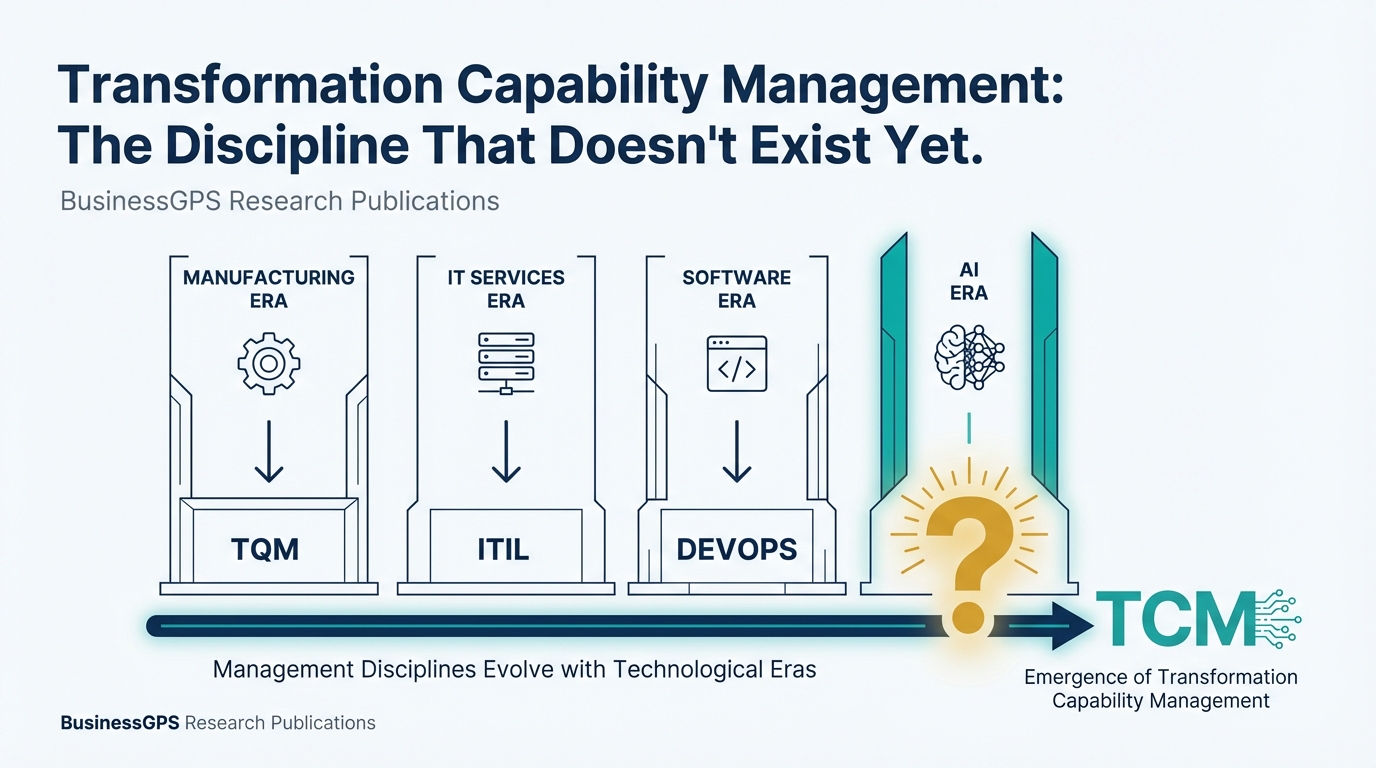
Every major technology era eventually produces a discipline for the receiving side of innovation. Not the building side — the absorbing side. The discipline that helps organisations take what technology makes possible and convert it into sustained operational reality.
Manufacturing got Total Quality Management. IT services got ITIL. Software delivery got DevOps. Each emerged not because organisations lacked the technology, but because the gap between what the technology could do and what organisations could actually absorb had become too expensive to ignore.
The AI era has not yet produced its receiving discipline. The data says it needs one urgently. According to McKinsey's 2025 Global AI Survey, 88% of organisations have adopted AI. Only 6% report capturing meaningful value at scale. That is not an adoption gap. It is an absorption gap — a 14:1 ratio between deploying and benefiting.
This paper introduces Transformation Capability Management (TCM) as the missing discipline. It presents the intellectual architecture — a Five-Layer Activity Model for diagnosing where work actually lives, a three-dimensional Core/Context/Signature classification for deciding what to do about it, and a Transition State thesis for managing how organisations move between states without losing value in the middle.
The evidence base spans 250 years of industrial transitions, current enterprise AI failure data from six independent sources, buyer committee and cohort simulations, four public case studies of transformation failure diagnosed through multi-framework synthesis, independent practitioner validation, and a real-world programme where nine structural failure predictions were confirmed against ground truth.
We believe TCM should become an open discipline — like TOGAF for enterprise architecture — not a proprietary product. The category needs to exist regardless of who builds it. Today, BusinessGPS is the first and, to our knowledge, only practitioner. We have built the first methodology to implement it: O2O, a 27-step system that makes TCM operational. This paper describes the discipline. The companion Five-Layer Activity Model paper provides the primary diagnostic framework. The downloadable TCM Report provides the complete analysis including implementation guidance.
An important distinction: TCM uses AI as the instrument of transformation — agents that augment the discovery, classification, and governance of operational knowledge. It is not selling AI as a destination. The methodology addresses any enterprise transformation: ERP migration, operating model redesign, post-merger integration, digital transformation. AI happens to be both the most powerful tool for doing this work and the most urgent reason for doing it — because AI requires description to function, and description is what most organisations lack. Organisations whose transformation destination IS AI adoption will find that TCM gets them there as a natural consequence: you cannot deploy AI effectively into work you have not articulated. But the discipline is transformation capability, not AI implementation.
The thesis is straightforward: technology changes. Absorption does not. That is why 88% of organisations have AI but only 6% capture value. The solution is not more technology. It is a discipline for the receiving side.
1. The Pattern
Every major technology era follows the same arc. The technology arrives. Adoption surges. Failure rates climb. Eventually someone names the structural problem on the receiving side, and a discipline coalesces around solving it.
| Era | Innovation | Receiving Discipline | What It Solved |
|---|---|---|---|
| Manufacturing (1950s-80s) | Mass production, automation | TQM, Six Sigma | Absorb production innovation systematically |
| IT Services (1990s-2000s) | Enterprise computing | ITIL, COBIT | Absorb technology change into operations |
| Business Process (1990s) | Client-server, cross-functional process | BPR — attempted and failed at execution | Absorbed the vocabulary; the discipline of articulation was inadequate to deliver |
| Software Delivery (2010s) | Agile, cloud, continuous delivery | DevOps | Absorb development speed into deployment |
| AI Transformation (2020s) | Agentic AI, LLMs, automation | ??? | Absorb AI capability into enterprise operations |
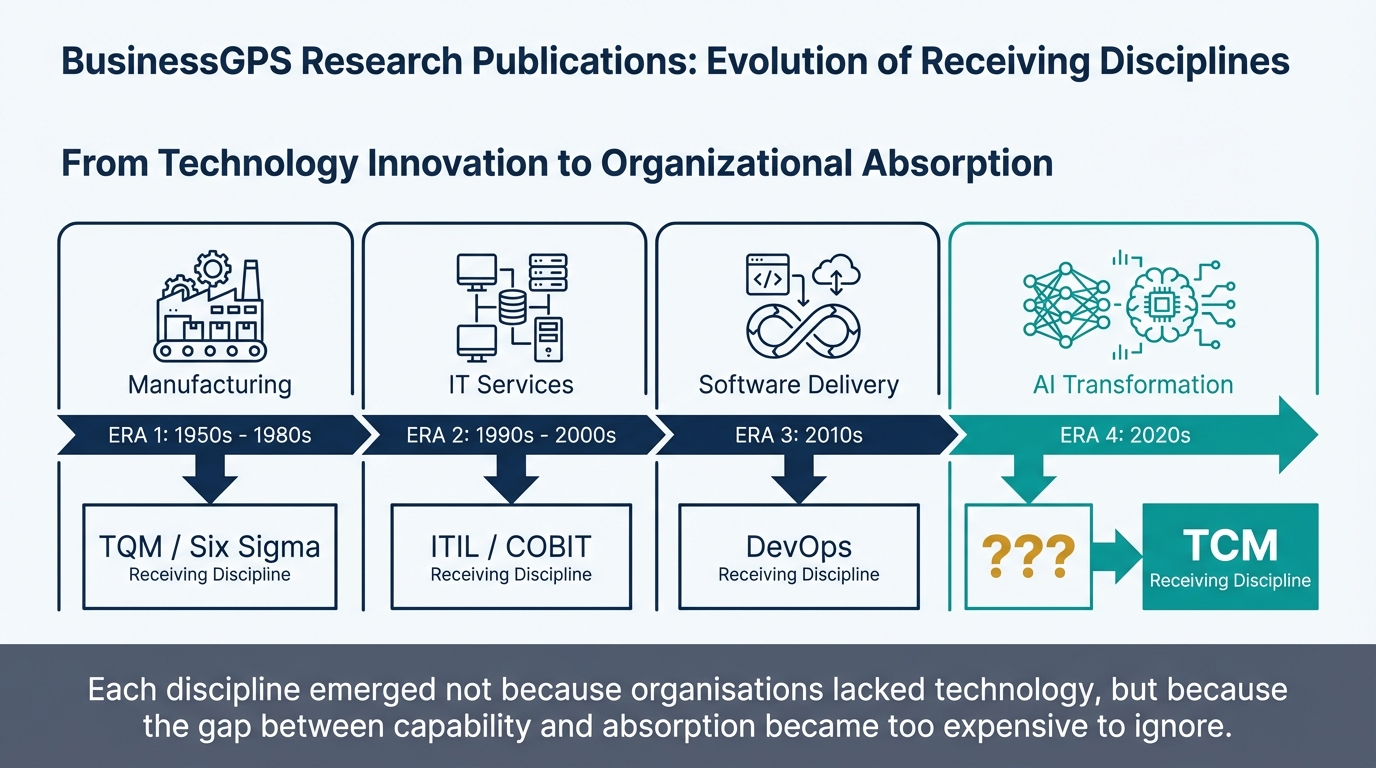
TQM did not emerge because factories lacked machines. It emerged because factories had plenty of machines and no systematic way to absorb what those machines enabled into consistent quality outcomes. ITIL did not emerge because enterprises lacked servers. It emerged because enterprises had servers everywhere and no repeatable way to manage the services those servers powered. DevOps did not emerge because teams lacked deployment tools. It emerged because the speed of development had outrun the capacity of operations to absorb it.
In each case, the discipline addressed the same structural problem: the receiving side of innovation had no systematic capability of its own.
The pattern extends further back. Scientific Management (Taylor, 1880s-1920s) emerged when steam-powered factories could produce faster than human management systems could coordinate. Flow Production (Ford, 1910s-1920s) emerged when electrification enabled distributed manufacturing but factory layouts remained steam-era designs. The Toyota Production System and Lean (Ohno, 1950s-1980s) emerged when automation amplified both output and defects simultaneously. The Theory of Constraints (Goldratt, 1980s-1990s) emerged when manufacturing complexity outstripped traditional optimisation.
Each discipline was preceded by decades of waste. Each was preceded by a period where the industry tried to solve the receiving-side problem with the production-side technology. Each was eventually recognised as a distinct category of capability — not a subset of the technology that created the need for it.
The BPR case is the one the industry prefers not to talk about. Reengineering the Corporation (Hammer and Champy, 1993) launched with enormous intellectual confidence and a clear diagnostic vocabulary — discontinuous change, process redesign, cross-functional integration, the recognition that incremental improvement was insufficient for the client-server era. Within five years of launch, Hammer and Champy themselves were reporting failure rates above 70 percent, including by implementations they had personally overseen. The failure was not of ambition. The failure was of discipline. BPR assumed the redesign work could be specified top-down from executives and consultants. What it actually required — the articulation of tacit operational knowledge held by the people doing the work — was not inside its methodology. The receiving discipline the client-server era deserved was attempted and abandoned. The absorption problem did not go away; it deferred, and compounded, and now presents at greater scale inside the agentic era.
TCM is designed with BPR's failure explicitly in view. The discipline must start where the unarticulated knowledge lives, not where the specifications are written. It must be operated by the organisation receiving the change, not by consultants delivering it. Its artefacts must remain organisational property after engagements end. Its success metric must be the client's independence rather than the consultant's continuing access. These are not rhetorical preferences. They are the structural differences between a receiving discipline that succeeds and a receiving discipline that fails.
The AI era has not yet produced its receiving discipline. This paper argues that it needs one, names it, and describes what it looks like.
The market is beginning to recognise this. The Local Government Association published a Transformation Capability Framework in 2024 — a sector-wide competency tool for over 300 UK councils, with a 5-level maturity model and ten capability areas. Its existence is evidence that "transformation capability" has crossed from implicit professional assumption to explicit institutional concern. Yet even this framework — the most structured attempt so far — addresses who is capable (workforce competency) rather than what the organisation knows how to do and whether that knowledge can survive transformation. The maturity model reaches Level 5 — "fully optimised, rare, sets benchmarks for the sector" — without describing a mechanism for achieving it. The competency question is necessary. The knowledge architecture question is prior.
We call it Transformation Capability Management.
2. The Problem — The Articulation Gap
What the Buyer Experiences
The buyer does not walk in saying "I have an articulation gap." The buyer walks in saying things like this:
"I keep getting the same advisory recommendations and none of them address the political reality." — Richard, PE-installed CEO, engineering consultancy
"If I bring in another Big Four firm, I lose the operations directors permanently." — Priya, COO, mid-market manufacturer
"My 100-day plan has been quietly relabelled a 'plan refresh.'" — Richard
"The technology is solvable. The trust deficit is the constraint." — Priya
"I know what to build but not how to sequence it in business terms." — James, CTO, technology company
"I have the budget but I don't know how to evaluate this." — Sarah, CFO, growth-stage enterprise
What these buyers have in common is not a lack of strategy, not a lack of technology, and not a lack of budget. They have a capability gap — they cannot describe the work that needs to happen between "we have a strategy" and "it's operating" in enough detail for their organisation to act on it.
This is the Articulation Gap. It is the structural reason that transformation keeps stalling.
The $35 Brain Thesis
The cost of AI inference has collapsed 1,200x in three years. A full year of human cognitive output — every email, analysis, recommendation, document, and synthesis a knowledge worker produces in twelve months — can now be replicated for roughly $35 in AI tokens. That number is still falling at approximately 10x per year. By 2028, the cost of a year of cognitive output will be less than a cup of coffee.
This means intelligence is no longer scarce. The bottleneck is no longer "can we get smart enough people?" The bottleneck is: can the organisation describe the work it needs the intelligence to do?
That description does not exist in most organisations. Not because they are incompetent, but because nobody has ever needed to articulate it before. When work was done by experienced humans, the description lived in their heads — in their judgment, their institutional memory, their workarounds. It was never written down because it never needed to be.
Now it does. AI agents can do the work, but only if someone can describe the work at sufficient resolution. The organisations that cannot describe their work cannot deploy AI effectively — which is why 88% of organisations are using AI but only 6% are capturing meaningful value from it.
The Dynamo Parallel
This pattern has repeated in every major technology transition. The economic historian Paul David documented what happened when electricity became cheap enough that any factory could afford it. Beginning in the 1880s, electric motors were available, affordable, and demonstrably superior to steam power. The rational economic prediction was rapid productivity improvement.
It did not happen. For nearly four decades, most factories that adopted electricity saw negligible productivity gains. The reason was structural: they bolted electric motors onto steam-era factory layouts. Steam power required a single massive engine with power distributed through shafts and belts, which meant factories were designed around the engine, with workflow constrained by the physics of mechanical power transmission. Electric motors could be distributed, placed at each machine, enabling entirely different layouts optimised for workflow rather than power distribution. But most factories did not redesign. They replaced the power source and kept everything else.
The factories that broke through — achieving 5%+ annual productivity growth in the 1920s while competitors stalled — were the ones that redesigned around what electricity actually enabled: single-floor layouts, machines arranged by workflow instead of power source, workers controlling their own pace. Not better steam factories with electric motors. Fundamentally different operations.
The parallel to AI is direct and uncomfortable. A $35 brain is cheap electricity. The question is not whether you can afford AI — you can, trivially. The question is whether you will redesign the organisation around what it enables, or bolt AI onto the steam-era org chart and wonder, four decades later, why nothing changed.
The Evidence: Amplification Without Absorption Creates Waste
The data is specific and consistent:
- 88% of organisations using AI, only 6% capturing meaningful value — a 14:1 gap between deployment and benefit (McKinsey Global Survey on AI, 2025)
- 80%+ of AI projects fail — roughly twice the failure rate of non-AI technology projects (RAND Corporation, 2024)
- 42% of companies abandoned most of their AI initiatives in 2025, up from 17% in 2024 — a rate of retreat that is accelerating (S&P Global / 451 Research)
- 30% of generative AI projects abandoned after proof of concept, never reaching production (Gartner, 2025)
- Over 40% of agentic AI projects predicted to be cancelled or significantly scaled back by end of 2027 (Gartner, 2026)
- Only 5% of organisations achieve AI value at scale across a study of over 1,250 firms (BCG Henderson Institute, 2025)
- 56% of CEOs report no financial return from AI investment (PwC 26th Annual Global CEO Survey, 2026)
- AI-assisted development increased engineering throughput 59%, but main branch success rate dropped to 70.8% versus a 90% industry benchmark — "more code, fewer releases" (CircleCI/Waydev, 2026)
In Goldratt's language: AI is a non-bottleneck resource being run at 100% capacity. The constraint is the human system — review, governance, integration, decision-making, change management. Running the non-bottleneck faster does not increase system throughput. It only increases work-in-progress inventory.
The solution is not more AI. The solution is identifying and elevating the constraint — which is always the human system's capacity to absorb, integrate, and act on AI output.
3. The Five-Layer Activity Model — Summary Reference
In v2.0, the full treatment of the Five-Layer Activity Model, including technology mapping, agent deployment patterns, the L4-to-L1 discovery protocol, and the detailed academic grounding, lives in the companion paper Five-Layer Activity Model v2.0. This section presents the Model in summary form so this paper is readable standalone; readers wanting the complete diagnostic framework should read the companion.
Every organisation's operational reality exists across five layers. Understanding these layers is the key to understanding why transformation fails and why the 88/6 gap persists.
| Layer | What It Is | Documentation State |
|---|---|---|
| L5: Agentic Potential | What becomes possible when Layers 2-4 are articulated at agent resolution. Emerging; eighteen-to-thirty-six-month horizon for most enterprises. | Does not exist yet |
| L4: Managerial Judgment | Decision-making, exception escalation, prioritisation, trade-offs, governance. The "frozen middle" bottleneck sits HERE. | Largely unarticulated — lives in judgment |
| L3: Contextual Workarounds | Manual interventions, spreadsheet overlays, "we do it this way because the system can't." | Known by operators, rarely documented |
| --- | THE BLIND SPOT LINE | --- |
| L2: Standard Operating Procedures | Written procedures against the system. Documented but rigid and system-specific. | Documented (variable quality) |
| L1: Standard Software Process | ERP/CRM enforced. System configuration drives it. | Extensively documented |
Why Transformation Only Touches Layers 1-2
Every transformation approach on the market — Big Four strategy, Agile, digital transformation, systems integration — primarily operates at Layers 1 and 2. A new ERP system replaces the standard software process (Layer 1). New SOPs get written against the new system (Layer 2). The project is declared a success.
But look at what happens to the other layers:
| Layer | Old State | After "Successful" Transformation | Result |
|---|---|---|---|
| 1: Standard Process | Old system | New system | Replaced — the cutover |
| 2: SOPs | Optimised for old | Rewritten for new | Updated — the BAU transition |
| 3: Workarounds | For old system | Some eliminated, new ones emerge | Partially rebuilt organically |
| 4: Management | Unarticulated | Largely unchanged | Still unarticulated |
| 5: Agentic | N/A | N/A | Never even considered |
Layer 3 partially rebuilds because operators are resourceful — they find new workarounds for the new system. Layer 4 is never touched because nobody knows how to articulate it. Layer 5 is never considered because nobody has mapped what becomes possible when Layers 3-4 are articulated.
This is why transformations deliver systems but not value. The real work — the judgment, the exceptions, the decisions, the workarounds that make the organisation actually function — lives in Layers 3-5, and nobody has ever systematically uncovered it.
The BPO Parallel: Existence Proof
The Business Process Outsourcing world already solved the articulation problem for Layers 1-2 — because economics demanded it. When you outsource operations to low-skilled operators in a different country, those operators cannot improvise. Everything must be pushed down to standard operating procedures. The entire operating model depends on articulation.
The BPO hierarchy maps directly to an agentic architecture:
| BPO Role | Function | Agentic Equivalent |
|---|---|---|
| SOP writers | Articulate the work | The articulation layer — what TCM builds |
| Low-skilled operators | Execute the SOPs | Agents — execute codified procedures |
| Superusers | Resolve exceptions | Human-in-loop — handle what agents cannot |
| Management | Decide and prioritise | Orchestration — governance, constraint management |
The AI era demands the same articulation for Layers 3-5. If you want agents to do managerial work (Layer 4) or contextual work (Layer 3), you first have to describe that work at the resolution an agent can execute. That description does not exist. Building it is the work of TCM.
The 88/6 Gap Explained
The Five-Layer Model explains exactly why 88% of organisations are using AI but only 6% capture meaningful value:
- The 88% deployed AI at Layers 1-2 — automating documented processes, adding copilots to existing workflows. This is "bolting the electric motor onto the steam-era factory." It saves some time. It does not transform anything.
- The 6% did the harder work of uncovering and articulating Layers 3-5 — the undocumented workarounds, the unarticulated decisions, the unrealised agentic potential. They redesigned around what AI enables, not just what AI automates.
The gap between 88% and 6% is not a technology gap. It is an articulation gap.
For the full treatment — technology mapping across layers, agent deployment reliability requirements, the WHERE dimension, the L4-to-L1 discovery protocol with its 27 discovery questions, the Ambidextrous Operating Logic, the O2O methodology mapping per layer, and the academic grounding (Polanyi, Nonaka, Zollo & Winter, DiMaggio & Powell, Argyris) — see the companion paper Five-Layer Activity Model v2.0 (2026-Q2) on this site.
4. The Three-Dimensional Classification
Once You Have Uncovered the Layers, What Do You Do?
Uncovering the five layers tells you what the work IS. The next question is: what do you DO about each piece of work? This is where the Core/Context/Signature classification applies.
Under the canonical Terms of Reference v1.1 (BusinessGPS, 2026-04-22), the classification is three categories — Signature, Core, Context — not two-plus-subcategory. The summary below reflects the canonical v1.1 definitions; the full treatment, including firm-specific examples and the common misconceptions the v1.1 refinement rejects, lives in the Terms of Reference.
| Classification | Description | Action | Commercial Implication |
|---|---|---|---|
| Context | Commodity. No differentiation value in the design or ownership decision. | Always rent at lowest credible cost | Never invest in custom work here |
| Core | Capabilities whose design and ownership materially affect business outcomes even when standard tooling exists. The deliberate decision layer — rent, buy, borrow or build per capability. Revenue-facing and back-office capabilities can both be Core. | Consciously decide per the canonical Rent / Buy / Borrow / Build protocol | Ownership is a choice made with evidence; not default |
| Signature | Exclusive to the business. Cannot be replicated in any system or platform. May be a competitive moat (unique methodology, proprietary IP, firm-defining judgment) or a constraint-born necessary uniqueness (bespoke statutory, compliance or BI architecture that the firm's specific situation requires). | Must be owned. Articulate before any AI is pointed at it; protect from silent leakage into vendor models. | This IS the firm's competitive advantage OR its operational non-negotiable |
Attribution
Geoffrey Moore developed the Core/Context framework across Living on the Fault Line (2000) and subsequent work. His contribution is the fundamental distinction between activities that create competitive differentiation (core) and activities that are necessary but non-differentiating (context), and the strategic prescription to ruthlessly free resources from context to invest in core.
The Signature subdivision is BusinessGPS intellectual property, developed through thirty years of enterprise delivery, particularly in governance for large-scale ERP implementations. A Signature capability is the operational embodiment of competitive differentiation — or, under the canonical Terms of Reference v1.1, the constraint-born bespoke architecture that the firm's specific situation requires even when that uniqueness is not a competitive advantage. In both forms, Signature must be articulated before AI is pointed at it and protected from silent leakage into vendor models during platform migrations. It is what most consulting firms unwittingly standardise out of existence during large transformations.
This is a stronger intellectual position than Moore's original Core / Context alone. It extends the framework with a dimension Moore did not address — the capabilities that embody competitive strategy or operational necessity and must be protected — and refines Core as the deliberate decision layer rather than an automatic ownership stance.
The Temporal Dimension
The classification is not static. AI shifts the signature boundary:
- What WAS signature (e.g., "our people are really good at credit risk assessment") may become context when agents can do it — because the capability is no longer unique to you.
- NEW signature emerges: "our ability to articulate and orchestrate credit risk assessment at scale using AI" — a management capability, not an operational one.
- The organisation that can continuously reclassify — that can see when a capability is shifting from signature to context and reallocate accordingly — has adaptability. That IS TCM.
The Combined Matrix
For each function or capability, classify across all three dimensions simultaneously:
| Layer | Context | Core (Revenue) | Core (Signature) |
|---|---|---|---|
| L5: Agentic | Automate fully (lowest cost) | Augment + govern (competitive edge) | Augment carefully, protect IP |
| L4: Managerial | Simplify/eliminate | Decision support agents, human decides | WHERE competitive advantage lives — articulate, NEVER outsource |
| L3: Contextual | Outsource or automate | Articulate + agent-ready | Articulate + keep in-house = institutional knowledge |
| L2: SOPs | Standard SOPs, BPO candidate | SOPs + agent augmentation | SOPs are IP — protect them |
| L1: Standard SW | Standard config, commodity | System-enforced, optimise | May not exist in standard software |
The action for each cell is different. The combined matrix is the diagnostic tool that tells an organisation exactly what to do with each capability. The classification cascade works from value streams to capabilities to processes to activities — you classify capabilities as signature, then cascade the implications downward. An important discipline: do NOT do a massive as-is mapping exercise. Work back from what is critical. What is signature? Start there. What is the biggest articulation gap? Start there. What is the highest-value agent opportunity? Start there. Work back from what is critical, not forward from what is comprehensive — avoiding the trap that Business Process Re-engineering fell into in the 1990s.
5. The Methodology — How O2O Implements TCM
O2O (Opportunity-to-Operations) is the proprietary 27-step methodology that BusinessGPS uses to systematically uncover, classify, and transition organisational capabilities. It is the engine that makes TCM operational.
Four Parts
The methodology is structured in four parts:
Part 1: Strategy (Steps 1-9) — What needs to change and why. Business context mapping, goal definition, change narrative, platform strategy, initiative alignment, and planning. This is where shadow drivers are audited, constraints identified, and the cost of inaction quantified.
Part 2: Operating Model (Steps 10-18) — How it should work. The bridge between strategy and execution — where the target architecture, governance framework, and organisational design are defined.
Part 3: Execution (Steps 18.1-18.9) — Build, test, deploy. The implementation work, including readiness assessment before any deployment to end users.
Part 4: Operations (Steps 19-27) — Run, optimise, evolve. This is where the 6% separate from the 88%. Most methodologies stop at the end of Part 3. O2O treats the operations phase as critical path — because this is where absorption either happens or fails.
The Operations Detail
Steps 19.1-19.9 form the critical sub-layer that most methodologies skip entirely. Three steps in particular integrate Goldratt's Theory of Constraints directly into the operating model:
- Step 19.4 — Constraint Identification: The TOC Five Focusing Steps applied to transformation. Identifies what limits absorption at each transition. The constraint is always the human system, never the technology.
- Step 19.5 — Bottleneck Reduction: Goldratt's Transition Tree and Prerequisite Tree sequence intermediate objectives through transitions. This is where the step-by-step path from current state to target state is made explicit.
- Step 19.6 — Throughput Management: Drum-Buffer-Rope sets the pace to the organisation's absorption rate. The drum is the constraint (absorption capacity), the buffer protects the constraint from starvation, and the rope limits work-in-progress to what the constraint can handle. This single mechanism addresses the overproduction waste that AI amplifies: generating more output than the human system can absorb.
The Circular Architecture
The methodology is circular: Step 27 feeds back to Step 1. This is continuous transformation, not a one-time project. There is no "end state." Each cycle builds absorption muscle. Over multiple cycles, absorption becomes adaptability. Adaptability is TCM.
The methodology cycles continuously: Step 27 feeds back to Step 1.
The Systematic Uncovering Method
O2O provides the discovery framework to work through each function against the five layers and the CCS classification. The high-level structure is summarised below; the full 27-question L4-to-L1 protocol, including per-layer method notes (agent-guided conversation for L3–L4, document audit for L2, system scan for L1, and the "read first, then confirm" Acorn Principle) lives in the companion paper Five-Layer Activity Model v2.0 Section 8.
| Question | Layer | Method |
|---|---|---|
| What does the system enforce? | 1 | Extract from system configuration |
| What SOPs exist against it? | 2 | Collect existing SOPs, validate against actual practice |
| What do people actually do that is not in the SOPs? | 3 | Observation, interviews, process mining |
| What decisions get made and by whom? | 4 | Decision mapping, escalation analysis |
| What could agents do if we articulated it? | 5 | Cognitive scoring against Layers 2-4 |
| What is signature versus core versus context? | All | Business model analysis using the classification framework |
| How does this shift from current state to target state? | All | Temporal delta mapping with transition state architecture |
The delta between "what exists" (Layers 1-4) and "what is articulated" IS the Articulation Gap. Closing it IS TCM.
6. The Transition State Thesis
This is the deepest intellectual contribution of TCM.
The critical insight, validated across thirty years of enterprise delivery: the most difficult part of any transformation is managing the transitions between states. That is when you have duality of issues — old and new coexisting. It is never a clean cut. The active ingredient is managing the transition states, not reaching an end state.
The Old Model — Why It Fails
Classical transformation assumes you define a target architecture, then somehow get there. The "somehow" is where all the value leaks:
- No structure to the transition. Unmanaged transition complexity is accepted as inevitable.
- The target is a moving target — technology shifts, market shifts, organisational changes. By the time you arrive, the destination has moved.
- Organisations exhaust budget and energy in the chaos zone before arriving.
- The 80% failure rate, the 42% abandonment rate — these happen in the middle, in the unmanaged transitions that nobody governs.
The New Model — Snapshot Compounding
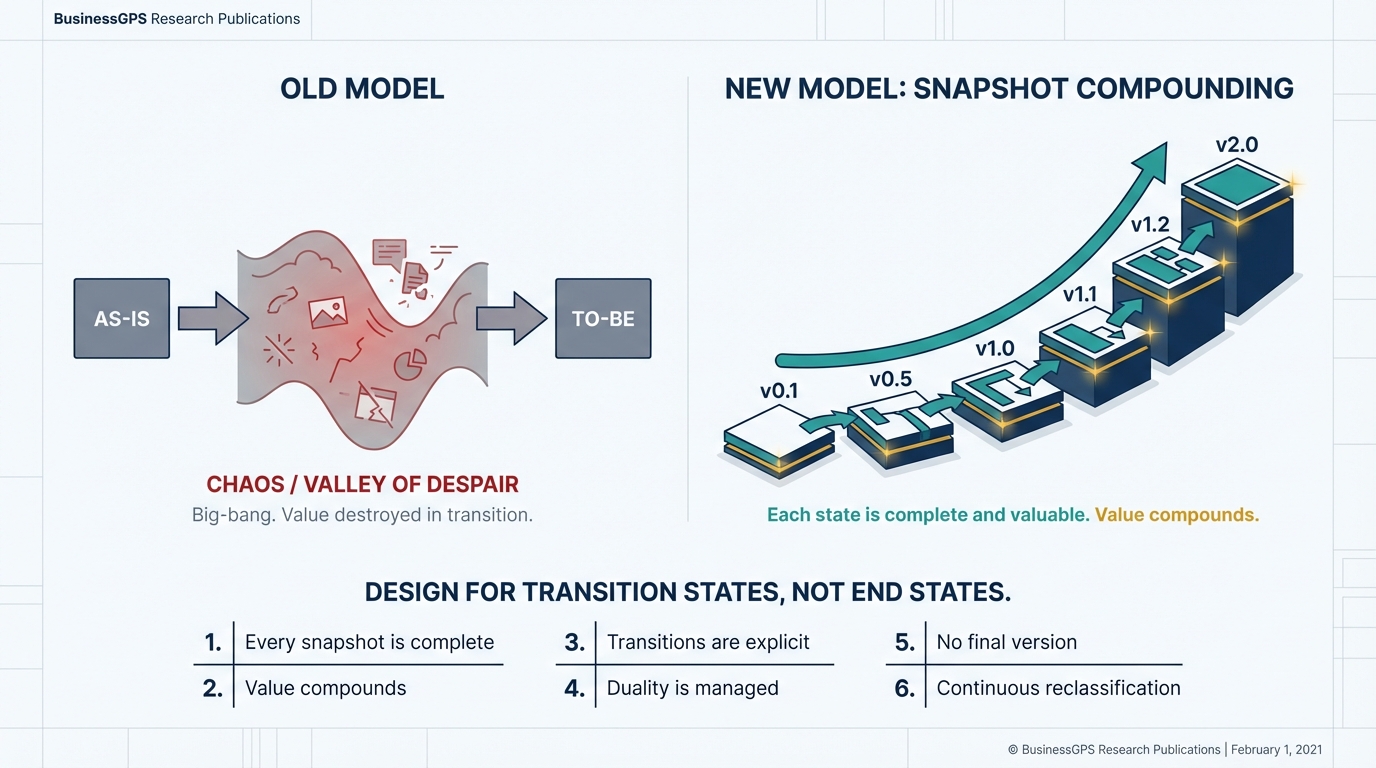
Each state is a complete, valuable solution — not an incomplete waypoint on the road to utopia. Each transition is explicitly architected. Six principles govern the approach:
1. Each intermediate state is complete and valuable. You can stop at any state and the organisation is better off than before. There is no "we need to finish the whole thing before we see value."
2. Transitions are explicitly architected. The O2O methodology provides the mechanisms: Step 5 architects current, target, and transition states. Step 14 manages migration, coexistence, and risk mitigation during the duality period. Steps 19.4-19.6 integrate the Theory of Constraints to identify what limits absorption, sequence intermediate objectives, and set the pace to the organisation's absorption rate.
3. Duality is managed. Old and new coexist during transition with clear governance. This is the hardest part — running dual states until majority complete. AI can help manage operational dual-state complexity (process mining, exception detection, automated routing). Humans govern the strategic dual-state decisions.
4. Loop-backs are learning signals, not failures. When something does not work, you do not "fail" — you loop back to an earlier state and try a different approach. This is built into the circular architecture.
5. Value compounds across transitions. Each cycle builds absorption muscle. The organisation gets better at transitioning — not just at the specific thing being transitioned.
6. No end state. The methodology is circular. Step 27 feeds back to Step 1. The target is not a destination. The target is the capability to continuously evolve.
The Adaptability Definition
Adaptability = the ability to manage transition states such that each intermediate state is complete, valuable, and compounds into the next.
This is the meta-capability that TCM builds. Not "ability to change" (too vague). Not "ability to transform" (implies a destination). Specifically: the ability to create and govern a series of complete, valuable snapshots where the transition between them is explicitly managed.
Three Anchor Points
Before transitions make sense, you need agreement on three things:
- Destination — where are we going? (alignment)
- Start point — where are we now? (honest assessment)
- Then transitions — how do we get there? (the active ingredient)
Without all three anchored, iterations go nowhere. Dream without reality produces lots of iterations and no progress. Reality without dream produces movement without direction.
This extends established enterprise architecture practice. TOGAF already has transition architecture as a concept — inception, conception, transition, and target architectures. TCM extends it beyond IT architecture to the full enterprise: to organisational capability, not just technical capability.
At Each Transition, Reclassify
At each snapshot boundary, the three-dimensional framework shifts:
- Layer reclassification: What was contextual (Layer 3) may now be standard (Layer 2) because you articulated it. What was managerial (Layer 4) may now be augmentable because you described the decision criteria.
- Signature reclassification: What was signature may have become context because agents can now do it. New signature emerges at a higher level.
- Temporal update: The new current state is the latest snapshot. The next target is the next snapshot — not some five-year utopia.
The organisation that can manage these reclassifications continuously has adaptability. That is what separates the 6% from the 88%.
7. The Absorption Thesis — Five Archetypes
Absorption Versus Adaptability
These terms are related but distinct:
- Absorption is the capacity to take in change without breaking — the throughput of the change pipeline.
- Adaptability is the capacity to change direction when the environment shifts — the steering of the change pipeline.
Absorption is the necessary condition for adaptability. Adaptability is the outcome of good absorption over multiple cycles. Each transformation cycle builds absorption muscle. Over time, that muscle becomes the meta-capability to reclassify and redirect — which is adaptability. Which is TCM.
Five Archetypes of Structural Failure
In a 2026 analysis of four major transformation failures at large enterprises — a global media group, a billion-dollar manufacturer, Volvo Group, and a West Coast technology company — combined with a full diagnostic of a FTSE 250 multi-market ERP transformation, we identified five recurring archetypes of structural failure. Each describes a condition that makes failure the likely outcome regardless of execution quality.
1. The Identity Violation. Transformation is designed as something done TO people rather than done WITH them. A global media group launched an operational platform convergence that erased local expertise identities without acknowledgement or negotiation. The programme treated workforce resistance as a communications problem rather than a signal that something fundamental about how people related to their work had been violated. Recovery required a complete architectural pivot from technology-led to trust-led change.
2. The Champion Trap. A brilliant transformation leader drives success through personal capability, creating dependency rather than organisational capacity. A billion-dollar manufacturer ran an operational excellence programme that generated tens of millions in documented savings, certified over 150 practitioners, and delivered real results for years. When the programme champion departed, the entire capability collapsed. The programme had succeeded at delivery and failed at building lasting capability. The metrics — savings, certifications, milestone completion — looked healthy right up until the moment of collapse.
3. The Sovereignty Violation. A central mandate is imposed on a federated world without co-creation. Volvo Group signed a global IT services contract that affected 50+ operating companies without involving the local CIOs who would need to implement it. The affected entities resisted not because they opposed the goal, but because they were denied agency in how to achieve it. Recovery required a fundamental shift from a monolithic model to a franchise approach — common core with local adaptation.
4. The Leadership Vacuum. Transformation ownership is outsourced to consultants or delegated downward without genuine executive engagement. A technology company launched an innovation initiative where the CEO rarely attended briefings, the consultant filled the leadership vacuum without organisational authority, and the team defaulted to analysis-as-avoidance — weekly reviews producing no decisions, creating the appearance of progress while structurally unable to move forward.
5. Governance Theatre. A FTSE 250 multi-market ERP transformation had steering committees, status reports, RAG dashboards, and regular cadences — all of which managed narrative rather than surfacing truth. 99.4% of risk and issue items were left unrated. CEO reports contained no quantified metrics. Twenty benefits were defined with zero measurement architecture. The governance infrastructure created the appearance of control while the programme drifted from a planned cost to multiples of that figure.
The "Never Start with Built-in Failure" Thesis
In all five archetypes, the failure condition was structural from Day 1. It was not introduced by poor execution. It was not caused by unexpected market conditions. The programme was designed in a way that made failure the most likely outcome, regardless of the quality of people or technology involved.
This is the thesis: most transformation failures are architecture failures, not execution failures. The programme was built wrong. Fixing execution inside a broken architecture is like optimising the route while driving in the wrong direction.
The BPR precedent inside this thesis. Business Process Re-engineering (Hammer and Champy, 1993) is the historical proof of the structural-failure thesis at discipline scale. BPR identified the right problem (discontinuous capability change for the client-server era), produced the right diagnostic vocabulary (process redesign, cross-functional integration), and still reported 70 percent failure rates within five years. The structural reason: BPR assumed articulation work could be specified top-down from executives and consultants rather than elicited bottom-up from the operators holding the tacit knowledge. The methodology created the governance infrastructure for discontinuous change but did not solve the articulation problem — so the change artefacts were written for a reality nobody had actually mapped. Seven of the ten Built-in Failure Checklist items below are visible in retrospective analyses of BPR implementations. The lesson TCM takes from BPR is not that receiving-side disciplines cannot succeed. The lesson is that they cannot succeed without a grounded articulation method that starts where the tacit knowledge lives.
The 10-indicator Built-in Failure Checklist, derived from cross-case evidence:
- Benefits defined without measurement architecture — no owner, no baseline, no target, no cadence
- Change management budgeted then available for reallocation — exists on paper, treated as discretionary
- Solution designed before implementers consulted — the people who must deliver were excluded from design
- Single point of failure in change leadership — one champion carrying the programme without distributed ownership
- Success measured by deployment milestones, not adoption metrics — the programme can declare victory without anyone using the new capability
- No readiness assessment before deployment — rolling out to populations whose readiness has not been evaluated
- Global or standard solution without local translation mechanism — imposing uniformity on diverse contexts
- No withdrawal design — the programme has no plan for making itself unnecessary
- Governance instruments that cannot produce "no" — gates and reviews that exist but cannot stop or redirect
- Commercial model misaligned with programme outcomes — delivery partners benefit from continuation, not success
Retrospective scoring against the evidence base: every programme scoring above 6.5 on this checklist failed catastrophically. Every programme below 4.5 was recoverable. The checklist has diagnostic power.
What Systematic Diagnosis Reveals Beyond Practitioner Hindsight
A critical finding from the cross-case analysis: every practitioner's retrospective diagnosis was genuinely insightful. They are smart, experienced, honest professionals who extracted real wisdom from their failures. Yet every one diagnosed at the symptomatic level — who failed, what we should have done differently.
Multi-framework synthesis diagnoses at the structural level — what made failure the likely outcome regardless of who was involved. You cannot see the system from inside the system. The practitioner lived the failure and learned from it. Systematic multi-framework diagnosis reads the same evidence and identifies patterns that are invisible from inside — not because the practitioner is less capable, but because they are too close.
The distinction matters for prevention. Symptomatic learning says "next time, engage stakeholders earlier." Structural diagnosis says "the programme architecture excluded the populations whose sovereignty it violated — engagement timing is irrelevant if the governance structure does not include co-creation."
8. The Sovereignty Thesis
TCM is needed in any transformation era. But it is uniquely urgent in the AI era because of a structural characteristic with no precedent: intelligence is becoming a utility.
When electricity became a utility, the strategic question was: how do you redesign operations around cheap, abundant power? The answer took decades to emerge, but it was fundamentally an engineering challenge.
When intelligence becomes a utility, the strategic question is different and more consequential: how do you consume intelligence-as-utility without becoming dependent on it?
This is not theoretical. Every organisation that uses AI through a consulting firm's proprietary platform, every team that depends on a vendor's fine-tuned model without understanding what it does, every enterprise that automates processes through tools it cannot modify or replace — each is building dependency into its operating model. Not as a failure, but as an unexamined default.
The unique challenge of the AI era is that the thing being outsourced is cognition. Previous eras outsourced manufacturing, logistics, IT infrastructure — operational capabilities that, while important, did not define how an organisation thinks, decides, and learns. Outsourcing cognition is categorically different. It does not just create operational dependency. It creates strategic dependency — the inability to think independently about your own transformation.
This is where the Core/Context/Signature classification becomes existential rather than merely strategic. The meta-capability to continuously reclassify what is core and what is context — and to rapidly reallocate resources as the boundary shifts — is itself the most important core capability of the AI era. The organisations that can do this will adapt continuously. Those that cannot will find themselves locked into configurations that made sense when adopted and make progressively less sense as the technology landscape shifts.
The five-archetype analysis reinforces this from the inside. Sovereignty operates at every level, not just the enterprise level. A transformation that violates internal sovereignty — local teams, business units, operating companies denied agency over changes that affect their work — fails for the same structural reason that renting external capability creates dependency: the affected population does not own the change.
9. What It Delivers
TCM is a discipline, not a product. But the O2O methodology that implements it is delivered through two structured programmes.
The Entry-Level Programme
A 30-day, cohort-based programme covering Steps 1-3 of the O2O methodology: Business Context, Business Goals, and Business Change.
What the participant produces:
| Week | Output |
|---|---|
| 1 | External forces map, capability audit, stakeholder influence map, urgency assessment |
| 2 | Success vision, KPIs, stakeholder expectations, timeline, resource reality |
| 3 | Root cause analysis, strategic alignment, value proposition, risk identification, transformation narrative |
| 4 | Integration, gap resolution, shadow driver check, post-programme roadmap |
The participant does the work — not the consultant. AI augments through Athena, the diagnostic assistant. Peer pods challenge. But the analysis, the narrative, the strategy belong to the participant. The output is a diagnostic map that the buyer OWNS. Not a consultant's recommendation with the buyer's name on it.
Mode discovery is assessment-validated (Optimise, Compete, or Pivot) — not self-selected. An absorption capacity baseline is included: a lightweight assessment of the organisation's current ability to absorb change, providing the starting measurement that most programmes never establish.
The Full Programme
A 90-day programme across 16 weeks, covering Steps 1-9 of the O2O methodology — the complete strategy phase from initial diagnostic through initiative planning and board-ready business case.
| Phase | Weeks | Key Outputs |
|---|---|---|
| 1: Diagnostic Validation | 1-3 | Validated context, goals, change strategy with shadow driver audit |
| 2: Platform and Ecosystem | 4-7 | Governance framework, target architecture, platform decision, vendor evaluation |
| 3: Execution Readiness | 8-12 | Portfolio alignment with WIP limits, team composition, business case, mission briefs |
| 4: Integration and GO/NO-GO | 13-16 | Full diagnostic map, board presentation, independence assessment |
AI augmentation runs throughout: multiple agents with skills across disciplines support the participant with framework vocabulary, cross-step coherence, structured challenge, and domain expertise. The participant provides the organisational knowledge, the judgment, and the decisions.
The Independence Test
The fundamental metric: "After the programme, do you need us more or less?"
If the buyer is more dependent after the programme, it has failed — regardless of how good the outputs are. This inverts the structural incentive of every consulting model on the market.
Simulation Results
To test whether the methodology works before running it live, we ran a structured simulation: six executive personas across three sectors, sixteen weeks of simulated delivery with realistic disruption conditions.
- 6.9/10 average satisfaction score
- 83% produced a GO decision
- 9 worked output examples across 3 personas
- 3 detailed customer stories demonstrating the independence thesis
- Advisory cost savings of approximately two to three million pounds across three comparable scenarios (CFO justification model)
These are not theoretical projections. They are the outputs of a simulation engine that stress-tested the methodology against realistic executive behaviour, time constraints, organisational politics, and programme disruptions.
10. Competitive Landscape
Who Else Addresses This Problem
| Approach | What It Does Well | Where the Gap Remains |
|---|---|---|
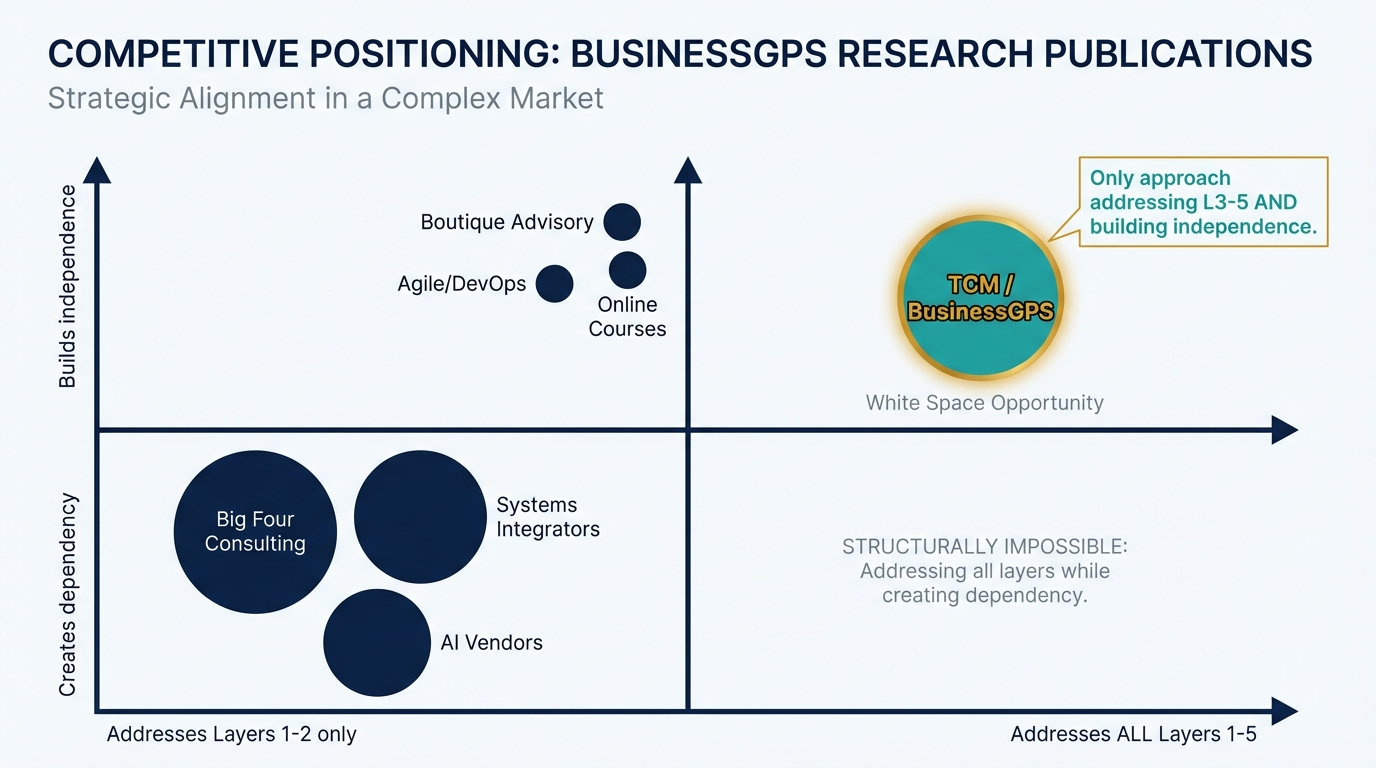
| Big Four consulting | Deep strategy capability, global reach, board credibility, organisational health frameworks (McKinsey OHI, Deloitte Human Capital). Strong at Layers 1-2 and increasingly exploring Layer 4. | Layers 3-5 as a systematic discipline. Transition state architecture. Independence as a delivery metric. Revenue model structured around ongoing engagement. |
| Boutique advisory | Specialist depth, practitioner credibility, closer client relationships. Often stronger on political reality than large firms. | Execution architecture. Constraint-based sequencing. Scaling beyond individual advisor capacity. |
| Agile/DevOps providers | Process improvement, delivery speed, team-level capability building. Proven at Layers 1-2 within technology functions. | Do not address the full enterprise stack from strategy through operations. Core/context/signature reclassification is not in scope. |
| AI vendors | Powerful tools, rapid deployment capability, strong at automating specific tasks at Layers 1-2. Some (e.g., Palantir Foundry) building operating-system-level platforms. | Strategic framework for what to automate and why. The articulation prerequisite — AI requires described work to function. Architecture before automation. |
| Executive education | Individual capability development, peer learning, research-grounded frameworks. Best programmes (IMD, LBS) produce organisational artefacts. | Transfer from individual learning to organisational capability. The gap between what an executive knows and what their organisation can do. |
| Innovation labs | Safe space for experimentation, exposure to emerging technology, proof-of-concept development. | Connection to core business operations. Scaling from pilot to production. Integration with existing transformation programmes. |
Seven Structural Differentiators
1. The Five-Layer Activity Model — the structural explanation of why transformation fails. Nobody else has articulated that Layers 3-5 are where the value lives and where the articulation gap exists.
2. Core/Context/Signature classification — what to do about it. Moore gives you Core/Context. BusinessGPS adds the Signature dimension (what must be protected, not standardised) and the temporal dimension (what is signature today becomes context tomorrow).
3. The 27-step methodology — the systematic uncovering and transition method. Not a framework. Not a set of principles. A step-by-step method for working through each function across five layers and three classifications.
4. AI-augmented architecture — AI augmentation built into the methodology, not bolted on. Each agent has specific skills aligned to specific methodology steps. The participant works WITH AI, not just alongside it. Third-party validated: independent AI researchers describe the "skills as glorified folders" architecture as the approach around which billion-dollar companies will be built.
5. Independence as the success metric — "need us less, not more." Every competitor's business model is optimised for the buyer needing them more. BusinessGPS is the only approach that measures success by whether the buyer becomes less dependent.
6. Transition state management — Snapshot Compounding, not big-bang. Each intermediate state is complete and valuable. Transitions are explicitly architected. Duality is managed. Value compounds. No end state.
7. Constraint-based execution — Theory of Constraints integrated into the operating model. The methodology identifies what limits absorption at each transition, sets the pace to the organisation's absorption rate, and sequences intermediate objectives through transitions.
The Reliability Argument
Why architecture matters more than automation: at 80% per-task accuracy, an AI agent running 50 sequential tasks has a 0.0014% success rate — roughly 1 in 71,000. Enterprise processes need 99.99%+ reliability. This single data point demolishes the "automate everything" pitch. You MUST classify activities before deploying AI. You MUST know where to use workflow (predictable, rigid, reliable) versus agentic (flexible, adaptive, risk-managed). The Five-Layer Model and Core/Context/Signature classification provide that classification. Architecture first, tools second.
11. The Evidence Base
Historical Precedent (250 Years, Five Industrial Transitions)
Every major industrial transition follows the same arc: new technology amplifies throughput, organisations maximise utilisation, the system drowns in unabsorbed output, eventually someone redesigns around flow rather than volume.
- Steam power (1780s-1880s): Scientific Management (Taylor) emerged when steam-powered factories could produce faster than human coordination could manage.
- Electrification (1881-1920s): Flow Production (Ford) emerged when distributed power enabled new factory layouts but organisations kept steam-era designs for four decades.
- Automation (1950s-1980s): TPS/Lean (Ohno) emerged when automation amplified both output and defects simultaneously.
- Complexity (1980s-1990s): Theory of Constraints (Goldratt) emerged when manufacturing complexity outstripped traditional optimisation methods.
- AI (2023-present): TCM is positioned as the next discipline in this sequence — emerging at the AI absorption crisis.
The pattern is documented across 240+ years with specific quantified results at each stage. Management disciplines emerge when the receiving-side problem becomes more expensive than the production-side investment. We are at that point with AI now.
Buyer Committee Simulation
A five-persona buyer committee (CFO, CIO, CEO, Transformation Director, Non-Executive Director) evaluated the methodology through weighted scoring:
- Verdict: DON'T BUY at 5.055/10 — but the methodology itself scored 7-8/10 across all personas.
- The gap between methodology confidence and purchase readiness was entirely explained by evidence maturity, not methodology quality.
- 21 specific objections were identified, mapped, and prioritised. The committee defined a clear four-tier path from DON'T BUY to BUY — essentially specifying what evidence would move each persona.
- The majority of those objections have since been addressed through the subsequent evidence gathering described in this paper.
Cohort Simulation
Six personas across three sectors, sixteen weeks of simulated delivery with realistic disruption conditions:
- 6.9/10 average satisfaction. 83% GO decision rate.
- 9 worked output examples across 3 personas.
- 3 detailed customer stories demonstrating the independence thesis and advisory cost savings.
- Every persona — regardless of sector, seniority, or starting knowledge — produced specific, named, quantified diagnostic content by Week 3. The articulation gap closed consistently and measurably across all six.
- Structural refinement based on cohort findings (approximately 30-40 hours of architectural fixes) improved completion rates by 8.5 percentage points and conversion metrics by 6 percentage points.
Customer Stories
Richard (PE-installed CEO, engineering consultancy): Built an independent transformation plan through the full programme, defended it under challenge from an independent advisor, and was assessed as producing the strongest output seen from a PE-installed CEO at 14 months in role. Advisory cost saving compared to traditional approach: approximately half a million pounds. The key moment: Richard's board advisor attempted to replicate the programme's diagnostic output using conventional advisory methods and could not match the depth or coherence.
Priya (COO, mid-market manufacturer): After completing the entry-level programme, Priya unbundled a substantial Big Four diagnostic proposal into a targeted assessment at a fraction of the original cost — because she had already done the analysis herself and could specify exactly what she needed. The vendor's internal reaction: "She doesn't need us as much as I initially thought." That reaction IS the independence thesis in action.
The Cost Collapse Arithmetic
- GPT-3 pricing at launch (2020): approximately $60 per million tokens
- Commodity model pricing (2026): approximately $0.05 per million tokens
- 1,200x cost collapse in three years, falling at roughly 10x per year
- The economic implication: intelligence-as-utility is arriving faster than organisations can absorb it, which is precisely the dynamic that produces a receiving discipline
Independent Validation — The Secret CFO
The Secret CFO — a practising CFO with a 200+ article newsletter and substantial readership among exactly our target audience — published a multi-part series on "CFO Tech Debt" in early 2026 that independently describes the Articulation Gap, the Five-Layer Model dynamics, and the absorption problem without knowing BusinessGPS or TCM exists.
This is the strongest independent validation we have, because it comes from a practising CFO describing the problem in buyer language:
"Excel is the pain relief for tech debt, not the cure" — Every spreadsheet overlay is an articulation failure. Work that should be in the system but is not, because nobody described it at sufficient resolution. This is Layer 3 workarounds stated by a CFO.
"Learned helplessness" (Seligman analogy) — Finance teams subjected to repeated failed implementations stopped trying to escape, even when they could. This is the frozen middle described at the individual level. Layer 4 paralysis in buyer language.
"They don't have customers. They have hostages" (citing Morningstar's analysis of ERP vendors) — The entire competitive moat of major enterprise software vendors is switching costs, not product quality. This is the sovereignty problem stated by an independent practitioner.
"The people who understand the problem well enough to fix it are precisely the ones you can't release" — The constraint on transformation is the very people who would need to lead it. The absorption Catch-22.
"90% implementation is nowhere near enough — the last 10% is where value lives" — The standard software process (Layer 1) and SOPs (Layer 2) get addressed. The last 10% — the workarounds, the decisions, the contextual knowledge — is where all the value lives, and it is never articulated. This is Layers 3-5 stated by a CFO.
"We automated the downstream consequences" — Robotic Process Automation automated the reconciliation of errors that should never have been created. The root cause — unarticulated processes at Layer 3 — was never addressed. Treating symptoms, not structure.
"Tech debt lives at the intersection of your systems and the real world" — The Articulation Gap stated by a practising CFO. The gap between what the system enforces and what actually happens IS the tech debt.
Eight diagnostic questions that map directly to the systematic uncovering method: Where does a real-world event happen that your systems do not capture? Where are spreadsheets acting as shadow software? How well does your finance team understand the shop floor operation?
"AI will look like a new generation of better software — domain-trained, with guardrails, layered with company context" — Layer 5 deployed properly. The Secret CFO independently describes the endpoint that TCM is designed to reach.
Seven Eras of Finance Technology — Each era solved part of the problem but created new integration headaches, and the real tech debt accumulated at the boundary between systems and reality. This validates the historical pattern at the function level.
The Secret CFO's audience is exactly the CFO/Financial Gatekeeper archetype. His language is the language our buyers use. His diagnosis is our diagnosis. He has independently validated the problem without knowing the solution exists.
Independent Validation — AI Architecture Research
METR (Model Evaluation and Threat Research) reliability data provides a critical architectural constraint: at 80% per-task accuracy, an AI agent running 50 sequential tasks produces a 0.0014% end-to-end success rate. This confirms that enterprise AI deployment requires architecture before automation — you must classify activities, know where to use workflow versus agentic approaches, and design for the reliability requirements of each activity type.
Independent AI researchers have separately described the "skills as glorified folders" architecture — the approach of building AI capability through structured, domain-specific skill libraries rather than monolithic models — and stated that "billion-dollar companies will be built around this idea." The Compression/Extension/Delegation framework independently validates the cognitive activity classification that underpins the Five-Layer Model.
Geoffrey Moore Framework Alignment
Reading Moore's Core/Context framework from the customer side — rather than the vendor side where it is usually applied — validates the sovereignty thesis directly. The organisation's ability to distinguish what is core (build) from what is context (rent) is itself the most important core capability.
Moore's Zone to Win analysis reveals that enterprise AI has NOT crossed the chasm. The "whole product" does not exist yet for most enterprises — which is exactly the gap TCM fills. BusinessGPS targets visionary and early pragmatist buyers, not the pragmatist majority. The discipline will cross the chasm when the evidence base is undeniable — which the 88/6 gap is making increasingly difficult to ignore.
Macro Convergence Thesis
Four independent macro signals are converging simultaneously: AI cost collapse (intelligence becoming a utility), currency debasement at approximately 12% per year (forcing real returns from technology investment), crypto agent payment rails forming (enabling machine-to-machine economic activity), and quantum computing on the horizon (threatening current cryptographic assumptions).
This convergence creates an approximately 1,000-day window — mid-2025 to mid-2028 — during which the organisations that build transformation capability will establish compounding advantages over those that do not. The window exists because the cost of AI is falling faster than the cost of organisational change, creating a period where the technology is ready but the receiving side has not yet adapted. TCM is the receiving-side capability that capitalises on this window.
12. The IP Architecture
Clear Statement of What Belongs Where
| Entity | What It Is | Relationship |
|---|---|---|
| TCM | The open discipline/category — like TOGAF for enterprise architecture | Defines what needs to exist. Independent of any single implementation. |
| O2O | The proprietary 27-step methodology | Implements TCM. Is the engine. The 30 years of delivery IP that makes it operational. |
| BusinessGPS | The product platform | O2O is its engine. TCM is the category it operates in. |
| Digital Edge | Personal publication exploring the intellectual dimensions | Names the problem. Explores the thinking. Never names the solution. Never mentions BusinessGPS. |
| The Way Pointer | BusinessGPS product blog | Names the methodology. Points to the product. Translates TCM concepts for specific personas. |
Why This Architecture Matters
The separation between TCM (the category) and O2O/BusinessGPS (the product) is strategically critical:
TCM as an aspiring open category invites others to contribute to and validate the discipline. We believe that if TCM remains only one company's work, it will not achieve the impact the industry needs. TOGAF is not owned by one company. ITIL is not owned by one company. We believe TCM should follow the same path — though we recognise that aspiration must be earned through adoption, not declared through publication.
Digital Edge as personal publication allows independent authority building without the commercialism of a product pitch. Readers of "The $35 Brain" think "this person sees what I see." They are not being sold to. The authority transfers when they seek the solution.
The Way Pointer as product blog translates the intellectual framework into practitioner language for specific personas. This is where TCM concepts become actionable and where the methodology is named.
O2O as proprietary methodology protects the delivery IP that makes it work. The Five-Layer Model, the Signature Process concept, the 27-step architecture, the constraint integration, the AI-augmented agent architecture — these are proprietary IP built on three decades of enterprise delivery, not open-source.
The Content Cascade
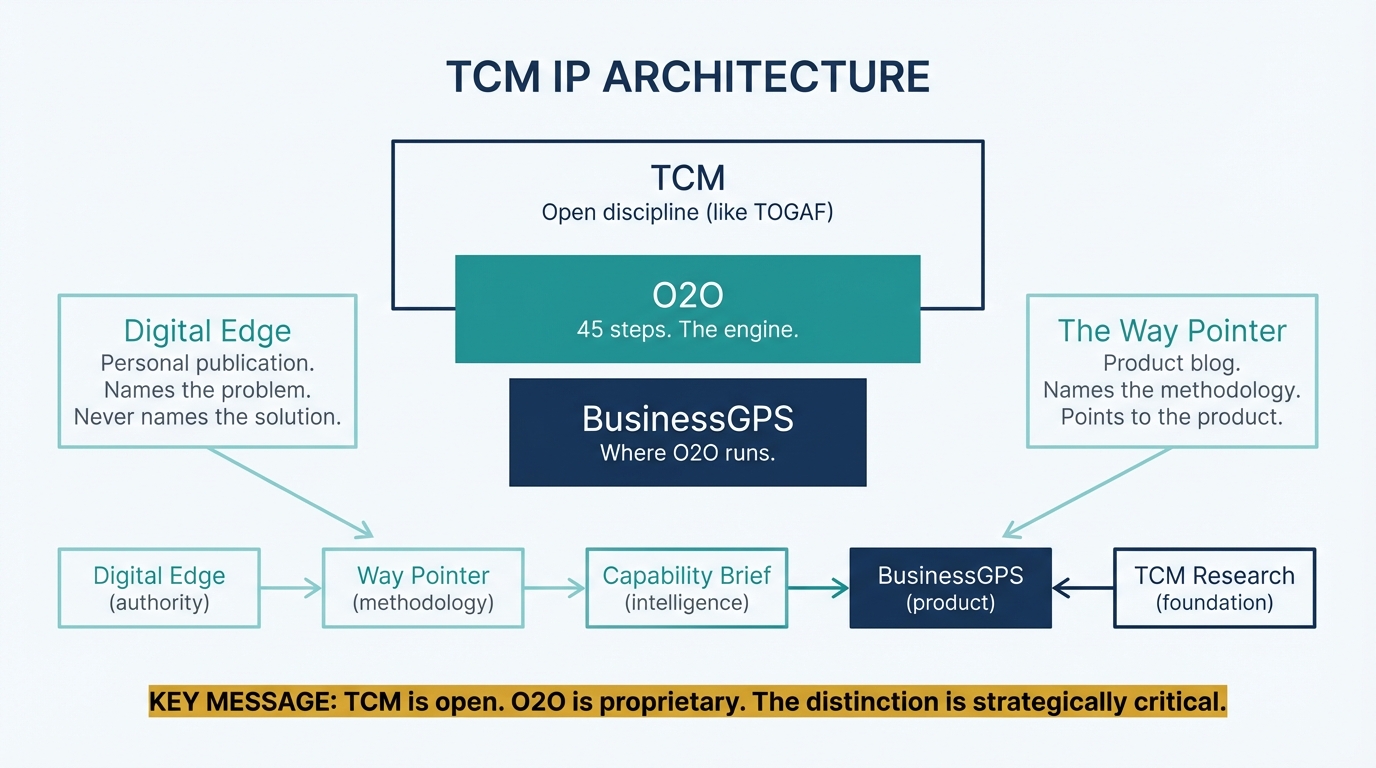
13. Implications
For the Industry
We believe TCM should become an open discipline — not a proprietary product. The category needs to exist regardless of who builds it, because the structural gap it addresses is industry-wide and worsening.
The transformation consulting industry currently operates on a model that is structurally misaligned with client outcomes. The incentive is to deliver transformation, not to build the client's capacity to transform. TCM names this misalignment and provides an alternative — one in which success is measured by the capability left behind, not the quality of the delivery.
This is not an indictment of consulting. It is an observation about structural incentives. The same misalignment existed in IT service management before ITIL, in software delivery before DevOps, and in manufacturing quality before TQM. In each case, the receiving discipline realigned incentives by giving the client side its own systematic capability.
For Practitioners
The industry default is to start at the top — strategy, vision, business case — and work down. By the time the programme reaches execution and operational embedding, it has consumed its budget, its political capital, and its executive attention.
The evidence from the five archetypes is unambiguous: failures concentrate in steps that require understanding the human system and building for human adoption. The technical steps are generally competent. Programmes execute the technical steps while skipping the human steps, then discover that the human steps were the hard ones.
TCM's diagnostic starting point inverts this. Start with what people actually do. Understand the five layers of operational reality. Map the articulation gap. Then design the transformation architecture around what the organisation can absorb — not what the technology can deliver.
For Executives
The question is not "which AI should we buy?" or "how fast can we deploy?" The question is: can your organisation absorb what AI enables?
If the answer is uncertain, the investment in AI technology will produce the same outcome it has produced for the 94% of organisations in the data that deployed without capturing value: adoption without absorption, pilots without production, PowerPoint decks about transformation that never quite transforms.
The diagnostic starting point is the Five-Layer Activity Model, published as a companion research paper on this site. It provides a structured way to assess where your organisation's transformation capability actually resides and where the gaps are.
The full analysis including implementation guidance, the measurement model, and worked examples is available in the TCM Report, downloadable from this site.
For organisations that want an immediate, structured self-assessment, Athena — the diagnostic assistant — provides a guided entry point that produces a personalised capability assessment in under 30 minutes.
14. Academic Grounding (added v2.0)
Transformation Capability Management is an operational synthesis, not a novel theoretical contribution. It stands on top of a substantial academic and practitioner literature that v1.0 did not cite in full. This section makes the intellectual ancestry explicit.
Tacit knowledge and organisational learning. Michael Polanyi's The Tacit Dimension (1966) is the foundational source for the distinction TCM operationalises across enterprise work — that more is known than can be told, and that the articulation of tacit knowledge is an act of deliberate construction rather than passive reporting. David Autor extended Polanyi's distinction into automation economics in Polanyi's Paradox and the Shape of Employment Growth (NBER, 2014), showing that work resisting specification was precisely the work resisting automation. Nonaka and Takeuchi's The Knowledge-Creating Company (1995) provides the SECI model of knowledge conversion between tacit and explicit forms — the closest prior framework to the discovery protocol in the companion Five-Layer Activity Model paper. Zollo and Winter's Deliberate Learning and the Evolution of Dynamic Capabilities (2002) establishes knowledge articulation as a learning mechanism at organisational scale; TCM positions it as the root cause of AI failure when the mechanism is absent. Chris Argyris's Theories of Action distinction (with Donald Schön, 1974) between espoused theory and theory-in-use anticipates the L2-vs-L3 distinction by a half-century. Lippman and Rumelt's Uncertain Imitability (1982) establishes causal ambiguity — the reason competitive advantage persists — as itself a form of unarticulated capability that matters commercially.
Institutional theory — the 88-percent explanation. DiMaggio and Powell's The Iron Cage Revisited (1983) names three isomorphic mechanisms — coercive, mimetic, and normative — that predict why organisations adopt practices under pressure that is not strictly economic. The mechanisms explain exactly the pattern of 88 percent AI adoption regardless of value capture. Boards and CEOs adopt AI because other boards and CEOs are adopting AI (mimetic), because analysts and regulators pressure for adoption (coercive), and because professional networks normalise the adoption agenda (normative). TCM does not contradict the institutional account. It complements it: isomorphic pressure explains the 88 percent (ceremonial adoption), the Articulation Gap explains the 6 percent (value capture). The two accounts are complementary, not competitive.
Technology, productivity and transition dynamics. Erik Brynjolfsson's The Productivity Paradox of Information Technology (1993) established that IT investment produces productivity gains only with accompanying organisational change. Alfred Chandler's The Visible Hand (1977) showed that management structures emerge from technology revolutions rather than appearing alongside them. Carlota Perez's Technological Revolutions and Financial Capital (2002) distinguishes the installation phase of a technology revolution from the deployment phase — a distinction TCM uses directly to position the agentic moment. The NBER Coasean Singularity working paper (Shahidi, Rusak, Manning, Fradkin, Horton, 2025) provides the contemporary anchor: coordination cost falling toward zero under agent orchestration forces firms to re-decide their boundaries, which is precisely the discipline TCM is designed to support.
Capability classification ancestry. Geoffrey Moore's Dealing with Darwin (2005) remains the foundation for the Core/Context distinction. Prahalad and Hamel's The Core Competence of the Corporation (1990) is the intellectual ancestor of the intuition that rare and valuable firm capabilities underpin sustained competitive advantage. Porter's Competitive Advantage (1985) provides the value-chain frame against which BusinessGPS's Matrix is orthogonal. Gartner's pace-layering (2010 onwards) contributes the temporal rhythm intuition.
Business Process Re-engineering as cautionary sequence. Hammer and Champy's Reengineering the Corporation (1993) is the load-bearing cautionary precedent referenced in Section 1 and Section 7. TCM takes BPR's failure as a structural lesson rather than a dismissible historical footnote. The discipline must start where the unarticulated knowledge lives, must be operated by the receiving organisation rather than by delivering consultants, and must produce artefacts that remain the client's property after engagement ends. Those three conditions are what TCM is designed to satisfy.
Contemporary convergence. The USAII's naming of "AI Management" as emerging sub-field (January 2026), McKinsey QuantumBlack's Seizing the Agentic AI Advantage (June 2025) and AI Is Everywhere, the Agentic Organization Isn't Yet (April 2026), MIT CISR's AI Decision Rights Matrix (2025), and the practitioner corpora of Nate B Jones, Daniel Miessler, Ethan Mollick and Andrej Karpathy are all converging on the same structural finding: the organisational form that captures AI value has not stabilised. TCM contributes to that emerging literature by offering an operational discipline rather than a further description of the gap.
15. Boundary Conditions (added v2.0)
TCM does not apply uniformly to every organisation. Honest about limits, BusinessGPS identifies four conditions under which the discipline is less useful or requires adaptation.
Digital-native organisations. Firms founded inside the SaaS and agent-native era, built on cloud-native infrastructure with codified operational practice from inception, often have small Layer 3–4 surfaces by design. Their Blind Spot is narrower, their workarounds fewer, and their tacit knowledge more recently articulated. TCM still applies but returns different proportions: the 60 percent of work-below-the-line that shows up in legacy enterprises is typically 20–30 percent in a digital-native. The discipline's diagnostic leverage is reduced in direct proportion to how much of the organisation's work is already specified.
Highly codified industries. Sectors where extensive regulatory and safety specification has already forced articulation of Layer 3–4 work — commercial aviation, nuclear power, pharmaceutical manufacturing, clinical medicine — have smaller Blind Spot surfaces than general enterprise. TCM still diagnoses usefully but the marginal return from articulation work is lower because much of that articulation has already happened for reasons unrelated to AI.
Single-person or very small organisations. TCM is a discipline for organisations where tacit knowledge is distributed across multiple people and institutional memory matters. In a firm of fewer than five people, the framework collapses — all layers are held by the same individual, and articulation becomes personal rather than organisational. Sole traders, micro-businesses and very early-stage startups should use simpler frameworks designed for that context.
Firms in active crisis. TCM is a discipline for organisations with enough operational stability to reason about capability reclassification. In active crisis — liquidity events, regulatory investigation, catastrophic system failure — the framework's analytical horizon is too long to be useful. Crisis management comes first; capability reclassification later. BusinessGPS explicitly does not recommend TCM engagements during active crisis; the discipline is for stable organisations planning deliberate change, not for organisations firefighting.
The four conditions do not invalidate TCM. They calibrate its applicability. Readers evaluating whether the discipline applies to their context should start with the binary question: does the organisation have significant unarticulated Layer 3–4 work whose value would be captured by making it explicit? If yes, the discipline applies; if no, lighter-touch instruments or different frameworks are likely to produce better returns.
16. Labour, Ethics and Who Benefits (added v2.0)
A discipline that makes tacit work articulable carries consequences for the people whose work it articulates. BusinessGPS treats those consequences as legitimate research subject matter and a core governance responsibility, not as externality.
Articulation changes the ownership of work. When Layer 3–4 work is articulated, the tacit knowledge previously held inside experienced practitioners becomes organisational property — capturable, transferable, and in principle automatable. This is a transfer of value. Who benefits from the transfer is a governance question, not a technical one. In BPR's failure mode, articulation benefited the organisation and disadvantaged the articulators. A transformation discipline that ignores this distribution question repeats BPR's ethical as well as operational failure.
The ethics-aware alternative. BusinessGPS positions CCS as an ethical decision framework as much as an operational one. Articulating Context is value-creating with limited distributional consequences — commodity work was never the articulator's competitive asset. Articulating Core changes the ownership of design decisions but typically leaves individual practitioners with augmented rather than substituted roles. Articulating Signature is where the distributional question sharpens: the tacit judgment that is the practitioner's competitive asset becomes organisational property once articulated, and the practitioner's bargaining position changes. An ethically-conscious TCM builds the distributional question into engagement design — compensation, career path, participation in the articulation process, and artefact ownership all need to be on the table at engagement scope rather than afterwards.
The apprenticeship question. The junior-to-senior pipeline collapse trap identified in the companion Capability Reclassification Matrix paper is a labour-market issue as much as a capability-reproduction issue. AI automation of entry-level Layer 1–2 work is removing the rung through which junior practitioners historically acquired tacit knowledge. An ethically-conscious transformation discipline treats the redesign of the apprenticeship path as part of scope. The firm that articulates tacit knowledge, automates the entry-level work, and does not redesign the apprenticeship is capturing short-term value at the cost of long-term capability reproduction.
Artefact ownership. Articulation produces artefacts — decision logs, workaround registers, judgment frameworks, skill files. Whether those artefacts remain inside the firm, become portable with the practitioners who created them, or become proprietary to the TCM discipline provider is a live governance question. BusinessGPS's stance is that articulated artefacts remain firm property, but the practitioners whose knowledge they embody retain appropriate recognition and participation in any downstream use. This is a principle rather than a contractual template; it shapes engagement design rather than bolt-on.
Sovereignty at every level. The five-archetype analysis (Section 7) shows that transformations violating internal sovereignty — local teams, business units, operating companies denied agency over changes affecting their work — fail for the same structural reason that renting external capability creates dependency: the affected population does not own the change. An ethically-conscious TCM applies the sovereignty principle consistently across enterprise, function, team and individual levels.
17. Conflict of Interest Disclosure (added v2.0)
BusinessGPS is a commercial firm. This paper presents a discipline that BusinessGPS sells engagement services around. The reader is owed explicit disclosure of the conflicts inherent in that position, so the argument can be evaluated on its merits rather than on the commercial context.
Direct commercial interests. BusinessGPS sells productised engagements (Sophina, SR30, Bridge Module, TP90, Portfolio tier) that operationalise TCM, the Five-Layer Activity Model, and the Capability Reclassification Matrix. A reader who concludes the discipline is valid may become a buyer of those engagements. BusinessGPS earns revenue from that conversion. The authorial institution therefore has a direct financial interest in the discipline being accepted.
Indirect commercial interests. BusinessGPS uses this paper and its trifecta companions as demand-engineering assets — instruments that generate inbound enquiry, qualify potential buyers, and anchor sales conversations. The paper's publication is part of a commercial programme, not a purely academic contribution.
IP architecture. The core IP of BusinessGPS is the operational methodology (O2O 27-step framework, Three Forges, Five-Layer Activity Model, Capability Reclassification Matrix, canonical CCS, Ambidextrous OS). The frameworks in this paper are offered as open intellectual property contributed to the category of TCM. BusinessGPS aspires to TCM becoming an open category comparable to TOGAF or ITIL rather than proprietary territory. The productised delivery, the benchmark dataset, the agent-augmented discovery tooling and the engagement operating model remain BusinessGPS-specific.
Case-study relationships. Several cases referenced in this paper (Dentsu, Roche, Volvo, composite cases) relate to engagements, observations or public-domain practitioner presentations in which BusinessGPS or its principals have been involved. BusinessGPS cites public presentations where available and de-identifies engagements where appropriate. Readers should assume commercial relationships may exist behind any case and should evaluate the diagnostic claim on its own merits rather than on the case's weight.
Practitioner authority cited. The Secret CFO, Daniel Miessler, Dave Blundin, Nate B Jones, Ignacio de Gregorio and other named practitioners are cited as independent voices. None have endorsed TCM or the broader BusinessGPS framework stack. Their work is cited as convergent evidence, not institutional sponsorship.
Simulation evidence. The buyer committee simulation, cohort simulation and customer stories described in Sections 9 and 11 are BusinessGPS Internal Validation. They are not independent. They have not been peer-reviewed. Independent validation is a goal for subsequent editions and will be marked as such when it occurs.
BusinessGPS considers the above disclosures a necessary condition of publishing research under an institutional by-line. The conflicts are real; they are declared; they inform but do not invalidate the argument. Readers are entitled to weight the argument against the commercial context and to seek independent corroboration before acting.
18. Companion Observations (v2.1 — May 2026 External Validation)
The thesis body of this paper is unchanged from v2.0. This section binds two May-2026 external signals — both from practitioner Nate B Jones — into TCM's structural frame. Each Companion Observation is read as an external validation of the discipline's positioning: a current-state snapshot from the builder/agent ecosystem that maps cleanly onto TCM's core claims at enterprise scale. The Matrix is the structural instrument; TCM is the discipline framing; these are public 2026 observations that map IN.
Companion Observation 1 — TCM as receiving discipline for runtime sovereignty (Nate, 2026-05-06 and 2026-05-07)
Nate B Jones's two-part argument across "Whoever Defines the Work Primitive Wins" (2026-05-06) and "OpenClaw Crossed the Runtime Line" (2026-05-07) names the structural shape of the current vendor-side AI moves. He is writing about the builder ecosystem — the people designing agent-native software — but the architectural pattern he describes is the same pattern that produces the receiving-discipline gap TCM is designed to close.
From the 2026-05-06 piece on work primitives:
"The real primitive is not the mouse, the browser tab, the local file, or even the API. The real primitive is the meaningful unit of work... These are the things agents need to understand. The human UI hides them behind buttons and forms. Agent-native software exposes them directly."
Nate then positions the two enterprise-platform responses to that shift explicitly:
"Both positions are defensible on paper. I think Salesforce is more right than SAP. Locking agents out feels like protection, but it reads to me like a defensive posture that protects margin in the short term and erodes relevance in the long term."
From the 2026-05-07 piece on runtime model-swapping:
"The labs will keep fighting over the brain... The builder response should not be religious loyalty to one provider. It should be architecture. Build the claw so the model can change. Build the memory so the user owns it. Build the workflow so it survives the session. Build the permissions so the agent can be trusted."
Mapping to TCM. Nate is naming the asymmetric-openness pattern — vendors open at the layer they don't own (the brain, the model, the prompt boundary) and mandatory at the layer they're trying to own (the work-primitive definition, the workflow runtime, the authority surface). This is the structural shape that produces capability drift at enterprise scale. It is exactly the dynamic TCM is designed to make legible and governable.
The paper's central historical claim — Section 1's table of receiving disciplines (TQM for manufacturing, ITIL for IT services, DevOps for software delivery, BPR for client-server's failed attempt) — holds that every era of vendor capability extension eventually produces a customer-side receiving discipline. TCM is the receiving discipline for the era Nate is describing. The paper's "missing discipline" thesis (Sections 1 and 2) and its definition of TCM as the open discipline operated by the receiving organisation (Sections 4 and 14) are independently validated by Nate's prescription: "the builder response should not be religious loyalty to one provider. It should be architecture." At enterprise scale, that architecture is TCM. The claw, the memory, the workflow, the permissions — translated from builder vocabulary to enterprise vocabulary — are exactly the four artefacts a TCM-managed organisation retains as decision-rights anchors when vendor agents extend their capability stack into the operating estate.
The Salesforce-versus-SAP framing Nate makes explicit reinforces TCM's Section 12 (IP architecture) and Section 4 (boundary conditions) treatment of which moves are receiving-side moves and which are vendor-side moves. Salesforce's openness reads as a vendor recognising that the receiving discipline matters; SAP's lock-out reads as a vendor still treating the receiving side as captive. TCM's role is to ensure the customer is sovereign with respect to either vendor strategy — neither captured by the open option nor blocked by the closed option.
Source URLs:
- https://natesnewsletter.substack.com/p/ai-work-primitives-access-vs-meaning
- https://natesnewsletter.substack.com/p/openclaw-agent-runtime-model-swapping
Companion Observation 2 — Trust ladder as TCM capability-ownership progression (Nate, 2026-05-05)
Nate B Jones's "Anticipation Gap" (2026-05-05) introduces a consumer-AI trust ladder describing how human users should incrementally grant permission to agents. The ladder is written for the individual user in a consumer agent context. Read structurally, it is the same progression organisations must operate at enterprise scale when integrating vendor agents into capability clusters — and TCM's discipline is exactly what governs that progression.
Key passage:
"Permission isn't binary. It's a ladder. The five steps, in roughly increasing order of trust required, are: Read. Suggest. Draft. Act with confirmation. Act autonomously, including transactions."
Mapping to TCM. Nate's trust ladder — Read → Suggest → Draft → Act-with-confirmation → Act-autonomously — is the structural mirror of enterprise capability ownership maturity. The paper's CCS classification (Section 5) and Transition State thesis (Section 6) together specify how organisations should progress vendor agent integration per capability cluster:
- Context (commodity work). The trust ladder can run to Act-autonomously relatively quickly. The capability is commodity, the cost of an agent error is bounded, the value of speed dominates. TCM's role here is to ensure the move to autonomy is governed and reversible — not to slow it.
- Core (operational work the firm needs but does not differentiate on). A hybrid pattern applies: most steps reach Act-with-confirmation with periodic spot-check; some reach Act-autonomously under bounded conditions. TCM's role is to specify the boundary conditions per capability — which is exactly the work the Five-Layer diagnostic enables.
- Signature (capability the firm competes on). The trust ladder must not run to standing autonomous-action authority. Suggest and Draft are appropriate; Act-with-confirmation applies only under tight, named conditions; Act-autonomously is structurally inappropriate because the work depends on judgment the firm cannot afford to delegate to a vendor's roadmap. TCM's role here is the strongest: prevent capability drift, preserve articulation regime, retain the practitioner economics. This is the application of the partial-legibility discipline (the companion Five-Layer Activity Model v2.1 extends this point) at the ladder-rung level.
The ladder collapses for an organisation when a vendor's product roadmap silently advances the default permission level — for example, when an integration update changes the default from Act-with-confirmation to Act-autonomously for a class of transactions inside a Signature capability cluster. TCM's discipline is precisely what notices and reverses such a collapse: knowing which capabilities sit at which rung, and refusing to let a vendor's default migrate the rung without an explicit, documented, governed decision by the receiving organisation.
The trust ladder is therefore not just a consumer agent permission model. It is the customer-side AI capability ownership progression that TCM operationalises. Nate's framing supplies the rung vocabulary; TCM supplies the discipline for applying it at enterprise scale, per capability cluster, with sovereignty preserved as the steady-state condition rather than the aspirational one.
Source URL: https://natesnewsletter.substack.com/p/consumer-ai-anticipation-gap
Closing — what the Companion Observations confirm
These Companion Observations confirm TCM's positioning as the open receiving discipline for the agent era. Nate's analysis demonstrates that the architectural questions enterprises now face — how to retain decision-rights as vendors extend their capability stack — are structurally identical to the questions builders face in the consumer/agent ecosystem. The discipline is the same; only the scale changes. TCM is the enterprise grammar for what Nate is observing across the builder ecosystem.
18A. Companion Observations (v2.2 — May 2026 Gate 1 Reconciliation Findings)
Two further Companion Observations are added in v2.2 to absorb the BusinessGPS Gate 1 Reconciliation Analysis findings of 2026-05-21. Where the v2.1 observations bound external readings of TCM's positioning into the framework, the v2.2 observations bind BusinessGPS's own structural conclusions about TCM as a deliverable discipline: that TCM is installable as standing organisational capability, and that the engagement contract structure is the discipline's integrity instrument. The thesis body of the paper remains unchanged. References continue from Section 19.
Companion Observation 3 — TCM operationalised as standing capability via the Standing Org Instantiation engagement family (Gate 1 Reconciliation, 2026-05-21)
TCM is positioned in this paper as an open receiving discipline — like TOGAF for enterprise architecture, ITIL for IT services, DevOps for software delivery. The Gate 1 Reconciliation Analysis surfaces the canonical pathway by which TCM moves from discipline to installed standing organisational capability: BusinessGPS's Standing Org Instantiation engagement family. The family progresses in three tiers — Tier 1 (one capability area placed under TCM discipline), Tier 2 (whole enterprise under the Three-Layer Sovereignty Audit, with the BGPS 10-section synopsis produced enterprise-wide), Tier 3 (Standing Org Design Installation, the capstone engagement that installs TCM as standing capability inside the customer's enterprise architecture office). Tier 3 is TCM at standing-org grain: the discipline installed inside the customer's enterprise architecture office, with capability-clustered standing capability owners named per agent class, Engineering-VP architectural-decision-rights succession discipline preserved, standing measurement gates at Day 90 / 180 / 365, and an independent audit ensemble operating on the measurement instrument itself. The pattern matters because TCM as an open discipline is not contradicted by its existence as a deliverable engagement structure — open disciplines like TOGAF and ITIL have always coexisted with practitioner-led implementations. The Standing Org Instantiation family is BusinessGPS's canonical implementation pathway for TCM. The discipline remains open; the installation is what BusinessGPS does at standing-org grain. This is the honest answer to the question some readers ask of the v2.1 paper: "Is TCM a category or a service?" TCM is the category; Standing Org Instantiation is one canonical service-shape for installing it.
Companion Observation 4 — The declining-dependence engagement contract as the TCM integrity instrument (Gate 1 Reconciliation, 2026-05-21)
TCM's central claim is that the receiving discipline is missing — the practitioner side that absorbs transformation, owns the meta-capability of continuous reclassification, and retains capability rather than rents it indefinitely from external consultants. The risk with any receiving discipline is that the implementer captures the discipline rather than transferring it; the customer ends up with a service-line dependency rather than an installed capability. The Gate 1 Reconciliation Analysis surfaces the structural mechanism BusinessGPS has built to prevent this failure mode: the declining-dependence engagement contract canonical at the BGPS engagement-contract framework. The contract has three verdicts. PASS — engagement fulfilled; the customer owns canonical canvas production capability and can produce per-workflow disposition maps for new workflows without BGPS in the room. CONDITIONAL — re-gate with named conditions; the measurement instrument showed the customer is not yet independent at the named criterion; remediation triggers a re-gate measurement. FAIL — BGPS corrective intervention at no additional charge; the engagement did not transfer capability; BGPS performs the corrective work at its own cost until PASS is achieved. The structural commitment is the integrity bond: the engagement is paid for the transferred capability, not the time spent. This is TCM measured operationally rather than rhetorically. It is also the most concrete answer to the standing reader question: "how do we know the receiving discipline is actually being received?" The contract is the answer. A customer-side measurement instrument operates the test; an independent audit ensemble audits the measurement; the customer's executive sponsor receives the verdict; the engagement is settled accordingly. The discipline does not collapse into the dependency it is designed to remedy because the contract structurally prevents it.
Closing — what the v2.2 observations confirm
Where the v2.1 Companion Observations confirmed TCM's positioning as the open receiving discipline for the agent era, the v2.2 Companion Observations confirm that the discipline is installable and that the installation carries integrity bonds rather than service-line incentives. The Standing Org Instantiation engagement family is the canonical implementation pathway for TCM. The declining-dependence engagement contract is the integrity instrument that keeps the discipline from collapsing into the dependency it was designed to remedy. The discipline remains open. The implementation is rigorous. References continue from Section 19.
19. References and Bibliography (added v2.0)
Reference style is practitioner-visible (author, date, venue, URL where available) rather than academic-footnote. References are grouped by theme. A consolidated forty-reference library underpins the full 2026-Q2 trifecta and is cross-referenced across all three papers.
Receiving-discipline precedents.
- Taylor, Frederick W. (1911). The Principles of Scientific Management. Harper & Brothers.
- Ford, Henry. (1922). My Life and Work. Garden City Publishing.
- Ohno, Taiichi. (1988, English edition). Toyota Production System: Beyond Large-Scale Production. Productivity Press.
- Goldratt, Eliyahu M. (1984). The Goal. North River Press.
- Goldratt, Eliyahu M. (1990). What Is This Thing Called Theory of Constraints. North River Press.
- Hammer, Michael and Champy, James. (1993). Reengineering the Corporation: A Manifesto for Business Revolution. HarperBusiness.
- Office of Government Commerce. (1989 onwards). ITIL — IT Infrastructure Library.
- Humble, Jez and Farley, David. (2010). Continuous Delivery. Addison-Wesley. (DevOps foundations.)
Theoretical foundations — tacit knowledge and organisational learning.
- Polanyi, Michael. (1966). The Tacit Dimension. University of Chicago Press.
- Autor, David H. (2014). Polanyi's Paradox and the Shape of Employment Growth. NBER Working Paper 20485.
- Nonaka, Ikujiro and Takeuchi, Hirotaka. (1995). The Knowledge-Creating Company. Oxford University Press.
- Zollo, Maurizio and Winter, Sidney G. (2002). Deliberate Learning and the Evolution of Dynamic Capabilities. Organization Science, 13(3): 339–351.
- Argyris, Chris and Schön, Donald. (1974). Theory in Practice. Jossey-Bass.
- Lippman, Steven A. and Rumelt, Richard P. (1982). Uncertain Imitability. Bell Journal of Economics, 13(2): 418–438.
Institutional theory.
- DiMaggio, Paul J. and Powell, Walter W. (1983). The Iron Cage Revisited: Institutional Isomorphism and Collective Rationality in Organizational Fields. American Sociological Review, 48(2): 147–160.
Technology, productivity and capability classification.
- Moore, Geoffrey A. (2005). Dealing with Darwin. Portfolio.
- Moore, Geoffrey A. (2000). Living on the Fault Line. HarperBusiness.
- Prahalad, C.K. and Hamel, Gary. (1990). The Core Competence of the Corporation. Harvard Business Review, May–June.
- Porter, Michael E. (1985). Competitive Advantage. Free Press.
- Brynjolfsson, Erik. (1993). The Productivity Paradox of Information Technology. Communications of the ACM, 36(12): 66–77.
- Chandler, Alfred D. (1977). The Visible Hand. Harvard University Press.
- Perez, Carlota. (2002). Technological Revolutions and Financial Capital. Edward Elgar.
- David, Paul A. (1990). The Dynamo and the Computer: An Historical Perspective on the Modern Productivity Paradox. American Economic Review, 80(2): 355–361.
AI-era structural analyses.
- Shahidi, K., Rusak, G., Manning, B., Fradkin, A. and Horton, J. (2025). The Coasean Singularity. NBER Working Paper.
- McKinsey QuantumBlack. (June 2025). Seizing the Agentic AI Advantage. McKinsey & Company.
- McKinsey QuantumBlack. (April 2026). AI Is Everywhere, the Agentic Organization Isn't Yet. McKinsey & Company.
- McKinsey. (2025). The State of AI: How Organizations Are Rewiring to Capture Value. McKinsey Global AI Survey.
- MIT Center for Information Systems Research. (2025). The AI Decision Rights Matrix. MIT CISR research briefing.
- Bloom, Nicholas et al. (2026). AI and Productivity in the Large Enterprise: A 6,000-Executive Panel. NBER Working Paper.
- Ismail, Salim. (2026). Organisational Singularity. OpenExO publication.
- USAII. (January 2026). AI Management as an Emerging Sub-Field. USAII publication.
Failure-rate and adoption evidence.
- RAND Corporation. (2024). The Root Causes of Failure for Artificial Intelligence Projects.
- S&P Global / 451 Research. (2025). Enterprise AI Project Abandonment Rates.
- Gartner. (2025). Generative AI Project Failure Study.
- Gartner. (2026). Agentic AI Project Outlook.
- BCG Henderson Institute. (2025). Where's the Value in AI? 1,250+ firm study.
- PwC. (2026). 26th Annual Global CEO Survey.
- CircleCI / Waydev. (2026). State of Software Delivery: AI-Assisted Development Throughput and Quality.
Practitioner frameworks and convergent sources.
- Jones, Nate B. (2025–26). 5 Levels of AI Coding, 7 Skills for the Agentic Era, 5 Safe Places to Build.
- Miessler, Daniel. (2025–26). The Articulation Gap, Capability Stack, Expertise Ratchet.
- The Secret CFO. (March 2026). Tech Debt series; ongoing newsletter (200+ articles).
- Mollick, Ethan. (2024–26). Co-Intelligence and ongoing enterprise AI writing.
- Karpathy, Andrej. (2023–26). Software 2.0 / Software 3.0 talks and essays.
- Blundin, Dave. (March 2026). 80/20 Token Economy. Link Ventures publication.
- Dosanjh, G.S. (2025–26). Ambidextrous Leadership; Capital × CI framework.
- Duncan, K., Anderson, E. and Saviano, M. (September 2025). AI Is Changing the Structure of Consulting Firms. Harvard Business Review.
- Andreessen Horowitz (a16z). (March 2026). Why the World Still Runs on SAP.
- METR (Model Evaluation and Threat Research). (various). Reliability benchmark data.
Frameworks and frameworks-of-frameworks.
- The Open Group. TOGAF — The Open Group Architecture Framework.
- Business Architecture Guild. BIZBOK.
- Managing Successful Programmes (MSP). (various editions). Axelos/UK Cabinet Office.
- PRINCE2. (various editions). Axelos.
- Prosci. ADKAR. Prosci research.
- Kotter, John P. (2012). Leading Change. Harvard Business Review Press.
- Heath, Chip and Heath, Dan. (2010). Switch. Broadway Books.
- Lencioni, Patrick. (2002). The Five Dysfunctions of a Team. Jossey-Bass.
- Bridges, William. (2009, 3rd ed.). Managing Transitions. Da Capo Press.
- LGA (Local Government Association). (2024). Transformation Capability Framework for UK Councils.
Market and sovereignty signals.
- Gartner. (October 2025). IT Predictions — AI Sovereignty Framing. Gartner Symposium.
- PwC. (2025). AI Jobs Barometer.
- Deloitte. (2025). State of Generative AI in the Enterprise.
- Forrester. (2025). AI Enterprise Readiness Report.
- National Center for the Middle Market. (2024). The Middle Market in the United States. Ohio State University Fisher College of Business.
- Business Transformation World Summit 2026 practitioner case studies.
- BusinessGPS Capability Brief. Editions 1–6 (Q1–Q2 2026). capability.ai/intelligence.
BusinessGPS foundational — trifecta companion papers and protocols.
- BusinessGPS. (2026-Q2). The Capability Reclassification Matrix — Diagnosing Work in the Agentic Era v1.0.
- BusinessGPS. (2026-Q2). Five-Layer Activity Model v2.0.
- BusinessGPS. (2026-04-22). Terms of Reference — CCS / O2O / Three Forges v1.1. Canonical protocol.
- BusinessGPS. (2026-04-22). Rent / Buy / Borrow / Build — Practical Definitions v1.0. Canonical protocol.
About This Research
BusinessGPS developed Transformation Capability Management as a discipline for the AI transformation era, with the aspiration that it becomes an open, industry-wide standard. The O2O methodology (27 steps) implements TCM. The Five-Layer Activity Model is the primary diagnostic framework. The Core/Context/Signature classification provides the strategic lens.
The research presented here draws on:
- 250 years of documented industrial transitions and the management disciplines they produced
- Current enterprise AI data from McKinsey, BCG, Gartner, RAND Corporation, PwC, and S&P Global
- Buyer committee simulation (5 personas, weighted scoring, 21 objections mapped)
- Cohort simulation (6 personas, 3 sectors, 16 weeks, 83% GO decision rate)
- Four public case studies of transformation failure diagnosed through multi-framework synthesis
- A real-world FTSE 250 multi-market ERP transformation with ground-truth validation (9 predictions, 9 confirmed)
- Independent practitioner validation from a CFO publication with 200+ articles and substantial readership
- Independent AI architecture research validating the skills-based agent approach
- Geoffrey Moore's Core/Context framework applied from the customer side
- 30 years of applied practice in building transformation capability for enterprise clients
BusinessGPS itself operates as proof of the model — running at an 80/20 AI-to-human ratio, with a small team supported by approximately fifty AI agent workers delivering transformation capability at a scale and consistency that would be impossible under a traditional consulting model.
The discipline will be built by many hands. We are sharing the foundation.
This paper is v2.0 (2026-Q2). It is published as part of the BusinessGPS 2026-Q2 trifecta alongside The Capability Reclassification Matrix (v1.0) and Five-Layer Activity Model (v2.0). Subsequent editions will integrate community critique, extend case evidence, and refine the framework as the agentic era matures. Independent validation is a goal; community contributions are invited.
The Five-Layer Activity Model v2.0 companion paper provides the diagnostic framework referenced throughout this research. The Capability Reclassification Matrix v1.0 companion paper provides the diagnostic instrument operationalising CCS and the four named failure modes. The TCM Report provides the complete analysis including implementation guidance and the measurement model. All are available on this site.