Two stories landed in the same week. They came from audiences that almost never converge. They reached the same diagnosis.
On the abundance side: Raoul Pal hosted a podcast on April 13 with Salim Ismail and Peter Diamandis, framed bluntly as "The Next 2 Years Will Change Everything!"^1^ A day later, on April 14, Salim's From Atlanta essay introduced what he called the Organizational Singularity.^2^ A day after that, on April 15, Peter Diamandis published a long analysis with the same title and the same thesis: hierarchy is collapsing, agentic intelligence is dissolving the firm, and two classes of organisation are about to emerge.^3^
On the CFO side: Boardroom Brief published "Are you sleepwalking into dark debt?" on April 24. Tim Cooper's piece named, for the first time at boardroom level, the category of liability sitting unrecognised inside every enterprise AI subscription contract. His prescription was specific: "Build a layer of enterprise-wide agentic AI under your control."^4^
Two diagnostic vocabularies. One picture of the same balance sheet. We have not seen this convergence before. When the exponential-thinking world and the boardroom finance world arrive in the same week at the same architectural conclusion, the category has just acquired its name.
The Numbers Nobody Is Denying
Five data points sit in the public record this April. None is contested. The implication only becomes visible when they are stacked.
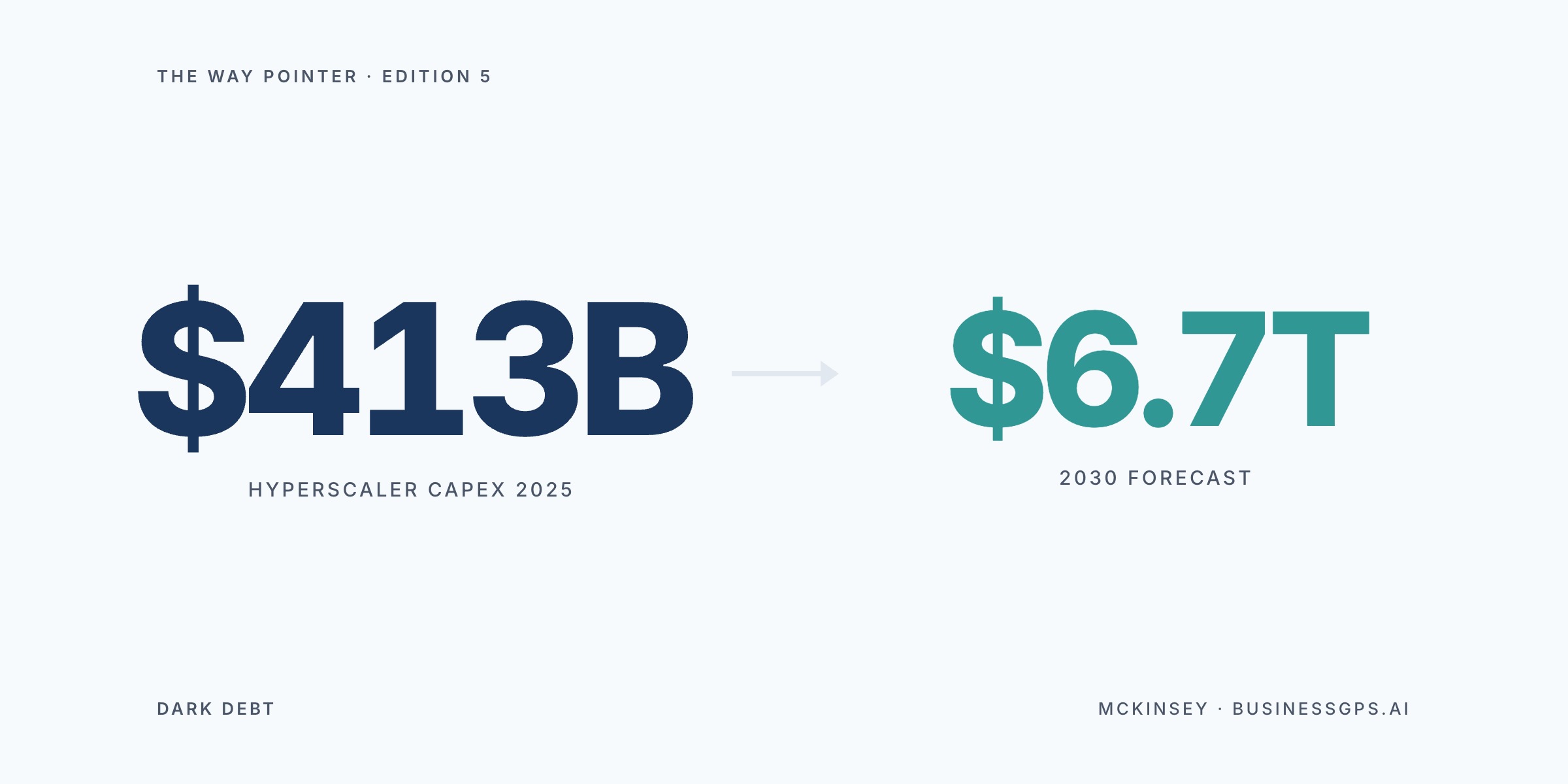
Hyperscaler capital expenditure for 2025 reached $413 billion, an 84% year-on-year increase, according to Brightlio's tracking of public filings.^5^ McKinsey's forward projection takes that figure to $6.7 trillion in cumulative spend by 2030.^6^ This is the largest infrastructure build-out in industrial history, and almost none of it is being financed at a gross-margin profit at the inference layer.
OpenAI shipped GPT-5.5 on April 21-22 with input pricing at $5 per million tokens and output pricing at $30 per million tokens.^7^ Twelve months earlier, the equivalent baseline price for a comparable frontier-class model sat below $0.50 per million tokens. The frontier price floor has moved roughly ten times in a year.
Gartner's analysis of agentic workflows, cited by The Secret CFO this week, places the token-consumption multiplier between 5x and 30x compared with single-shot prompting.^8^ Agents loop. They retrieve. They re-plan. They self-correct. Every additional reasoning step is another paid round trip.
EY's most recent enterprise survey reported that 78% of large organisations now agree their AI adoption is outpacing their risk management.^9^ This is not a worry expressed by analysts. It is the boards saying it about themselves.
And in the same window, Anthropic confirmed a $100 billion compute commitment to AWS alongside a $40 billion arrangement with Google — a $140 billion vendor capital structure dependency at a single AI lab, financed against future revenue that the lab does not yet earn.^10^
Stack the numbers and the outline becomes visible. Multiply the roughly ten-times input price reset by the 5-to-30x agentic multiplier and the workflow-level cost surface for a comparable AI-mediated task is between 37 and 225 times where it sat a year ago. That is not a forecast. It is the arithmetic of a frontier model and an agentic deployment pattern colliding inside a contract that nobody has yet repriced. The cost has not arrived on most P&Ls. It will.
What Dark Debt Actually Means
Dark debt is the term Boardroom Brief introduced this week for the class of liabilities a finance team cannot see today because the underlying compute is being sold below cost. The liabilities are real. They have just not yet been recognised in any forecast, contract addendum, or risk register. They will surface the moment investor patience for hyperscaler losses ends.
The mechanism is specific. AI providers at the frontier are running at gross-margin loss. Subsidised inference is the price they pay to capture enterprise workflow. Every percentage point those providers move closer to break-even is a percentage point of price increase that will be passed on to the enterprise. The Anthropic Pro Code tier reduction in mid-April 2026, which cut included usage by approximately half without a corresponding price reduction, is the concrete preview. It is bait-and-switch realised, not bait-and-switch threatened.
The CFOs Boardroom Brief cites describe the experience plainly. Michael Perica, CFO of Rimini Street, has been quoted on what compounded software inflation looks like in practice: "Compounded, double-digit subscription fee increases — unforecasted, unbudgeted, and more restrictive."^4^ Brian Chasin, CFO at Soba NJ, describes his procurement discipline as consumption-based contracts only with a 90-day kill clause, because no other contractual posture gives the finance function any real defence against unilateral repricing.^4^
These are not the views of capability sovereignty zealots. They are the views of working CFOs who have already been priced.
The contract terms that define dark debt exposure are now clear enough to enumerate. Contracts that grant the vendor unilateral repricing rights as "AI features" are added carry the largest exposure. Contracts that bundle AI usage into seat licences obscure consumption from the finance function. Contracts that route enterprise data through the vendor's training or retrieval layers convert the customer into a free contributor of model improvement, which is itself an unrecognised contribution. Contracts that lock workflows to a single model baseline create migration cost the moment the vendor regresses or reprices.
Each of these terms reads as routine commercial language at the procurement layer. Each of them is a balance-sheet item in disguise.
Why The Abundance World Said The Same Thing In The Same Week
The Pal–Diamandis–Salim convergence was not coordinated. The three writers operate on different platforms with different audiences. They arrived at the same architectural diagnosis within 48 hours of each other because the underlying mechanics had become unavoidable.
Diamandis put the demand-side framing most starkly. His April 15 analysis describes an inversion he calls the Organizational Singularity: companies will shrink by up to 80%, while individual entrepreneurs equipped with agent fleets spawn five times faster than before. "Coase's Law is dead," he writes — the firm's reason for existing, which was the relative cheapness of internal coordination, dissolves the moment AI agents make external coordination cheaper than meetings. Two classes will emerge. The first he calls Orchestrators: small teams of operators with deep capability over their AI architecture, who use it to compose and recompose work at speed. The second he calls Displaced: organisations whose operating model assumed a vendor would reliably deliver capability that was never owned, and who discover too late that rented capability does not survive a price reset or a model regression.^3^
Salim Ismail's framing is more operational. His Organizational Singularity essay argues that AI-native intelligence systems beat hierarchical org charts at every coordination task, because the bottleneck has shifted from information availability to human latency. The architecture he prescribes — a digital twin built at the edge, an explicit Human/AI Decision Boundary, an Intelligence Stack that senses, interprets, decides, acts and learns continuously — sits on the same architectural axis as the Boardroom Brief prescription. Both essays describe an operating model in which the capability layer is owned, governed, and decoupled from any single vendor's commercial trajectory.^2^
This is the same diagnosis as dark debt. It is just stated from the demand side rather than the contract side. If your operating model assumes a vendor will reliably deliver capability you do not own, you are the organisation that gets disrupted. If your operating model is capability-led, you are the orchestrator. The abundance world calls it the Organizational Singularity. The CFO world calls it dark debt. They are pointing at the same architecture.
The Mechanic The Boardroom Now Sees
What Boardroom Brief did this week was put the architectural conversation into vocabulary the audit committee already uses. Two questions sit at the centre of the prescription, and any board can ask them on Monday morning.
The first is stack exposure. Which contracts in the company's technology estate allow the vendor to reprice as AI features are embedded? The CFO does not need to read the contracts to start the audit. The general counsel and the head of procurement can produce the list inside a fortnight. The list, sorted by current spend and by dependency-criticality of the workflow, is the dark debt inventory.
The second question is one-way doors. What flags a commitment as irreversible? Migration cost is the obvious flag. Data lock is the deeper one. A contract that routes the enterprise's institutional knowledge into a vendor's retrieval layer, that trains the vendor's evaluation suite against the enterprise's exception cases, or that ties the orchestration logic to a proprietary agent framework, is a one-way door regardless of whether the procurement function recognised it as such at signature.
Boardroom Brief's verbatim prescription closes the loop: "Build a layer of enterprise-wide agentic AI under your control."^4^ This is the architectural statement, in CFO-readable English, of what Salim and Diamandis describe in exponential-thinker English. It converges on what we have been calling capability ownership. The orchestration layer sits on the company's balance sheet. The data sits on the company's balance sheet. The workflow logic sits on the company's balance sheet. The institutional knowledge sits on the company's balance sheet. The vendor's role contracts to compute provider, with full portability across providers and across model baselines.
This is not theoretical. The architecture is buildable today. What has been missing was the boardroom-level vocabulary for why it is now non-optional. Dark debt is that vocabulary.
The Andreessen Resolution Applied To Your Operating Model
There has been a long-running argument between two views of the AI future. Marc Andreessen's view holds that AI creates more growth, more businesses, more abundance — that the productivity surface expands faster than the displacement surface and the net result is more work, not less. Dario Amodei's view holds that white-collar labour is about to face a contraction sharper than any in industrial history, with entire job categories collapsing inside a five-year window.
Diamandis's resolution this week is the one that travels: "AI destroys jobs but creates businesses."^3^ Both views are right at the same time. The destruction is the displacement of operating models that assumed rented capability. The creation is the proliferation of operating models that own capability and recompose it at speed.
The corollary for institutions is the one boards now have to internalise. AI destroys vendor-locked operating models but creates capability-led ones. Both views of the future are right. The difference between them is which class your organisation lands in. That class is determined by architecture decisions that are being made — or deferred — this quarter.
Your Waypoint
Three concrete moves. One this week. One this month. One this quarter.
This week, list every AI-related contract that contains a unilateral repricing clause or an "AI features" upgrade pathway. The list does not need to be perfect. A first pass from procurement will surface 80% of the exposure. For each contract, quantify the dollar exposure at three repricing scenarios: +50%, +100%, and +200%. The Anthropic Pro Code precedent — roughly a 2x effective price increase realised inside one quarter — is the reference scenario, not a worst case. The total exposure across the contract list, at +100%, is the company's unrecognised AI liability. That number belongs on a single page.
This month, ask the question that turns the page into a board paper. "What is our plan if a key AI provider doubles its prices tomorrow?" The plan does not need to be elaborate. It needs to name the workflows that would be affected, the migration paths that exist for each, the data dependencies that constrain migration, and the specialist accountable for executing the migration if it becomes necessary. The absence of any of these elements is itself the answer the board needs.
This quarter, design the architecture choice that the dark debt category now forces. Orchestration on whose balance sheet? The orchestration layer is the part of the AI stack that sequences agent calls, manages context, governs tool use, evaluates outputs, and recovers from exceptions. If it sits on a vendor's platform, it is rented and reprice-able. If it sits on the company's platform, it is owned and depreciable. The choice is binary. The economics of dark debt make the rented option progressively more expensive than the owned option from this point forward, on a curve that compounds.
The Way Pointer position has been consistent for eighteen months. Capability sovereignty is the only durable answer to AI as enterprise infrastructure. What changed this week is that the boardroom now has the term that names what gets lost when sovereignty is deferred. Dark debt is not a metaphor. It is a balance-sheet item that the next financial cycle will surface. The firms that took the architecture decision before the cycle pay once. The firms that defer it pay at compounding rates, on a contract clock that the vendor controls.
If you want the full framework for how capability ownership gets architected, classified, and governed — the discipline that turns episodic AI spend into compounding capability — our TCM research paper maps the territory.
References
- Pal, R., The Next 2 Years Will Change Everything!, Real Vision podcast with Salim Ismail and Peter Diamandis, April 13, 2026. Available at: realvision.com
- Ismail, S., From Atlanta: The Organizational Singularity, OpenExO newsletter, April 14, 2026. Available at: openexo.com
- Diamandis, P., The Organizational Singularity Is Here, Abundance Insider, April 15, 2026. Available at: diamandis.com
- Cooper, T., Are You Sleepwalking Into Dark Debt?, Boardroom Brief, April 24, 2026. Available at: boardroombrief.co
- Brightlio, Hyperscaler Capex Tracker: 2025 Year-End Review, March 2026. Available at: brightlio.com
- McKinsey & Company, Global Compute Infrastructure Outlook to 2030, February 2026. Available at: mckinsey.com
- OpenAI, GPT-5.5 Pricing Announcement, April 21-22, 2026. Available at: openai.com
- Gartner, Agentic Workflow Token Consumption Multipliers, cited in The Secret CFO, AI Cost Engineering for Finance Leaders, Saturday Playbook, April 25, 2026. Available at: cfosecrets.io
- EY, Global Enterprise AI Risk Survey 2026, April 2026. Available at: ey.com
- Anthropic, AWS and Google Compute Partnership Announcements, April 2026. Coverage synthesised across The Information and Bloomberg, April 17-22, 2026.
- Carlyle Compass, Private Equity Quarterly: AI Cost Exposure in Portfolio Companies, Q1 2026. Available at: carlyle.com
- Anthropic, Claude Pro Code Tier Update, April 2026. Mid-month tier reduction reducing included usage approximately 50% without commensurate price reduction. Coverage via developer community threads and TheWhiteBox, April 16-22, 2026.