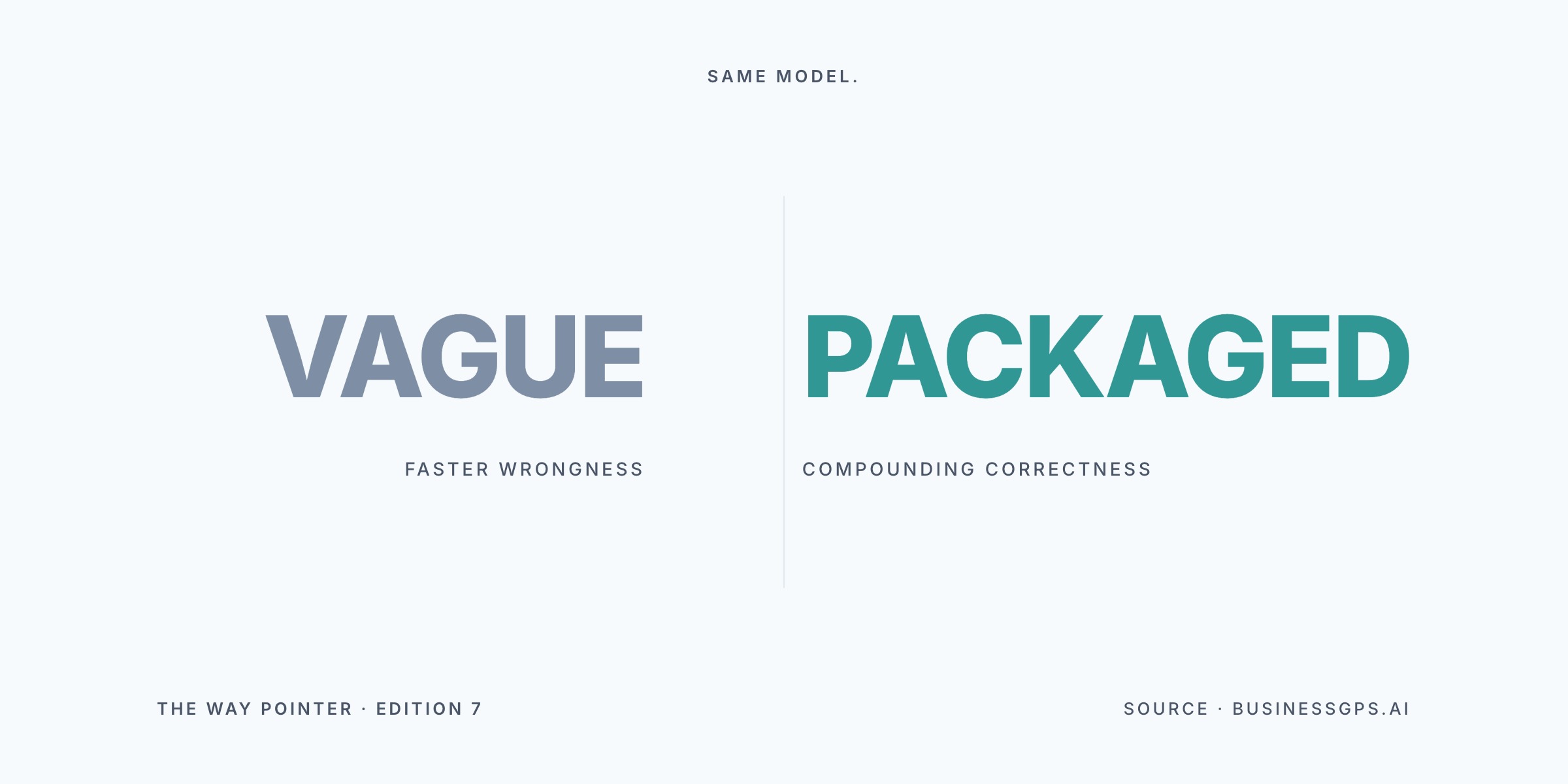
A stronger model with a vague environment does not give you more help.
It gives you faster, more confident wrongness.^1^
That sentence^1^ is the cleanest summary of what just changed in agentic work. GPT-5.5 inside Codex is scoring 82.7% on Terminal-Bench 2.0 and posting a 73-point lift on Expert-SWE.^4^ The model can now sustain multi-tool execution: sequencing actions, picking tools, reading errors, recovering. The capability ceiling moved. The bottleneck moved with it.
It moved out of the model. It is now sitting inside the work.
The hard question is no longer whether the model can act. It is whether the work has been packaged clearly enough for the model to act well.^1^ Every time someone opens a fresh thread and starts pasting the repo layout, the standard, the failure modes, the docs, the tools, the constraints, that person is the operating system. They are reconstructing the workflow from memory because the workflow does not exist as an asset anyone can pick up. Once the model is strong enough to inherit a process, the absence of a process becomes the binding constraint.
This is the second of the Way Pointer's three sovereignty layers. The first layer is substrate: the data, records, and APIs the agent acts on. We covered that one last week.^7^ The third layer is cognition: whose model, on whose runtime, with whose memory. The middle layer is craft. It is the discipline of turning ambiguous work into something a machine can re-perform without you in the room. That craft has a name now. The name is work packaging.
Intelligence stopped being the binding constraint
For a decade the gating question on AI usefulness was the model's reasoning depth. That is no longer the gating question. As Nate B Jones put it on 9 May, the problem moved from intelligence to workflow structure not because intelligence stopped mattering but because intelligence became good enough to expose the absence of structure.^1^ The strong model is a flashlight in a cluttered room. The cluttered room is the surprise.
The symptoms are familiar even when the diagnosis is new. A code review that misses the team's review standard. A release note that drifts into engineering language for a customer audience. A customer summary that mixes administrative material into the team-facing recap. Each output looks fine on its own. Together they describe a company that runs faster and means less.^1^ When the human did the work, the inconsistency hid inside individual judgment. When the agent does it, the inconsistency becomes mechanically visible. The vagueness gets a mirror.
The tax this exposes is not new. It is the implicit cost of standards that live in three or four senior heads, get transferred at desk-level over years, and survive on the hand-corrections of the people most expensive to lose. That tax is what stops scaling the moment the model can do the volume.
The four-rung ladder: prompt, skill, plugin, connector
Work-packaging is a ladder of escalating commitment. The rung that makes sense for a given workflow is determined by how often the work happens, who needs to repeat it, and how much it depends on house-style judgment.
Rung one is the prompt. Plain English. Used once. Disposable. The right answer when the work happens once and never recurs in the same shape.
Rung two is the skill. A skill is not a prompt library. It is a reusable operating procedure that tells the model how to approach a category of work, what standards to apply, which mistakes to avoid, and what kind of output counts as finished.^1^ It encodes judgment. It survives across threads. The right answer when the same work happens repeatedly in roughly the same shape.
Rung three is the plugin. A plugin bundles a skill with the tools it needs, the integrations it depends on, the deterministic checks that catch its known failure modes, and the unwritten parts of the team standard. It travels between people, projects, and engagements. The workflow becomes a product.^1^ The right answer when the workflow has to move beyond one person's machine.
Rung four is the connector or hook. The Model Context Protocol server, the script, the deterministic invariant. This is what gives the agent live system access and the verifiable check that proves the workflow did what it claimed. The right answer when the workflow has to act on real systems and must not drift.
Mapped onto Transformation Capability Management, this ladder is almost too neat. Rung one is ad-hoc Context. Rung two is patterned Core. Rung three is productised Signature. Rung four is substrate-level governance. The progression from ad-hoc to substrate is the same progression TCM describes for institutional capability, rendered at the desk-level for an individual practitioner. The ladder is TCM operationalised for the IC. The IC is where the next 24 months of competitive separation will happen.^1^
Five signals that say the workflow is worth packaging
Not all work belongs on the ladder. Most of it can stay at rung one and that is fine. The question is whether you can recognise the small subset of work that is genuinely worth promoting. Five signals do most of that recognition.
Repetition. The work happens every week, every release, every pull request, every customer cycle. If a piece of work has a recurring beat, the cost of re-instructing the model each time compounds against you.
Same instructions every time. Every run uses the same caveats, the same source hierarchy, the same constraints, the same output format. If you keep typing the same scaffolding, that scaffolding is a skill in disguise.
Tool repetition. The same systems are used every run: the same tracker, the same chat, the same drive folder, the same design tool. If the tool list is stable, a plugin can carry the integrations once and stop you doing it again.
House-style judgment. The work depends on team standards that have never been written down in one place. The way your team reviews code is not your manager's preference. It is an institutional asset that disappears every time a senior engineer leaves.
Hand-correction repetition. The same failure mode keeps showing up. You catch it every time. Once you know the failure mode, embed the catch in the workflow rather than catch it manually for the rest of your career.^1^
A team can score the five signals in an hour. The output is a short list of workflows that deserve to climb the ladder, and a much longer list that should remain disposable. The discipline is not in promoting more work. It is in promoting only the work that earns the promotion.
A worked example that is not about engineers
Most of the discussion of skills, plugins, and agents lands inside engineering teams. The wider lift is happening somewhere quieter. An editorial worker who does not write code recently built a plugin for first-pass review. The plugin reads each piece three different ways: once for argument, once for clarity, once for factual consistency. It flags rough sections, prose-coherence breaks, and unsupported claims.^1^ She built it herself. She did not wait for an engineer to build it for her.
The capability that used to live as tacit craft inside her head now lives as a portable artefact she can hand to a teammate, run on someone else's machine, and improve over time. If the model behind it changes next quarter, she swaps it and the plugin keeps working. If she leaves the team, the plugin stays. The boundary between what she knows and what the organisation can do without her narrowed by exactly the size of the plugin she shipped.
This is what capability sovereignty looks like at the desk level. Not an abstract claim. A skill she used to perform in private now packaged into something the organisation can re-perform. Two years from now the people who learned to package will be compounding. Everyone else will be explaining the workflow on Tuesday morning.^1^
Consistency before automation
The seduction in this conversation is to skip directly to autonomous agents running large parts of the business by themselves. Most enterprises will not get there in 24 months. The prize that is genuinely available is something quieter: reproducible, governable, standard-bearing capability execution. Can the agent do this task the same way tomorrow? Can a teammate invoke the same workflow and get a similar standard? Can the agent remember the review philosophy without being told again?^1^
The first value of work-packaging is not autonomy. It is consistency. Consistency at scale is the foundation autonomy will eventually be built on. It is also valuable on its own, and it is achievable in this budget cycle. Teams that pursue consistency first will have something to govern, something to audit, and something to improve. Teams that chase autonomy first will have plausible-sounding outputs, no audit trail, and a 2027 board review they cannot defend.
This connects directly to last week's substrate argument. The five structural tests we published on 5 May filter the tools the agent acts on.^7^ Work-packaging filters the work the agent does inside those tools. Substrate plus work-packaging produces governable, repeatable, defensible capability. Either one alone is insufficient. A perfect substrate executed against vague work still produces faster wrongness. A perfect work-package run on a chat-shaped substrate still rebuilds the workflow every six months.
Sapphire week makes the same argument from the vendor side. Every major suite is racing to ship the surface area (MCP servers, agent runtimes, vibes interfaces, headless modes) that lets agents act inside the suite without a human logging in.^10^ The vendors are betting that customers who do not own their work-packaging will adopt whatever packaging the suite provides. That is a real bet. It is also a sovereignty trap. The customer who packages their own work can pick up any suite. The customer who lets the suite package the work has bought a marriage they cannot exit without rebuilding the work from scratch.
Where the work-packaging capability has to sit
Three places this capability can live, and the first two are wrong by design.
It can sit with a system integrator. The big firms will package your workflows for a fee, ship the plugins on their stack, and run them on your behalf. The output will be useful. The dependency will not. Each quarter the package needs to be re-run against the next model release, the next tool change, the next team rotation, and the integrator is the only one who knows how. The capability never accrues to your organisation.
It can sit nowhere by default. Most enterprises today have no named owner for work-packaging. Engineering owns code. Product owns features. The transformation function owns programmes. Nobody owns the question of which workflows have been promoted from prompt to skill to plugin, or whether the team's accumulated craft is being captured anywhere durable. When the desk changes hands, the work resets.
Or it can sit with you, owned, named, scheduled. This is Transformation Capability Management applied at the workflow layer. An internal practice for identifying which workflows deserve packaging, who owns each plugin, what standards each one encodes, and how the portfolio gets reviewed when the underlying models or tools change. The artefacts are owned. The capability to produce them is owned. The model and the runtime and the suite become substitutable. The work-packaging stays.
That is the difference between a capability you can demonstrate to a regulator, an acquirer, or an auditor, and one that lives in the heads of people you cannot afford to lose.
Your Waypoint
Pick three workflows your team runs every week. Choose deliberately. One you assume is well-defined. One you suspect is held together by the same person doing the same hand-corrections. One that sits at the centre of a workflow you intend to make agentic.
Score each one against the five signals: repetition, same instructions, tool repetition, house-style judgment, hand-correction repetition. Mark each signal present or absent. Five signals, three workflows, fifteen marks. About 90 minutes total.
For each workflow, decide which rung of the ladder it belongs on. Prompt, skill, plugin, or connector. Four or five signals present is almost certainly a plugin candidate. Two or three is a skill candidate. One signal is a prompt and that is fine.
Bring the table to your next leadership meeting. The conversation that follows is the most important capability conversation you will have this quarter, because the act of scoring forces a question most organisations have not yet asked. Who owns the discipline of promoting work up the ladder, and who is going to own it next year?
If you want the framework that turns this from a one-off audit into an institutional practice, our Transformation Capability Management research paper maps the full territory: substrate, work-packaging, and cognition together.
The model is no longer the bottleneck. The work is. Teams that learn to package will compound. Teams that keep retyping the workflow will explain it to a different model on a different morning, with a different sense of déjà vu, every Tuesday for the next two years.
References
- Jones, N. B., Codex Plugins: The Bottleneck Moved, Substack, 9 May 2026. Available at: natesnewsletter.substack.com
- Jones, N. B., 271 bugs found in Firefox — the future of safe code, Substack, 8 May 2026. Available at: natesnewsletter.substack.com
- Jones, N. B., OpenClaw and the swappable agent runtime, Substack, 7 May 2026. Available at: natesnewsletter.substack.com
- OpenAI, GPT-5.5: Terminal-Bench 2.0 and Expert-SWE results, public release notes, May 2026. Available at: openai.com
- Mozilla, Project Mythos adversarial-review preliminary findings (271 bugs identified, zero attributed to a human attacker), May 2026. Available at: mozilla.org
- BusinessGPS, The Capability Brief — Edition 7, 11 May 2026. Available at: capability.ai/intelligence
- BusinessGPS, Five Questions That Decide Which Tools In Your Stack Survive The Agent Era, 5 May 2026. Available at: capability.ai/blog/five-questions-that-decide-which-tools-survive-the-agent-era
- BusinessGPS, Five-Layer Activity Model: How Work Actually Happens In An Organisation, 1 April 2026. Available at: capability.ai/research/five-layer-activity-model
- IDC, AI Pilot Production Readiness Survey, 2025. Cited in Jones, N. B., May 2026.
- Salesforce, Headless 360 and Agentforce Vibes 2.0 announcement, April 2026. Available at: salesforce.com
The Way Pointer is published by BusinessGPS — the transformation capability platform helping organisations make strategic choices about what they build, what they buy, and what they own.