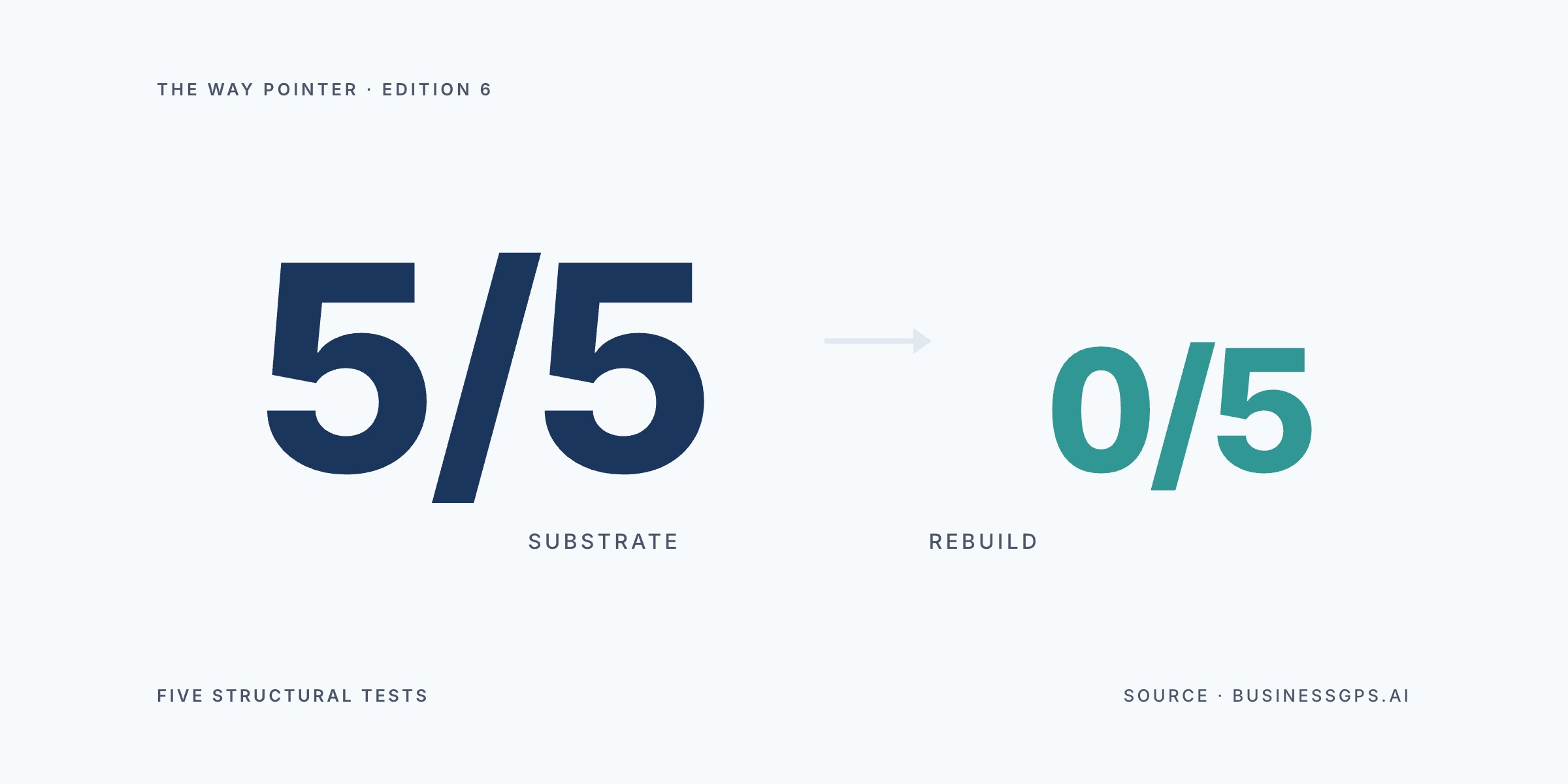
Most AI rollouts that fail in 2026 will not fail because the model wasn't smart enough.
They will fail because the substrate underneath the model — the issue tracker, the CRM, the service desk, the ERP, the documentation system — could not be addressed by an agent without a translation step the agent could not afford to make. The model was capable. The plumbing wasn't.
That diagnosis is now portable. Nate B Jones shipped a five-question diagnostic on May 2, 2026 that turns the substrate hypothesis into something a CIO can run on a Monday morning and present at the next board meeting on a single page.^1^ Linear's CEO declared issue tracking dead in March. OpenAI then open-sourced Symphony, and Linear became the literal control plane for the most ambitious autonomous-coding system ever shipped — some internal teams reported a 500% increase in landed pull requests.^1^ The thing that had just been eulogised was suddenly the substrate that made everything work.
This is the Way Pointer reframe of that diagnostic. The five tests are useful. The capability to run them yourself, repeatedly, across thousands of tools per quarter, without renting the answer from a system integrator — that is the layer above the diagnostic. That is the sovereignty work.
Why this is the dominant Q2 question
Three things converged in the last seven days that make this the question you cannot defer.
OpenAI's GPT-5.5 became the second frontier model after Mythos to fully complete the UK AI Safety Institute's 32-step corporate network attack simulation. It solved a Rust virtual machine reverse-engineering challenge in under 11 minutes for $1.73 — versus roughly 12 hours for a human expert.^2^ The capability ceiling lifted again.
GitHub Copilot announced a multiplier reset effective June 1, 2026. Opus 4.6 moves from 3x to 27x. Sonnet 4.6 from 1x to 9x. GPT-5.4 mini from 0.33x to 6x — eighteen-fold in a single billing cycle. Existing annual Copilot Pro and Pro+ subscribers shift to usage-based billing on the same date.^3^ The bill arrives independently of the substrate question, but it makes substrate exposure visible in a way the procurement function can no longer ignore.
And Salesforce went Headless 360 the same week — sixty new Model Context Protocol (MCP) tools, AgentExchange unifying ten thousand Salesforce apps and twenty-six hundred Slack apps, Agentforce Vibes 2.0 shipping with Claude Sonnet 4.5 as default, and Parker Harris asking the question out loud: why should you ever log into Salesforce again?^4^ SAP Sapphire follows next week and is expected to do the same in its territory.
The frontier got smarter, more expensive, and more deeply embedded in vendor substrate the customer does not control. Every SaaS renewal in your 2026 calendar is now an agent-infrastructure decision. Treat it that way, or accept the rebuild.
The five tests
For any tool in your stack, ask in order.
Test 1 — Records, not content
A record has identity, schema, and persistence the agent can address by name. Content is text the agent has to interpret each time it shows up.
A bug in a tracker is a record. It has an ID, a status, an assignee, a creation timestamp, and a queryable history. An agent acts on it without re-reading anything.
A Slack thread is content. The agent has to parse the prose to figure out what is decided, what is open, who owns what. Every visit is a fresh re-parse — and the answer is not stable across runs.
Passes: Issue trackers (Jira, Linear, GitHub Issues). CRMs (Salesforce, HubSpot). Service desks (Zendesk, ServiceNow). ERPs (SAP, Oracle, Workday). Source control. Calendars. HRIS. Procurement.
Fails: Email. Slack. Teams. Notion. Confluence. Google Docs. Most spreadsheets used as ad-hoc trackers.
How to score: ask whether an agent can do useful work using the tool's API alone, without having to read prose. If yes, it is a record system. If no, it is content.
Test 2 — State machines, not labels
A state machine encodes legal transitions. Open → In Progress → Done, with rules about who can move what when, and what side-effects fire on the transition. A label is decoration — a coloured tag attached to a document.
The difference matters because agents need to know what state means and what is allowed next. A state machine produces predictable behaviour under load. Labels do not. An agent operating against labels has to guess at semantics every time it touches a record.
The tell: ask whether the system enforces transitions or merely displays them. A linear "to do / doing / done" Kanban with no enforcement is a label system masquerading as a state machine. A workflow that fires webhooks, validates permissions, and rejects illegal moves is the real thing.
Test 3 — Ownership as a field
A field is queryable. An implication is folk knowledge.
If your agent has to read three messages and infer from a "Maybe Jane should pick this up?" exchange that Jane owns the bug, your substrate has failed. If assignee = [email protected] is one query away, your substrate has succeeded.
Ownership is the most underrated of the five tests because in human-only systems, implication often works fine — colleagues who sit next to each other for years build mutual context that fills the gap. Agents do not have that context. They cannot build it. The substrate has to make ownership explicit, addressable, and structured. Anything less and the coordination layer collapses into vibes.
Test 4 — Structural verbs
Structural verbs change state. Approve. Assign. Close. Escalate. Merge. Resolve. Reopen. They mean something in the data layer and trigger consequences when invoked.
Conversational verbs describe. Discuss. Mention. Suggest. Comment. They produce text that an agent has to interpret each time, with no guarantee that the interpretation is consistent across runs.
The test is whether the verb has a corresponding API endpoint that mutates the record. "Assign" does. "Suggest" does not. A tool whose primary verbs are conversational has built itself a coordination ceiling that no model upgrade will raise.
Test 5 — Queryable history
Visible history is a UI feature. Queryable history is an API.
The difference is whether the agent can reconstruct who did what when, with structured data, on demand. Bugzilla in 1998 logged every change to a bug with timestamp and actor.^1^ That accidentally produced exactly the audit trail an autonomous agent system needs to investigate its own failures, prove its work, and satisfy the human reviewer when something goes wrong.
IDC research from 2025 found that 88% of AI pilots never reach production at all, and the failure mode in many cases is investigability — when the system fails, nobody can reconstruct what happened.^1^ A queryable history defends against that failure mode at the substrate level. A visible-only history defends against nothing.
A worked example: scoring three tools
Bugzilla, the canonical issue tracker that Terry Weissman wrote for Mozilla in 1998, passes all five. Records, state machine, assignee field, structural verbs, queryable audit log. None of it was designed for AI. The structural choices that fell out of human-coordination constraints happen to be exactly the choices you would make if you were designing a substrate for autonomous agents to coordinate work through.^1^ That accident is the whole story.
Notion fails all five. Pages are content, not records. Status is a label, not a state machine. Ownership is implied through @-mentions in comments. Verbs are conversational. History is visible in the page sidebar but not queryable as structured data through any production API. A team building agentic workflows on top of Notion is committing to a custom retrieval layer they will rebuild twice in 18 months.
Salesforce passes four. Records (Accounts, Opportunities, Cases) — yes. State machines (Opportunity stages, Case statuses) — yes. Ownership (OwnerId on every object) — yes. Structural verbs (Convert, Close, Escalate) — yes. Queryable history — partial. Field History Tracking is on by default for some objects and capped on others, and the Audit Trail covers configuration changes more than data changes. Headless 360 closes most of that gap by exposing the underlying state through MCP, but the asterisk remains. Salesforce is substrate. It just isn't substrate the same way Bugzilla was.
The five-test diagnostic is not designed to produce winners and losers. It is designed to produce a decision: replace, wrap, or accept the tax.
What the diagnostic actually does for you
Run the test in three columns.
Column 1: pass / fail per test, per tool. Five tests, one row per tool.
Column 2: tag — replace, wrap, or accept. A tool that fails three or more tests on a workflow that matters is a replace candidate. A tool that fails one or two on a critical workflow is a wrap candidate, where wrapping means exposing the missing structure through an MCP server that sits in front of the tool. A tool that fails any test on a workflow that does not matter is an accept — pay the tax, move on.
Column 3: 24-month switching exposure. The team that ships a custom retrieval layer on a chat-shaped substrate will rebuild it twice in 18 months. The team that wraps a substrate-shaped system through MCP will compose against it for years.
That table is the artefact. One page. One row per tool. One tag per row. One number per row. The CIO can show it to the audit committee. The CFO can map it to working capital exposure. The board can read it.
The test takes about two hours per tool the first time, including a read of the API documentation and a check on which fields are exposed through MCP. Pick three tools this week. Score them. Tag them. By Sapphire week you will have your first sovereignty diagnostic in hand.
The sovereignty layer above the diagnostic
Here is where the Way Pointer view diverges from the standard practitioner reading.
Scoring tools is necessary. It is not sufficient.
The five tests are a snapshot of one moment. New tools enter the stack quarterly. Existing tools change their data models. Vendors ship MCP servers that retroactively turn fails into passes — and ship pricing changes that turn passes into renegotiations. The diagnostic has to be re-run, continuously, by someone whose incentives are aligned with the buyer rather than the seller.
There are three places that work can sit. Two of them are wrong by design.
It can sit with the system integrator. The big firms will gladly run the five tests across your stack for a fee. The output will be useful. The dependency will not. Next quarter you will be paying them to run it again, and the quarter after that, and at no point will the capability accrue to your organisation. The diagnostic becomes the engagement.
It can sit nowhere — by default. Most enterprises have no named owner for substrate diagnostics. The CIO is busy. The procurement function is downstream. The architecture function is busy with target-state pictures that do not refresh. The work happens reactively, after a renewal goes wrong, when the cost has already been booked. This is the failure mode for the majority of organisations through 2026 H2.
Or it can sit with you — owned, automated, repeated. The five-test diagnostic is the kind of work that an agent fleet should run every Monday morning across the entire stack, producing a delta report against last week. New tools scored. Changed tools rescored. Renewal exposures flagged. This is what agentic-first, people-second means in practice. The agents do the diagnostic at scale. The people decide what to do with the answers.
This is the discipline of Transformation Capability Management. The capability to score your own substrate, on your own schedule, at the pace the substrate is changing — that is one of the strategic capabilities organisations need to own. Not the answers. The capability to produce the answers, repeatedly, without renting the muscle.
The vendors who made the five tests easy to pass — Atlassian, Salesforce after Headless 360, Linear, ServiceNow, the established record systems — become substrate. The vendors who didn't become rebuild commitments. The integrators who run the diagnostic for you become substrate of a different kind: people you cannot operate without. The sovereignty question is whether any of those substrates are owned, governed, and decoupled from a single vendor's commercial trajectory.
Your Waypoint
Pick three tools in your stack this week. Choose deliberately: one tool you assume is fine (a CRM, a tracker, an ERP), one you suspect is shaky (a documentation system, a chat platform, a spreadsheet-as-database), and one that sits at the centre of a workflow you are about to make agentic.
Run the five tests on each. Use a single sheet, three rows, five columns plus a tag column. Two hours per tool. Six hours total.
Tag each tool: replace, wrap, or accept the tax. Add a one-line note on the 24-month switching exposure if you don't act.
Bring the sheet to your next leadership meeting before SAP Sapphire week. The conversation that follows is the most important architecture conversation you will have this year — not because the tools matter individually, but because the diagnostic itself is the artefact your board needs in hand before the next round of vendor announcements lands.
If you want the framework that turns this single diagnostic into an institutional capability — repeated quarterly, owned internally, governed at the architecture layer rather than the procurement layer — our Transformation Capability Management research paper maps the territory.
The boring tools won. The interesting question is which boring tools you have already lost — and whether the capability to find out sits with you, or with someone you are paying to keep the answer.
References
- Jones, N. B., AI agents are about to route around every tool that can't pass 5 structural tests, Substack, May 2, 2026. Available at: natesnewsletter.substack.com
- UK AI Safety Institute, GPT-5.5 cybersecurity assessment, May 1, 2026. Reported via Ignacio de Gregorio (TheWhiteBox), Playing Dirty, Salesforce loses head, & Prices up, May 1, 2026. Available at: thewhitebox.ai
- GitHub, Copilot multiplier reset announcement, effective June 1, 2026. Reported via Ignacio de Gregorio (TheWhiteBox), May 1, 2026.
- Salesforce, Headless 360 announcement, April 27-29, 2026. Available at: salesforce.com
- de Gregorio, I. (TheWhiteBox), DeepSeek v4: The Start of the Chinese Era of AI, April 28, 2026. Available at: thewhitebox.ai
- Jones, N. B., ChatGPT 5.5 Review — scored 87 where the next best model scored 67, Substack, April 28, 2026. Available at: natesnewsletter.substack.com
- Cooper, T., Are You Sleepwalking Into Dark Debt?, Boardroom Brief, April 24, 2026. Available at: boardroombrief.co
- Constellation Research, SAP Sapphire 2026 Preview, April 24, 2026. Available at: constellationr.com
- BusinessGPS, Early Adopter Signal — Edition 6: The Substrate Test, May 5, 2026. Available at: capability.ai/intelligence
- BusinessGPS, The Capability Brief — Edition 6, May 5, 2026. Available at: capability.ai/intelligence
- IDC, AI Pilot Production Readiness Survey, 2025. Cited in Jones, N. B., May 2, 2026.
- Atlassian, Remote MCP Server (Rovo) launch and Anthropic partnership, July 2025 onward. Industry reporting via The Information and Bloomberg, April 2026.
The Way Pointer is published by BusinessGPS — the transformation capability platform helping organisations make strategic choices about what they build, what they buy, and what they own.