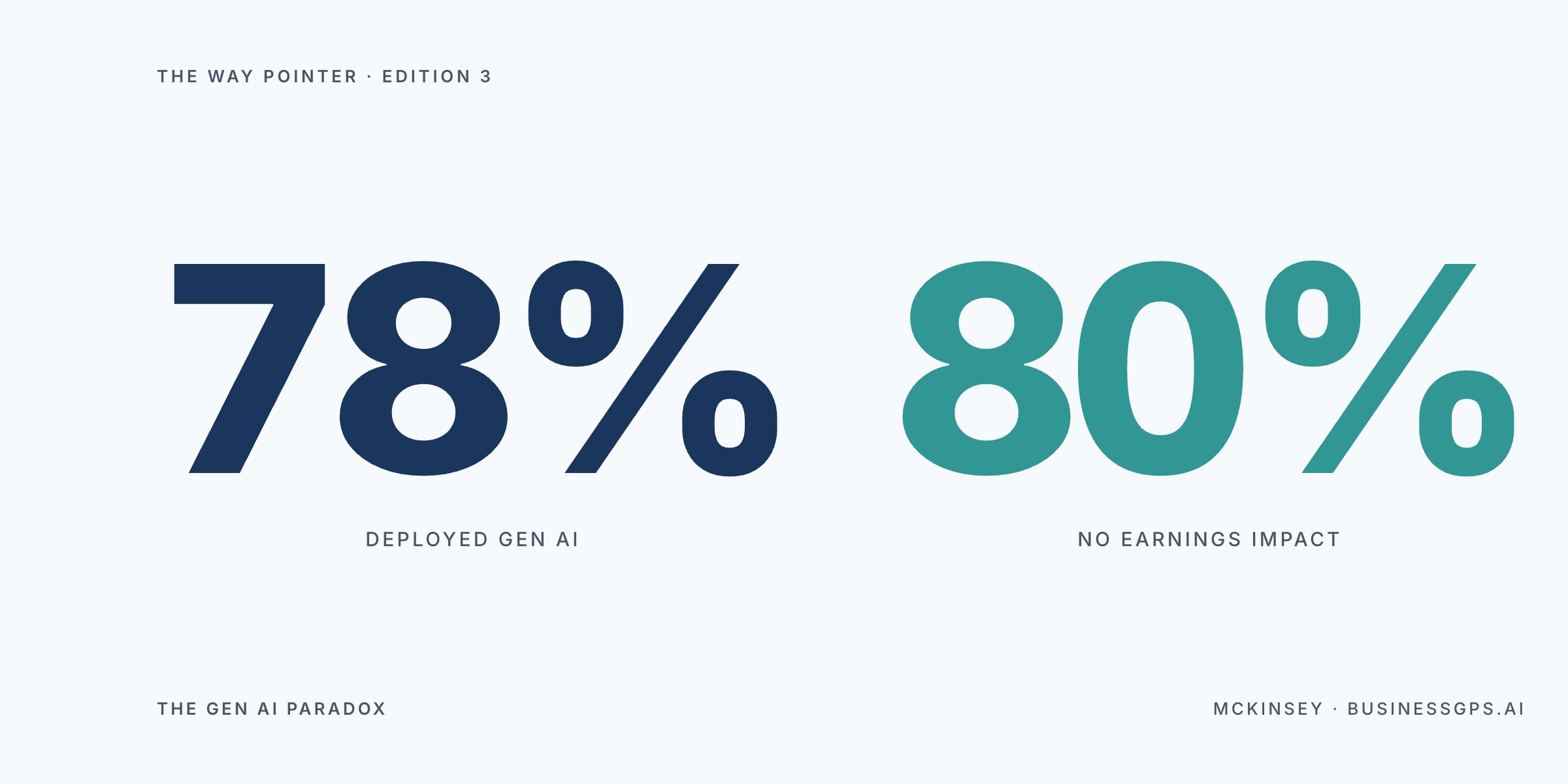
McKinsey published a 28-page report in June 2025 that should have ended every argument about why enterprise AI is underperforming. The title calls it "The Gen AI Paradox." The data makes the AI capability gap impossible to ignore: 78% of companies have deployed generative AI. Roughly the same percentage report no material contribution to earnings. Only 1% consider their gen AI strategies mature.^1^
Read those numbers again. Nearly eight in ten organisations deployed the technology. Nearly eight in ten have nothing to show for it. One in a hundred thinks they know what they are doing.
If you approved an AI budget in the past eighteen months, you almost certainly live inside that paradox. The question is what to do about it.
The 90% Pilot Graveyard
The McKinsey report contains a statistic that deserves to be printed and taped to the wall of every AI programme office in the country: fewer than 10% of vertical AI use cases ever make it past the pilot stage.^1^
That is not a rounding error. That is a 90% failure rate — not of the technology, but of the organisation's ability to move from "this works in a demo" to "this changes how we operate."
The horizontal tools scaled. Microsoft 365 Copilot reached roughly 70% of the Fortune 500.^1^ But McKinsey's own assessment is that these enterprise-wide copilots deliver "diffuse, hard-to-measure gains." The high-impact use cases — the ones that redesign how claims get processed, how supply chains get optimised, how customer journeys get rearchitected — are stuck. Ninety percent of them die between proof of concept and production.
McKinsey names six barriers. Fragmented initiatives. A lack of packaged solutions. LLM limitations. Siloed AI teams. Data gaps. Cultural apprehension and organisational inertia.^1^ Notice the pattern. Five of the six are organisational. One is technical. The report's own conclusion makes this explicit: "The bigger challenge won't be technical. It will be human: earning trust, driving adoption, and establishing the right governance to manage agent autonomy."^1^
The consultancy that charges $500,000 for an AI strategy engagement just published 28 pages explaining that the problem is not the technology they help you select.
Three Levels, One Trap
McKinsey introduces a three-level adoption model that maps the value gap with uncomfortable clarity.^1^
| Level | What It Means | Typical Gain |
|---|---|---|
| Level 1: Bolt-on | Insert AI into existing workflows | 5-10% |
| Level 2: Assist within workflow | AI augments human decisions within redesigned processes | 20-40% |
| Level 3: Reinvent around agents | Redesign processes with AI agents as first-class participants | 60-90% |
Almost every enterprise is at Level 1. Copilot in Outlook. A chatbot on the intranet. An AI coding assistant that developers use for boilerplate. These are bolt-on deployments — the technology is present, but the work itself has not changed. McKinsey puts the gain at 5-10%.
Level 3 — full process reinvention — delivers 60-90%. The gap between bolt-on and reinvention is not incremental. It is categorical. An order of magnitude separates what most organisations are doing from what the technology makes possible.
Arthur Mensch, CEO of Mistral AI, wrote in the report's foreword: "Not 'How do we add AI?' but 'How do we want decisions to be made, work to flow, and humans to engage?'"^1^ That is not a technology question. That is an operating model question. And the difference between Level 1 and Level 3 is not a matter of spending more on AI. It is a matter of redesigning how the organisation works before deciding where AI fits.
If your AI strategy is "give everyone Copilot and see what happens," McKinsey's own data says you are optimising for 5-10% while leaving 60-90% on the table.
The Perception Trap
The McKinsey data would be alarming enough on its own. Then a peer-reviewed study from METR landed a finding that makes the problem worse.
Experienced software developers using AI coding tools performed 19% slower on real tasks — while reporting that they felt 24% faster.^2^ The gap between perceived and actual performance is 43 percentage points. Developers believed AI was helping. It was not.
This is not an indictment of AI coding tools. It is an indictment of what happens when you bolt AI onto existing workflows without restructuring the work itself. The tools function. The workflows absorb them badly. And the people doing the work cannot tell the difference, because their subjective experience is of a faster, smoother process that is — measurably — producing less.
Extend this beyond software development. If METR can document a 43-point perception gap among experienced developers — people who work with code for a living and should be the most qualified to judge whether a tool is helping — what is happening in finance teams, operations teams, and customer service centres where the feedback loops are longer and the measurement is softer?
The answer, almost certainly, is that organisations are systematically deceiving themselves about AI ROI. Not because people are dishonest. Because the perceptual tools we use to assess "is this working?" are not calibrated for a technology that makes the process feel better while making the output worse.
If you are measuring AI adoption by user satisfaction surveys or self-reported time savings, McKinsey's pilot graveyard and METR's perception gap are telling you the same thing: your data is not just incomplete. It is wrong in the direction that makes you more confident in a failing strategy.
The Adaptation Industry That Does Not Exist Yet
One week after the McKinsey report resurfaced in analyst circles, Marc Andreessen — not a man given to pessimism about technology — said something striking on the Latent Space podcast.
"Both the AI utopians and the AI doomers are far too optimistic," he said, "because they believe that because the technology makes something possible, 8 billion people are going to change how they behave. And it's just like, no."^3^
Andreessen, who backed Netscape, Facebook, and GitHub, went further: "There are going to be a lot of companies and a lot of products and in fact entire industries that are going to get built to basically actually help all of this technology actually reach real people."^3^
McKinsey quantifies the failure. Andreessen names the cause. Neither offers the solution — and that itself is instructive.
The consulting industry is structurally positioned to diagnose the problem and then sell the remedy as an engagement. McKinsey's report is 28 pages of evidence that organisations need process reinvention capability. Their prescription: hire cross-functional transformation squads. The capability leaves when the squad does. The next transformation cycle starts the dependency again.
This is not a criticism of McKinsey's competence. It is a description of the consulting business model. Consultancies rent capability to organisations. The structural incentive is to deliver the project, not to ensure the organisation can do it again without help. Only 45% of firms ensure knowledge transfer from external partners, according to BCG's own private equity survey from January 2026.^4^ More than half of consulting engagements end without the client being able to repeat what was done.
The industry Andreessen describes — the one that will help technology "actually reach real people" — cannot be the same industry that created the dependency in the first place. The adaptation layer needs to be built on a different model: one that transfers capability rather than renting it.
What the CFO Needs to Hear
If you are a CFO or CIO reading this, three things crystallised this week.
You are almost certainly stuck at Level 1. McKinsey's data says fewer than 10% of vertical use cases survive pilot. The enterprises capturing 60-90% gains are not using better models. They reinvented their processes. If your AI programme is deploying tools into unchanged workflows, you are buying the illusion of transformation at a fraction of the possible return.
Your adoption metrics are probably lying to you. The METR J-curve means that the people using AI tools feel productive while delivering less. Satisfaction surveys and self-reported time savings are worse than useless — they actively reinforce a failing strategy. You need output measurement, not sentiment measurement.
AI costs are about to rise, and your current approach will not survive the price correction. CoreWeave's $90 billion backlog and Samsung's eightfold profit growth signal that subsidised AI pricing is ending.^5^ When subscriptions move from $20 per month to $200 or $1,000 per month per seat, "give everyone access and hope for the best" becomes financially untenable. You will need to know precisely which tasks warrant AI and which warrant deterministic automation. That classification exercise — deciding what is core and what is context — is the discipline that separates organisations capturing value from those burning budget.
The Discipline That Closes the Gap
The gen AI paradox is not a technology problem. McKinsey says so. Andreessen says so. METR's data proves it empirically.
It is a capability problem. Organisations have deployed the tools without building the internal muscle to absorb them — to classify work, redesign processes, measure outcomes, and transfer knowledge so the capability compounds rather than evaporates when the engagement ends.
We call that discipline Transformation Capability Management. Not because the name matters, but because the gap it describes is real, quantified by a dozen independent sources, and not being addressed by the institutions that identified it.
The consulting industry diagnosed the problem. But diagnosing a capability gap and then selling more rented capability to close it is not a solution. It is a subscription.
The organisations that will capture the 60-90% gains McKinsey describes will be the ones that own their transformation capability — that can reclassify work, redesign processes, and absorb change repeatedly, without restarting the dependency cycle each time.
Your Waypoint
Before your next AI programme review, run a single diagnostic.
Take your five highest-priority AI use cases. For each one, ask: is this a bolt-on (we inserted AI into an existing workflow), an assist (we redesigned the workflow to incorporate AI decisions), or a reinvention (we rebuilt the process with AI as a first-class participant)?
If all five are bolt-ons — and McKinsey's data says they probably are — you have found the constraint. The value is not in deploying more tools. The value is in moving at least one use case from Level 1 to Level 3, which means redesigning the process before you touch the technology.
Pick one. The one with the clearest measurement. The one where you can define "success" in financial terms, not adoption metrics. Redesign the workflow first. Deploy the AI second. Measure the output, not the sentiment.
That is how the 10% that survive the pilot graveyard got out.
If you want the full framework for building transformation capability — the discipline that turns episodic AI projects into compounding organisational change — our TCM research paper maps the territory.
References
- McKinsey / QuantumBlack, Seizing the Agentic AI Advantage: A CEO Playbook to Solve the Gen AI Paradox, June 2025. Authors: Sukharevsky, Kerr, Hjartar, Hamalainen, Bout, Di Leo. Available at: mckinsey.com
- METR, AI Coding Tool Productivity Study, April 2026. Cited via Nate B Jones analysis. Available at: metr.org
- Andreessen, M., interview on Latent Space podcast, April 3, 2026. Available at: latent.space
- Boston Consulting Group, Private Equity Survey: AI and Transformation, January 2026. Available at: bcg.com
- CoreWeave backlog and Samsung Q1 2026 earnings reported via Reuters, April 2026.