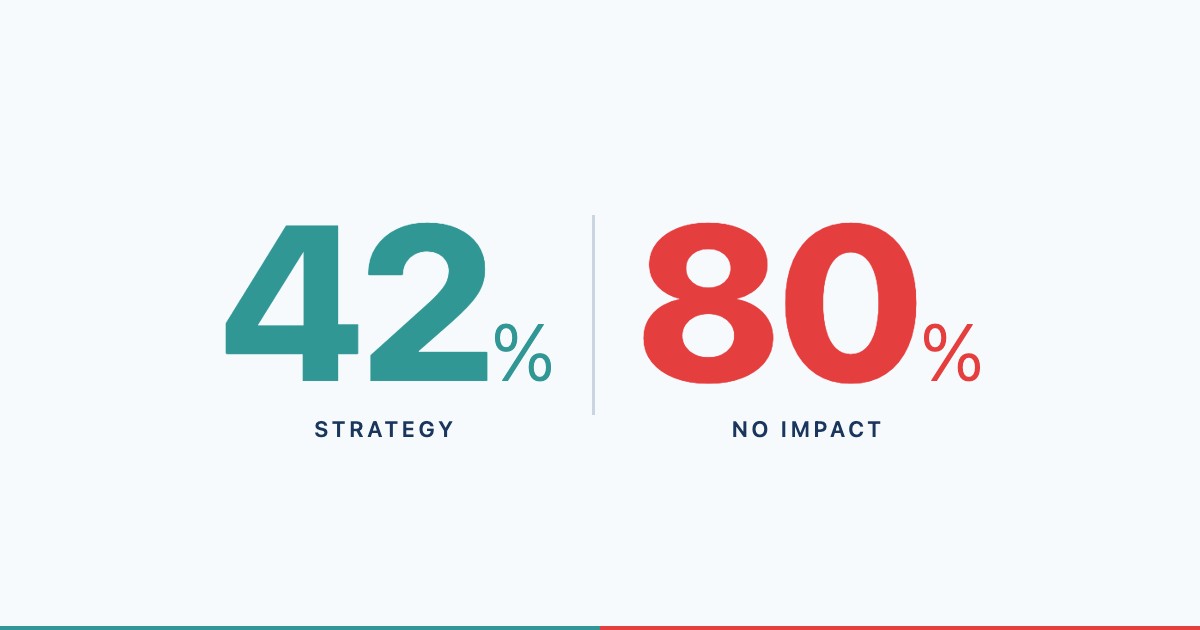
Forty-two percent of enterprises say their AI strategy is highly prepared. That figure comes from Deloitte's State of AI in the Enterprise report, published in 2026 — their flagship annual survey covering thousands of organisations worldwide.^1^
Forty-two percent. If you stopped reading there, you might think things are going well.
But Deloitte's own respondents report feeling less prepared than last year in infrastructure, data management, risk governance, and talent.^1^ The strategy arrow points up. Every operational arrow points down. That is not a paradox. It is a diagnosis.
The Shape of the Gap
The Deloitte data paints a specific picture, and it is worth sitting with the specifics rather than reaching for a summary.
Worker access to AI rose by 50% in 2025. Companies expecting 40% or more of their AI projects in production are set to double within six months.^1^ These are real gains in adoption velocity. Nobody disputes that organisations are deploying AI faster than ever.
The trouble shows up one layer deeper.
Only 34% of Deloitte's respondents describe their organisations as "deeply transforming" with AI. Another 30% are redesigning key processes. The remaining 37% are using AI at the surface level — task automation, text generation, isolated productivity tools bolted onto existing workflows.^1^ That 37% is the frozen middle. They have the strategy decks. They have the board mandate. They have the tools deployed. What they do not have is the organisational machinery to absorb any of it into how work actually gets done.
Revenue growth from AI "largely remains an aspiration," Deloitte notes. Seventy-four percent of respondents hope to grow revenue through AI. Twenty percent are actually doing it.^1^ That 54-point gap between aspiration and execution is not a technology problem. Technology does not explain why three-quarters of enterprises are hoping for something that only one-fifth are achieving.
Somebody Else's Data, the Same Diagnosis
Deloitte is not the only source documenting this gap. But the convergence across independent research is what makes the pattern structural rather than anecdotal.
The National Bureau of Economic Research surveyed 6,000 executives across the United States, United Kingdom, Germany, and Australia in early 2026. Their headline finding: while approximately 70% of firms actively use AI, over 80% report no measurable impact on either employment or productivity over the past three years.^2^ Some analyses of the same data put the no-productivity-impact figure closer to 90%.
Absorb that for a moment. Eighty to ninety percent of firms using AI have nothing measurable to show for it.
The NBER survey also found that over two-thirds of top executives use AI — but for an average of 1.5 hours per week, with a quarter reporting no use at all.^2^ Leaders who spend ninety minutes a week with AI are being asked to design the organisational absorption of AI. The mismatch is structural, not personal. Executives cannot diagnose where AI should transform work if they have not experienced it transforming their own.
Then there is Harvard Business Review. In March 2026, Thomas Davenport and Laks Srinivasan published the results of a survey of 1,006 global senior executives. Their finding cuts against the prevailing assumption that generative AI is the value driver. Fifty percent of respondents said their companies get the most value from analytical AI — dynamic pricing, customer targeting, pattern detection. Forty percent said rule-based AI delivers the most. Only 9% chose generative AI, and just 2% chose agentic AI.^3^
The implication: organisations are investing in the newest forms of AI while the value sits in forms that demand operational integration — workflow redesign, data pipelines, measurement systems. The glamorous bet is on generative. The money is in the operational.
The Management Problem Hiding Inside the Technology Budget
Davenport and Srinivasan's research surfaces a finding that should reframe every AI investment conversation happening in 2026.
Only 2% of organisations assign AI value accountability to the CFO. When they do, 76% report achieving a "great deal" of value from AI. Under CIOs or CTOs, that figure drops to 53%. Under functional executives, 32%.^3^
This is not a minor variation. CFO accountability produces more than double the value realisation of functional executive accountability. The finance function brings measurement rigour, credibility, and the organisational authority to hold business units accountable for outcomes rather than activities. Most organisations treat AI as a technology initiative with a technology owner. The data says it is a management discipline that performs best under financial governance.
The same research documents a six-stage economic maturity model. At Stage 0 — unmeasured pilots — only 4% of respondents report a "great deal" of value. At Stage 3 — post-implementation assessment — 44% report it. At Stage 5 — formal reporting to boards and investors — the figure reaches 85%.^3^
The progression from 4% to 85% is not driven by better algorithms or more sophisticated models. It is driven entirely by management practices: measurement, accountability, reporting cadence. The organisations capturing value are not technologically superior. They are managerially disciplined about knowing what their AI is doing and whether it is worth the investment.
Why Workflows Come Before Tools
McKinsey's 2025 research, cited in the HBR study, found that organisations redesigning workflows before selecting AI tools are twice as likely to report significant financial returns.^4^ Twice. Not from better technology. From sequencing.
This finding maps precisely to the Deloitte picture. The 37% using AI at the surface level have, overwhelmingly, selected tools first and hoped workflows would adapt. The 34% deeply transforming have done something more difficult: they have examined how work is actually performed, identified where AI changes the work itself — not just accelerates it — and restructured the operating patterns before deployment.
The Solow productivity paradox is instructive here. Economist Robert Solow observed in 1987 that "you can see the computer age everywhere but in the productivity statistics."^5^ Productivity growth ran at 2.9% from 1948 to 1973, dropped to 1.1% after mass computerisation, and did not recover until the late 1990s. The delay was caused by organisations flooding themselves with computing power they had not restructured their work to absorb. The data was everywhere. The workflows were unchanged.
We are watching the same pattern repeat. AI is everywhere — 70% adoption, per the NBER survey.^2^ Productivity impact is nowhere — 80-90% reporting nothing. The gap is not the technology. The gap is the organisational work of restructuring how value gets created, who is accountable for it, and how you know whether it is working.
The Missing Discipline
Here is where the diagnosis points somewhere specific.
The gap between strategic readiness and operational capability is not a gap that better project management will close. It is not a gap that more pilots, more training programmes, or more consulting engagements will close — at least not structurally.
It is a capability gap. The organisations that are capturing value from AI have built — deliberately or through accumulated practice — the internal muscle to classify their work, identify where AI changes the nature of that work, redesign workflows before deploying tools, measure outcomes with financial rigour, and transfer knowledge from external partners into permanent internal capability.
That is not one skill. It is a discipline. We call it Transformation Capability Management — the systematic ability of an organisation to absorb, sustain, and compound change without permanent dependency on external support.
TCM is not a product pitch. It is an observation about what is missing from the enterprise landscape. The consulting industry has spent decades building sophisticated methodologies for deploying change. It has not built — and has limited structural incentive to build — the discipline for ensuring organisations can sustain what gets deployed. Only 45% of firms ensure knowledge transfer from external partners, according to BCG's own PE survey from January 2026.^6^ That is not a criticism of consultancies. It is a description of a market gap that nobody has named as a discipline until now.
Deloitte names "insufficient worker skills" as the biggest barrier to AI integration.^1^ HBR shows that 58% of organisations have not trained employees and 29% acknowledge leaders lack the understanding to drive value.^3^ But the employee data contains a revealing detail: only 13% cite workforce resistance as an inhibitor.^3^ Employees are not resisting. They are waiting — for leadership direction, for redesigned workflows, for the organisational infrastructure that makes AI adoption coherent rather than chaotic.
The frozen middle is not frozen because people are unwilling to change. It is frozen because the organisation lacks the capability to orchestrate the change that its own strategy demands.
Your Waypoint
Before your next AI programme review, ask for three numbers. Not activity metrics — deployment counts, training completions, pilot launches. Three outcome numbers.
First: what is the measured productivity impact of our AI investments over the past twelve months? Not projected. Measured. If nobody can answer, you are in the 80% the NBER found — using AI and unable to quantify what it has done.^2^
Second: who is accountable for AI value in financial terms, and do they have a finance background or finance partnership? If accountability sits with a technology function alone, the HBR data says you are leaving half the potential value unrealised.^3^
Third: how many of our AI initiatives redesigned the workflow before selecting the tool? If the answer is "we selected tools and adapted workflows around them," the McKinsey evidence says you halved your probability of significant returns before you started.^4^
Three questions. You can ask them Monday morning. The answers will tell you whether your organisation is strategically ready and operationally capable — or whether, like the majority of enterprises in every major survey published this year, you are strategically committed and operationally unsure.
If you want to go deeper, our TCM research paper maps the full discipline of transformation capability — what it is, why it has been missing, and what building it looks like in practice.
References
- Deloitte, State of AI in the Enterprise, 8th edition, 2026. Available at: deloitte.com/insights/state-of-ai
- National Bureau of Economic Research, AI Adoption and Firm Performance: Survey of 6,000 Executives, 2026. Available at: nber.org
- Davenport, T. H. and Srinivasan, L., "The Economics of Artificial Intelligence," Harvard Business Review, March 2026. Available at: hbr.org
- McKinsey & Company, The State of AI in 2025, 2025. Cited in Davenport and Srinivasan (2026).
- Solow, R. M., "We'd Better Watch Out," New York Times Book Review, 12 July 1987.
- Boston Consulting Group, Private Equity Survey: AI and Transformation, January 2026. Available at: bcg.com