Three numbers arrived in the same week. Each on its own would be worth a board paper. Together they redraw the economics of enterprise AI.
On April 14, The Information reported that Anthropic has moved its Claude Enterprise pricing to usage-based billing. Large customers now pay a $20-per-seat monthly fee plus charges based on the compute they actually consume. A licensing adviser quoted in the report estimated that, for heavy users, costs could double or triple.^1^
The following day, Uber's Chief Technology Officer Neppalli Naga told the same publication that his team had burned through the full annual Claude Code token budget in three months.^2^ One of the most senior AI-native executives in the Fortune 100, operating at a $180 billion market-cap company, overshot his plan by four times in a single quarter.
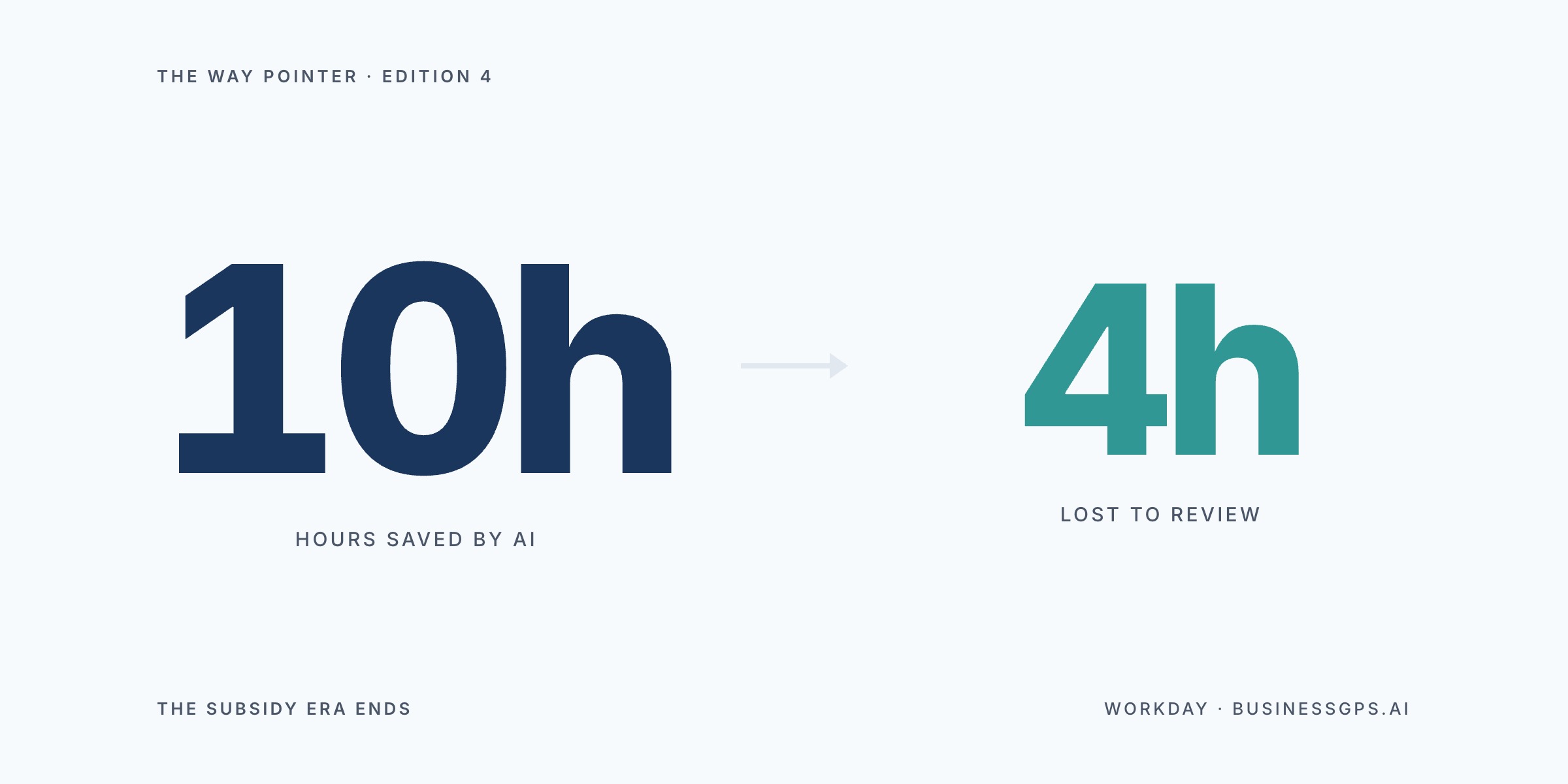
And on April 16, Boardroom Brief published research from Workday showing that employees and leaders who use AI every day review its output more rigorously than human work. For every ten hours of efficiency gained, nearly four are lost to fixing outputs — hours that "tend to fall on more senior people, in more constrained windows, doing more cognitively demanding work."^3^
This is not three unrelated stories. It is one story told three times. The subsidy era that masked the absorption gap is over. The gap is now exposed as direct cost, as hidden governance tax, and as vendor-trust risk. The firms that own their capability architecture will pay once. The firms that rent will pay forever, at compounding rates.
Why the Subsidy Masked the Gap
For eighteen months, enterprises with no operating-model redesign could claim progress through the metric that mattered least: access. Cheap, unmetered foundation-model access let organisations deploy copilots into unchanged workflows and call it transformation.
The underlying problem had already been documented by every serious research institution in the field. McKinsey's Gen AI Paradox found that 78% of companies deployed generative AI and roughly the same percentage reported no material earnings contribution, with fewer than 10% of vertical use cases surviving the pilot stage.^4^ NBER data placed productivity gains at zero for 80-90% of organisations.^5^ PwC reported 56% with no payoff. Deloitte put talent-readiness at 20%. RAND documented an 80%-plus failure rate. Forrester declared SaaS as-we-know-it dead.
The technology was working. The organisations were not. The gap was absorption, not capability.
Subsidy obscured the gap by making the failure cheap. A bolt-on Copilot that delivered 5-10% instead of the 60-90% that process reinvention could deliver was invisible waste, because the seat licence was roughly fixed and generously provisioned. Cheap failure is invisible failure.
Unsubsidised AI exposes the gap. And it exposes it in three ways at once.
The Three Exposures, Now Naked
Direct price exposure. Anthropic's pricing change converts every prompt, every agent loop, every coding session into a metered cost. Uber's four-times-in-a-quarter blowout is not an outlier. It is a preview. Organisations that have not classified which work warrants AI and which warrants deterministic automation will watch compute costs compound against undifferentiated output.
Ignacio de Gregorio, who writes TheWhiteBox and had forecast the move days before it happened, framed the economics bluntly: "Not your AI, not your intelligence."^6^ His view is that Anthropic moved first because it has the least cash runway and the most compute pressure, but the economics apply to every major lab. Subsidised inference is a negative-gross-margin business at the frontier. No lab will indefinitely fund enterprise learning loops at a loss.
Hidden governance exposure. The Workday ten-for-four ratio puts a number on what the McKinsey Paradox implied but did not quantify. Seventy-seven percent of daily AI users review AI output more rigorously than human work. The gains cluster at the operator layer. The losses cluster at the executive layer. And the hours are not interchangeable — four senior hours are not priced like ten operator hours.
Tim Cooper's summary for Boardroom Brief captures the mechanism: "AI use expands faster than permissions, escalation pathways, and ownership are defined. Early gains mask the issues. But they become visible when AI outputs enter approval flows, trigger exceptions, or face audit scrutiny."^3^
The remedy Workday names is specific. Move from human-in-the-loop to human-on-the-loop. Stop reviewing every output. Define rules, manage exceptions, escalate only what the rules flag. HOTL is not a productivity hack. It is a capability. It requires defining the rules, training the reviewers, maintaining the exception patterns, and continually retuning thresholds as the work changes. That capability cannot be outsourced to the vendor selling the AI, because the vendor has a commercial interest in expanding, not bounding, the scope of AI use.
Trust-vector exposure. The third mechanism appeared in the same week Anthropic released Opus 4.7. Developer communities, benchmarking services, and independent analysts described the release as a regression. The model reportedly thinks less on average per task, ignores instructions more often, and has been described as "lazy" and "condescending."^7^
Ignacio's analysis suggests three candidate causes: a more-compressive tokenizer that increases revenue per query, a partially-successful distillation from an unreleased larger model, and a deliberate compute-budget resistance baked into the model's behaviour. Whichever is correct, the effect is the same: enterprises running mission-critical workflows on a specific model baseline now face a forced migration decision with no independently benchmarked alternative that matches what they had.
That is vendor-lock liability made suddenly concrete. A capability that depends on one vendor's model baseline is a rented capability. The rent can be repriced or the quality can be degraded without client consent.
What Ownership Actually Means
Ownership is often misread as vertical integration — build your own model, hire your own research team, run your own data centre. That is a caricature, and it is a caricature the big labs are quietly happy to let survive, because it makes ownership look impossible.
Real ownership is architectural, not infrastructural. Two of this week's most-read commentators converged on the same description of what it looks like.
Salim Ismail, the author of Exponential Organizations, published the first essay of what he calls the Organisational Singularity. His language is clean and unsentimental: "The firm as we know it is breaking. Not because people are failing but because the cost of coordination, decision-making, and knowledge execution is collapsing toward zero. When that happens, the logic of hierarchy inverts. The bottleneck is no longer information. It's human latency."^8^
His architectural prescription has four moves. Start at the edge, not the core. Build an agent-centric digital twin in parallel to existing workflows. Make the Human/AI Decision Boundary explicit — low-sigma decisions (routine, reversible, well-defined) move to agents; high-sigma decisions (ambiguous, high-stakes) stay with humans. And rebuild the organisation as an Intelligence Stack that senses, interprets, decides, acts, and learns in continuous loops.^8^
The pseudonymous Secret CFO reached the same destination from a CFO's angle. His Saturday Playbook this week broke AI products into five categories — foundation models direct, foundation model extensions, AI wrappers, AI-native platforms, and custom builds — and offered a three-question filter for every procurement decision on the board agenda: How sensitive is the data? Does the output feed back into the books and records? What is your internal capability to build and maintain?^9^
His recommendation: buy for the spine (systems of record, billing, procure-to-pay, the data layer), borrow where the market does not serve the workflow (engage a specialist builder), and build sparingly. The memorable line: "As execution alpha gets obliterated by AI, ideas become more valuable. Protect your ideas, not just your data."^9^
Strip away the vocabulary differences and the two writers describe the same architecture. Owned capability is not a server rack. It is:
- Owned classification of which work warrants AI versus deterministic automation.
- Owned evaluation suites, so a vendor model change does not silently degrade a critical workflow.
- Owned governance — the HOTL rules, the exception patterns, the escalation paths, the specialist who is accountable when an agent makes a decision the board has to defend.
- Owned data portability and model-switching abstractions, so the capability survives a vendor repricing or a quality regression.
- Owned decisions about what stays human and what moves to agents, with the authority to re-draw that line as the work changes.
This is the architectural meaning of capability sovereignty. We have written about it as Transformation Capability Management — the public discipline that complements the proprietary methodologies enterprises use to install it. The important point this week is not the name. It is that the architectural conversation has arrived, independently, in the two most widely-read commentary streams that senior CFOs and CIOs consume.
The Economic Asymmetry
The pricing shift makes the economic case for ownership sharper than any rhetorical argument ever could.
Firms that own the architecture pay once — a capital investment in classification, evaluation, governance, and portability. That investment depreciates across every workflow it supports, compounding in value as the scope of AI-mediated work expands.
Firms that rent pay forever, at compounding rates:
- Usage-based pricing compounds as AI scope expands. Every new workflow, every additional agent loop, every deeper integration adds variable cost.
- The governance tax compounds as adoption deepens without HOTL discipline. The more workflows an organisation bolts AI into without redesigning the review layer, the more senior hours it burns recovering from undifferentiated output.
- Vendor-change costs compound each time a model baseline shifts. Every regression like the Opus 4.7 episode forces a migration that a rented architecture has no clean way to absorb.
- Regulatory compliance compounds as the EU AI Act reaches high-risk enforcement on August 2, 2026, as DORA concentration rules tighten for financial services, and as data-localisation laws in thirty-four countries force decisions about where model weights live and who controls the training data.
The firm that rents cannot depreciate the rent. The firm that owns depreciates capital investment across a compounding value base. That is not an ideological preference for ownership. It is arithmetic.
Ignacio's closing line in his April 20 analysis is the cleanest statement of where this lands: "Now more than ever, your compute is your moat. Your lack thereof is your doom."^10^
What Changes Now
Three actions any CFO, CIO, or CEO can take this quarter.
Rebase your AI cost model on unsubsidised pricing. If your FY26 plan still assumes the per-seat economics of 2025, rebase it for two-to-three-times heavy-user cost and the end of generous fixed allowances. Anthropic moved first. Other labs will follow within nine to twelve months. Subsidised competitors will look cheaper in the meantime. Plan for the convergence, not the outlier.
Measure the governance tax before you scale any agentic workflow. Take Workday's ten-for-four as a starting hypothesis and audit one live workflow against it. Count the senior hours consumed by review, exception management, and re-engineering. If you cannot name the specialist accountable for governing an agentic workflow, the workflow is ungoverned — and it is also unpriced. Fix before expanding.
Build your buy-and-borrow spine explicitly. Apply the Secret CFO three-question filter to every AI procurement decision on your board agenda this quarter. Anything that fails two of the three tests is not a "buy faster" or "build more" problem. It is either a candidate to borrow — engage a specialist builder — or to defer until the organisation's absorption capacity has caught up.
These three actions do not close the capability gap on their own. They are what any organisation can do before committing to a full capability programme. They are also the honesty audit that makes the programme conversation useful rather than aspirational.
Your Waypoint
One concrete move this week.
Take one existing AI workflow — ideally one that has already scaled inside your organisation. Run it through the Secret CFO three-question filter and the Human/AI Decision Boundary.
For the filter: How sensitive is the data flowing through it? Does the output feed into books, records, or master data? What is your internal capability to maintain it? For the boundary: Which decisions in this workflow are low-sigma (routine, reversible, well-defined) and which are high-sigma (ambiguous, high-stakes, consequential)? Who reviews which?
Write the answers on a single page. Name the specialist accountable for the governance layer. Name the model the workflow assumes and the evaluation suite that would tell you if the model silently regressed.
Circulate that page to your CFO, CIO, and Head of Risk. Use it as the opening artefact for your next budget conversation about AI.
That page is capability sovereignty in draft form. It will not replace a programme. It will not answer every question. It will change the terms on which the next decision gets made — from "how much more AI do we buy?" to "which capabilities must we own, and how?"
That is the question the subsidy era let organisations defer. It is the question unsubsidised AI now forces.
If you want the full framework for how capability ownership gets architected, classified, and governed — the discipline that turns episodic AI spend into compounding capability — our TCM research paper maps the territory.
References
- The Information, Anthropic Shifts Enterprise Pricing to Usage-Based Model, April 14, 2026. Available at: theinformation.com
- The Information, interview with Neppalli Naga, Chief Technology Officer, Uber, April 15, 2026. Available at: theinformation.com
- Cooper, T., Are CFOs Ready to Review Work Produced by AI?, Boardroom Brief, April 16, 2026. Workday research cited. Available at: boardroombrief.co
- McKinsey / QuantumBlack, Seizing the Agentic AI Advantage: A CEO Playbook to Solve the Gen AI Paradox, June 2025. Available at: mckinsey.com
- Shahidi, A., Rusak, G., Manning, G., Fradkin, A., Horton, J., The Coasean Singularity, NBER Working Paper, September 2025. Available at: nber.org
- de Gregorio, I., 12 Insights to Keep You Abreast with AI, TheWhiteBox, April 16, 2026. Available at: thewhitebox.beehiiv.com
- LM Arena community reports and developer threads on Anthropic Opus 4.7, April 17-20, 2026; synthesised by TheWhiteBox, April 20, 2026.
- Ismail, S., From Atlanta: Earthrise, Artemis, and the Edge of the Organization, OpenExO newsletter, April 14, 2026. Available at: openexo.com
- Secret CFO, Buy, Build or Borrow: AI for CFOs III, Saturday Playbook, April 18, 2026. Available at: cfosecrets.io
- de Gregorio, I., Opus Nightmares, Cerebras IPO, Why AI Is Not That Big, TheWhiteBox, April 20, 2026. Available at: thewhitebox.beehiiv.com
- Workday, AI at Work Research, 2026. Cited via Boardroom Brief. Available at: workday.com
- European Commission, AI Act High-Risk Enforcement Timeline, August 2, 2026. Available at: artificialintelligenceact.eu