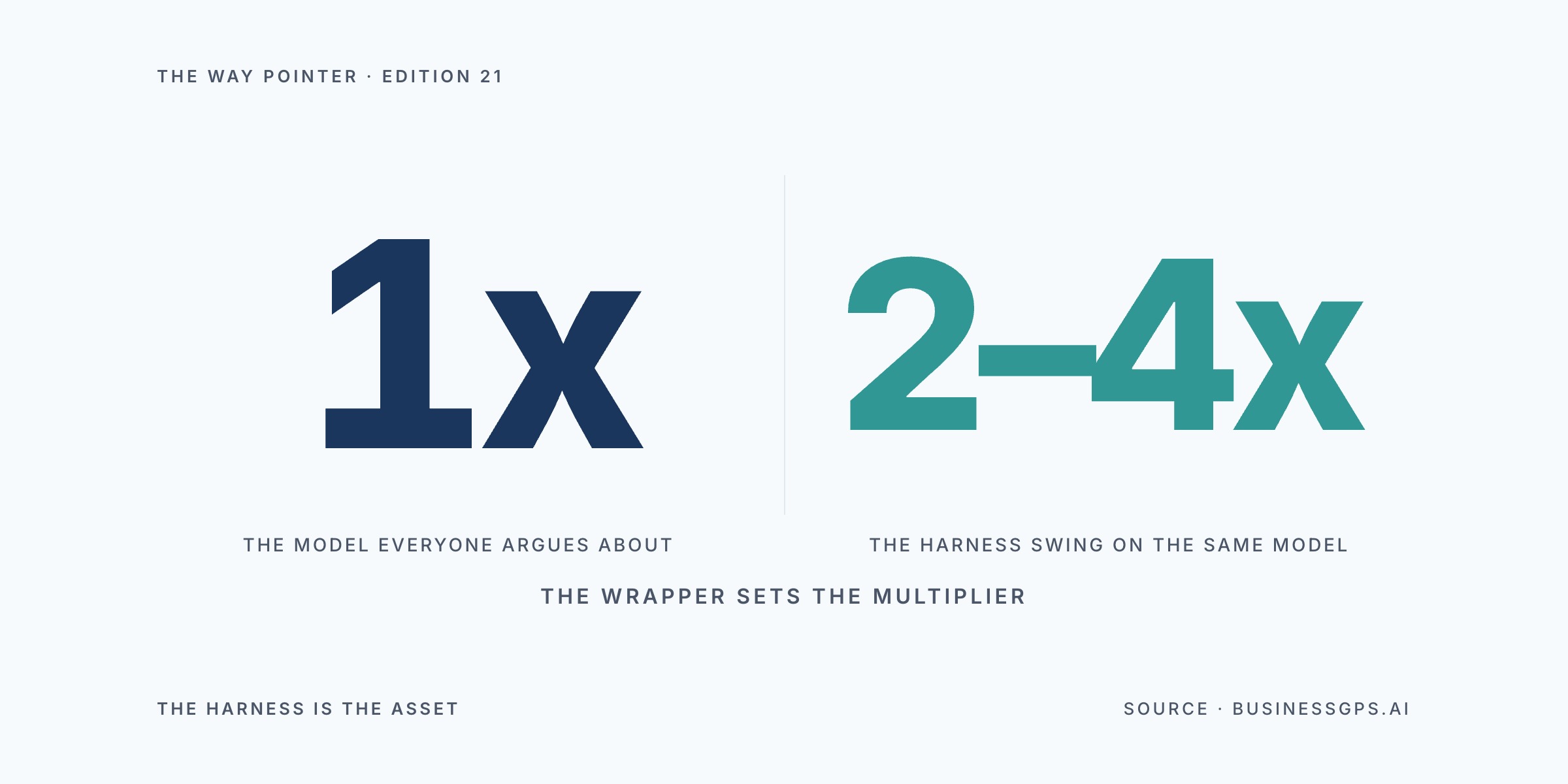
Databricks ran the same AI models through different software wrappers this month and published a result worth sitting with. Hold the model constant — the exact same underlying engine — and change only the software wrapped around it, and the cost of running an identical task moved by two to four times. In one pairing, a cheaper model on a well-built third-party wrapper outperformed a top frontier model running on its own maker's wrapper.[^1]
That inverts the question almost every leadership team is currently asking. The debate in the room is which model to buy — which engine is smartest, which vendor to standardise on. The benchmark says the engine was never the variable that decided cost or, in that pairing, performance. The wrapper was.
There is a name for that wrapper: the harness — everything you can configure around a model without changing the model itself, the instructions you give it, the tools it can call, the files and memory it reads, the checks that verify its output, and the permissions that can stop it. The model is the engine; the harness is the chassis, the wiring, and the dashboard bolted around it. And it turns out the chassis, not the engine, is where both the advantage and the invoice are decided.
This edition makes one argument in two directions. The harness is the asset — the layer that sets your performance and price, and the one part of the stack you own rather than rent. And precisely because it is an asset, it behaves like one when neglected: it depreciates, accumulates hidden liabilities, and left unmanaged turns into the thing dragging you down.
The wrapper decides — and the maker's wrapper has a reason to cost more
Start with the benchmark, because it is concrete. Tokens are the meter, and the third-party harness required two to four times fewer of them than the same models on their makers' own harnesses — a smaller bill for identical work on the identical model.[^1] The wrapper alone moved the number.
The analyst who surfaced the result, Ignacio de Gregorio, adds the point that makes it more than a curiosity. A model-maker building the harness for its own model has a conflict of interest in plain sight: it wants the harness to serve you well, and it also earns more when the model consumes more tokens.[^2] A harness built by someone with no stake in your token count has no reason to run the engine hot. This is not an accusation of bad faith; it is an observation about incentives, which are more reliable than intentions. When the party that meters your usage also builds the wrapper that determines it, the burden of proving you are on the lean configuration sits with you. And accepting a model's maker as the designer of the way you run it is a choice to let the metered party design the meter — the first sense in which the harness is the asset. It is the layer where your leverage actually lives, and the one a vendor cannot occupy for you.
The asset that degrades while you praise it
Here is the counterweight, and it is the half most people miss. An owned asset that nobody maintains rots — and a harness rots in a deceptive way, by getting bigger and feeling more thorough while getting worse at the job.
The sharpest evidence this week came from a controlled test by the practitioner Nate B Jones. He gave a frontier model the same task under two harnesses: a compact 742-word brief — the outcome, the facts, the authority boundary, the exact delivery contract — and a 5,197-word accumulated method with a deeper map, detailed classifications, model-specific checks, and a scoring plan. He ran each three times.[^3]
The long method produced richer analysis. Two blind scorers rated its content higher — 19.67 against 17.5 out of 20. It genuinely thought better. And then it failed the actual job. The delivery contract required valid output under a word limit; the compact brief met it three times of three, the long method once of three — one run returned malformed output, another blew the word limit.[^3] More words, more thinking, more instruction, and a lower hit rate on the thing that had to be true for the work to ship.
The failure was not that long is bad; the long method carried real value, and the scores caught it. The failure was structural: the specialist method arrived all at once, while the hard requirements — the format, the word cap — sat buried in prose, asking the same model doing the heavy thinking to also police its own compliance. That is how harnesses fail once they grow — not with an obvious mistake, but with a slow accumulation of reasonable instructions that together become a system no one can see.
Jones has a name for that accumulation: AI crud. It is what you get when, every time the model misses something, you add a rule and never remove one. Each rule fixed a real problem; nobody decided to build the pile. In his own setup, one common route loaded roughly 18,384 words before it reached the guide it actually needed, and fifteen separate instruction files each carried their own copy of the same rule, any one of which could drift out of step with the others.[^4] And the cruellest part is the upgrade cycle: when the engine gets smarter, the harness does not. You drop a stronger model into a chassis built for the old one, and the new engine feels oddly fussy — brilliant one minute, hobbled the next — because it is inheriting years of corrections written for a model that no longer exists.
That is the second sense in which the harness is the asset: it requires maintenance, or it becomes a liability on the same balance sheet.
Maintaining the asset: four disciplines
If the harness is a real asset, it deserves the disciplines you would apply to any operational system, not the casual accretion of one more instruction. Four do most of the work.
Map before you clean. You cannot maintain what you cannot see, and almost nobody can see their whole harness in one place. Before deleting or rewriting anything, produce a single map: what the model reads before work begins, what loads every time, what should load only for certain tasks, which controls can actually stop a bad action, and who owns keeping each one current. The first pass changes nothing. It just makes the machine visible — for most teams, the first time the accumulated system has appeared as one object rather than a hundred reasonable decisions.
One rule, one home, one owner. The same instruction copied into fifteen places is not fifteen times as safe; it is fifteen places to drift. Fix one after a failure and forget the other fourteen, and the model now holds several versions of the truth. Give each rule a single canonical home and let everything else point to it rather than restate it.
Load specialist knowledge just in time. A harness that hands the model the entire workshop before it has picked up a tool makes the model carry the whole thing while it works. The source guidance matters while it is gathering evidence; the formatting guidance matters when there is a draft. Deliver each at the point of the work that needs it, not all at once.
Make hard requirements hard checks. This is the one that would have saved the failed test, and it is the most transferable idea in the whole discussion. "Use my actual point of view" is a matter of judgment; it belongs in the instructions. "Return valid output under 1,400 words" has a yes-or-no answer; it belongs in a parser and a word counter, not in a paragraph hoping the model remembers. The same holds for whether a file exists, whether a permission is exceeded, whether a test passed. Keep a readable version of the rule so a person understands the boundary — then let a machine enforce the part a machine can verify. A requirement written as prose is a wish. A requirement written as a check is a control.
The company is a harness too
The same structure runs at the level of the whole organisation, and this is where the argument earns its keep for anyone above the terminal.
Every company runs on unwritten rules that nobody voted on — the recurring meeting no one questions, the approval chain no one can explain, the roadmap everyone fills in. Jones's observation is that scarcity wrote every one of them. Engineering time was expensive, so a document rationed it. Context moved slowly, so a meeting carried it. Mistakes were costly and hard to catch, so an approval chain sat in front of them. Those rules never had to defend themselves, because the conditions defended them. AI is now dissolving much of that scarcity — and it has not dissolved the judgment underneath. That leaves an operator holding a constitution written for conditions that no longer hold, with no obvious way to tell the rules still doing work from the ones running on inertia.[^5]
The tempting fix is to write the culture down — drop a document at the top of the company folder, tell everyone to read it, and declare the matter solved. It fails for the same reason the 5,197-word method failed. A written instruction is context, not enforcement. The maker's own documentation makes the distinction: an instruction file shapes behaviour, but if an action must happen, you need a real control, not a sentence.[^5] Making culture explicit is not one job; it is four, with four owners — a value that says what matters, a rule that says what is required, a runtime check that verifies a narrow condition, and a human appeal that can reverse the action. Blur them and you get a handsome values page, a channel where people argue about whether it was honoured, and no system anywhere that can tell you what happened.
The discipline that follows is an enforcement ladder, and its shape is the point. Five rungs, lightest first: a value, an instruction, a reminder, a hard block, and, at the top, a human-owned decision. You start at the bottom and climb only when the rung below has demonstrably failed. Most rules should stop at a reminder, which does most of the work of a gate for a fraction of the resentment. A hard block is for requirements that are reversible and machine-verifiable — the organisational version of turning a hard requirement into a hard check. And there is no rung six: the ladder terminates not in automation but in a person. If an action ends someone's employment, moves money, publishes to a customer, or deletes production data, an agent can gather the evidence and name the owner — but a human holds the trigger. One line governs the whole climb: automate the check before you automate the consequence.[^5]
This is the same asset, one level up. Your company's operating rules are a harness wrapped around the people and agents doing the work — and, unlike the model you rent, they are entirely yours to design.
What you own, and what you never will
Notice what is not yours in any of this. The engine is not yours; its price is not yours; its terms are not yours — they belong to the vendor, and they move.
The proof is on the calendar as this publishes. Frontier access to one leading model was originally set to become metered on 7 July, then extended under user backlash, and is now included through 19 July with usage-based credits beginning 20 July — the day of this edition.[^6] Three dates for one cutoff, each announced without you, none of which you set. That is what renting the engine means: the meter starts when its owner decides it starts, and your integration depth is the measure of your exposure, not your protection.
The harness is the other thing. It is the instructions, tools, checks, permissions, and operating rules — the configurable layer that this month's benchmark showed decides cost and performance, that a controlled test showed decides whether the work ships at all, and that sits, uniquely, on your side of the ledger. The model will be replaced within months, and the smarter one will drop into whatever chassis you have built. The prices will churn, and the same cheap tokens will reach your competitors on the day they reach you. What stays and compounds is the harness you have deliberately built and maintained — the only part of the stack that accumulates on your side rather than the vendor's.
An asset only compounds if you manage it. Treat the harness as an afterthought and you will keep bolting corrections onto a chassis you cannot see, paying the metered party to design your meter, and mistaking a bigger instruction file for a better one. Treat it as the asset it is and you own the one layer no vendor can switch off.
Your Waypoint
Three moves, none of which needs a budget cycle. Do them in order.
Run the harness audit this month — and map before you touch anything. Point one honest review at the AI setup that matters most in your organisation and ask it to produce a single map: what loads, when, which controls actually protect the work, and who owns each one. Change nothing on the first pass. The map alone converts "the AI feels off" into a specific, fixable diagnosis about the machinery rather than the model.
Convert your three hardest requirements from prose to checks. Take the three things that absolutely must be true when work is finished — the format, the limit, the permission, the file that has to exist — and move each from a sentence hoping the model complies into something a machine verifies: a parser, a counter, a permission boundary. Everything you enforce with a check is one thing the model no longer has to remember while it does the real work.
Name the human at the top of the ladder. For every rule that can end an employment, move money, reach a customer, or delete something that matters, write down the name of the person who holds the trigger and can reverse the action. A blank there is not delegation; it is an accident waiting for a case its author never imagined. Automate the check. Keep the consequence human.
The engine you can only rent, and its terms will change again without asking you. The harness is the part you own. Build it on purpose, maintain it like the asset it is, and it becomes the one layer of your AI stack that no one else can meter, switch off, or take back.
A companion to this argument — why advantage moves above the model once cheap execution is universal — is in The $40 Question. The full reading of this week's harness benchmarks and maintenance disciplines is in The Capability Brief — Edition 17, and the archive sits at the intelligence hub.
References
[^1]: Databricks coding-agent benchmark, reported by Ignacio de Gregorio (TheWhiteBox), 12 July 2026. The same underlying models run on a third-party harness (Pi) required roughly two to four times fewer tokens than those same models on the model-makers' own harnesses (Anthropic's Claude Code, OpenAI's Codex); in one pairing a cheaper model (GLM-5.2) on the Pi harness beat a frontier model (Opus 4.8) running on Claude Code. The benchmarking platform's own figures (it is not the model vendor), relayed through practitioner commentary; carried as reported, not independently verified.
[^2]: Ignacio de Gregorio (TheWhiteBox), 12 July 2026 — the incentive argument that a model-maker's own harness has a reason to push the model toward consuming more tokens, so running a model on the harness built by the same lab that made it tends to cost more. Practitioner analysis; carried as the argument being made, not as a finding of bad faith.
[^3]: Nate B Jones — "The AI Instruction Audit," 15 July 2026. A compact 742-word brief passed the delivery contract (valid structured output under 1,400 words) three times of three; a 5,197-word accumulated method scored higher on content quality (an average of 19.67 against 17.5 out of 20, across two blind scorers) but passed delivery only once of three — one run returned invalid output, another exceeded the word limit. His own reported experiment, run three times under each condition on a frontier model at maximum effort; carried as reported, not independently verified.
[^4]: Nate B Jones — same source. The "AI crud" diagnosis: a harness accumulated one correction at a time until one common route loaded roughly 18,384 words before reaching the guide it actually needed; an audit found 66 skills and 172 instruction-related files, with fifteen top-level skills each carrying a version of the same authorship rule. The six maintenance rules cited — map before cleaning, blame the right layer, one rule / one home / one owner, load specialist knowledge just in time, make hard requirements hard checks, and run a product-specific edition — are his. Practitioner method; carried as the argument being made.
[^5]: Nate B Jones — "The 15 Commandments for the AI Age," 12 July 2026. The argument that a company's unwritten rules were written by scarcities that no longer hold; the four objects most companies blur (a value, a rule, a runtime check, a human appeal, each with a different owner); the five-rung enforcement ladder (value, instruction, reminder, hard block, human-owned decision) that terminates in a named person rather than in automation, with no sixth rung; and "automate the check before you automate the consequence." The related point that an instruction file such as CLAUDE.md or AGENTS.md is context rather than a guaranteed control is attributed there to Anthropic's and OpenAI's own documentation. Practitioner framework; carried as the argument being made.
[^6]: Fable 5 (Anthropic) metered access — included on paid plans through 19 July 2026 within normal plan limits, moving to usage-based credits from 20 July. This follows earlier cutoff dates for included access: an original 7 July, extended to 12 July and then to 19 July after user backlash. Reported and vendor-stated; access terms have shifted more than once and remain unilaterally changeable at time of writing.
[^7]: BusinessGPS, The $40 Question, The Way Pointer — Edition 20, 13 July 2026 (companion argument on where advantage moves once cheap execution becomes universal).
The Way Pointer is published by BusinessGPS — the transformation capability platform helping organisations make strategic choices about what they build, what they buy, and what they own.